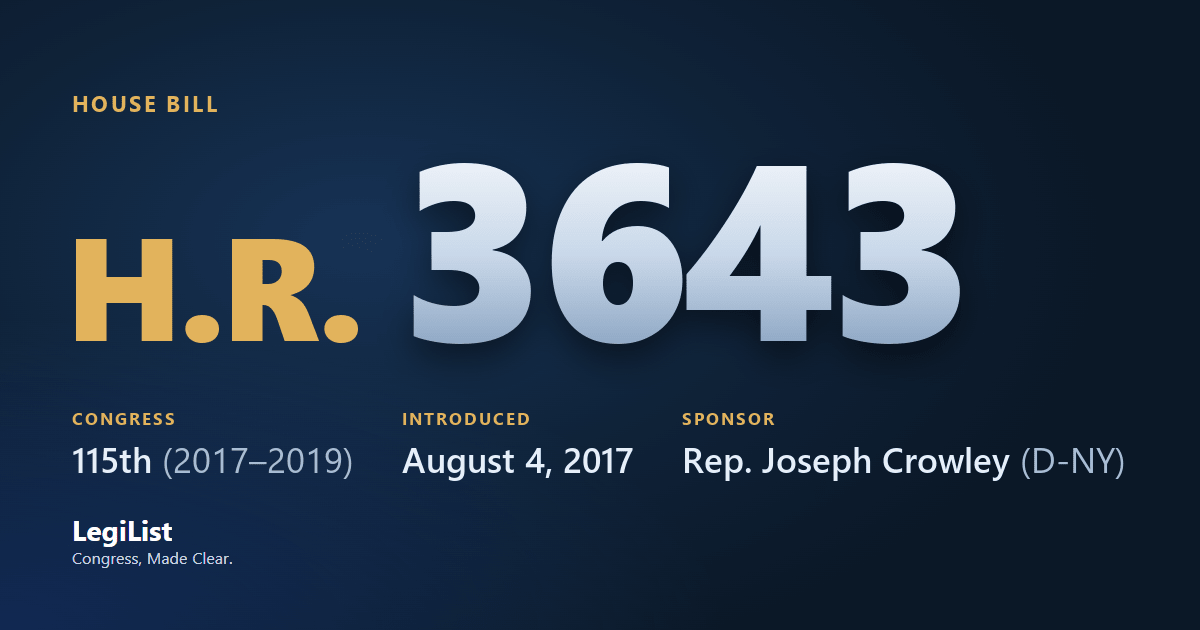
Children First Act of 2017
Latest action · Aug 4, 2017 Referred to the Committee on Ways and Means, and in addition to the Committee on Education and the Workforce, for a period to be subsequently determined by the Speaker, in each case for consideration of such provisions as fall within the jurisdiction of the committee concerned.
Progress
Where this bill reached, and when. A stage with no date was not reached; one that failed a vote and later carried shows the date it carried.
- IntroducedAug 4, 2017
- Passed HouseNot reached
- Passed SenateNot reached
- To the PresidentNot reached
- Became lawNot reached
Summary
Children First Act of 2017
This bill provides additional funding for the Department of Health and Human Services (HHS) to make grants under the Temporary Assistance for Needy Families (TANF) program to provide child care for infants and toddlers under the age of four. Specifically, HHS must make grants to: (1) expand access to high-quality child care for infants and toddlers who do not receive child care funded through the Child Care and Development Fund (CCDF), (2) increase the quality of child care funded through CCDF, and (3) provide financial incentives to highly-qualified child care providers and their workforce. HHS may make grants to enable the provision of child care during nontraditional and unpredictable hours.
Under current law, an individual is exempted from TANF's mandatory work requirements if the individual is a single custodial parent caring for a child who is under 6 years of age. This bill expands the exemption to include a single custodial parent or other individual with custody caring for a child who is under 13 years of age.
Cosponsors 4
Members who signed on, in the order they did. Signatures ran from Aug 4, 2017 to Sep 6, 2017; 1 is an original cosponsor, there from the day it was introduced.
| Seat | Cosponsor | Signed on | |
|---|---|---|---|
| D-FL | Lois Frankel | Original | Aug 4, 2017 |
| D-FL | Kathy Castor | Sep 1, 2017 | |
| D-NY | Nydia M. Velázquez | Sep 1, 2017 | |
| D-NY | Kathleen M. Rice | Sep 6, 2017 |
Committees 2
Where it was sent and what each committee and subcommittee did with it, in order.
| Chamber | Committee | What it did |
|---|---|---|
| House | Ways and Means Committee | Referred Aug 4, 2017 |
| House | Education and Workforce Committee | Referred Aug 4, 2017 |
Actions 2
Everything that happened, newest first.
- Aug 4, 2017Introduced in House
- Aug 4, 2017Referred to the Committee on Ways and Means, and in addition to the Committee on Education and the Workforce, for a period to be subsequently determined by the Speaker, in each case for consideration of such provisions as fall within the jurisdiction of the committee concerned.
Research
What has been written about this bill: committee reports, cost estimates, the sponsor’s authority statement, printed hearings and the Congressional Research Service’s work.
Constitutional authority
The sponsor’s statement, as printed in the Congressional Record, vol. 163, no. 133, August 4, 2017, page H6589.
Titles 2
Every title it has carried, official and short, at each stage.
- Official Title as Introduced
- To amend part A of title IV of the Social Security Act to provide additional child care funding, and for other purposes.
- Short Titles as Introduced
- Children First Act of 2017
Subjects
Assigned by the Library of Congress. Policy area: Families.
- Alaska Natives and Hawaiians
- Appropriations
- Child care and development
- Child safety and welfare
- Disability and paralysis
- Families
- Government information and archives
- Indian social and development programs
- Poverty and welfare assistance
- Preschool education
- State and local government operations
- U.S. territories and protectorates
Text 1
Each version as it was printed, newest first.
- Aug 4, 2017Introduced in House
Support LegiList
This page is free, carries no paywall, and is built and maintained by one person. If the record here is useful to you, a few dollars keeps it going.
Everything here is as published by Congress: the summary is the Congressional Research Service's, the action wording is the clerks', and the subjects are the Library of Congress's. How far it got is read from the actions themselves, taking the most recent one of each kind, so a bill that failed a vote and later passed is shown as having passed. Records come from this bill on Congress.gov and govinfo.gov; cost estimates are the Congressional Budget Office's, and the hearings are the printed hearings GovInfo publishes, which can appear months after the hearing.