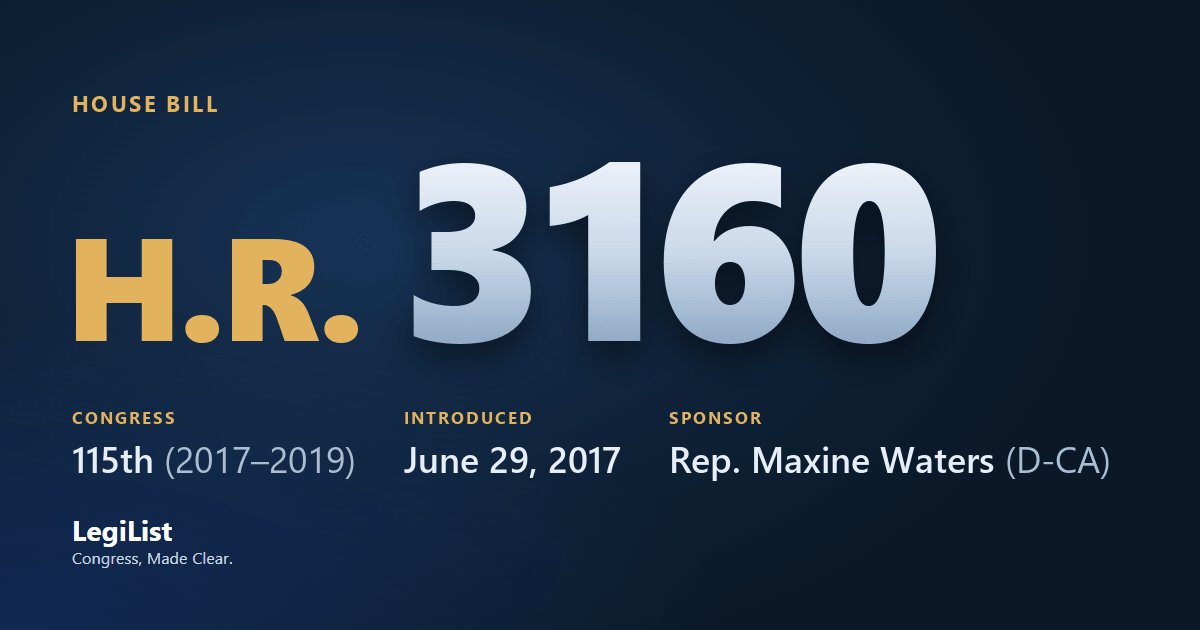
Public Housing Tenant Protection and Reinvestment Act of 2017
Latest action · Jun 29, 2017 Referred to the House Committee on Financial Services.
Progress
Where this bill reached, and when. A stage with no date was not reached; one that failed a vote and later carried shows the date it carried.
- IntroducedJun 29, 2017
- Passed HouseNot reached
- Passed SenateNot reached
- To the PresidentNot reached
- Became lawNot reached
Summary
Public Housing Tenant Protection and Reinvestment Act of 2017
Public Housing One-for-One Replacement and Tenant Protection Act of 2017
This bill amends the United States Housing Act of 1937 regarding: (1) demolition, disposition, or both pursuant to conversion of any public housing unit; and (2) the taking of public housing units through the use of eminent domain.
The bill exempts from specified requirements for demolition and disposition of public housing, public housing projects removed from a public housing agency (PHA) inventory under the program for conversion of demolished or distressed public housing dwelling units to tenant-based assistance.
Real property containing dwelling units in public housing is excluded from the Department of Housing and Urban Development (HUD) federal regulations or any substantially similar regulations with respect to:
- certain real estate; and
- implementing HUD requirements for demolition or disposition of public housing projects, and conversion of public housing to tenant-based assistance.
Public Housing Preservation and Rehabilitation Act of 2017
The public housing Capital and Operating Funds are reauthorized.
HUD may guarantee notes or other obligations issued by PHAs to finance: (1) the rehabilitation of PHA public housing; (2) the modernization of such housing through energy efficiency improvements; or (3) the construction, rehabilitation, purchase, or conversion of public housing units to replace any demolished, disposed of, or converted.
Requirements are specified for PHAs that utilize housing tax credits under the Internal Revenue Code for rental housing units.
The bill eliminates a specified limitation on the use of amounts from the Capital Fund or Operation Fund by a PHA to construct new public housing units.
Choice Neighborhoods Initiative Act of 2017
HUD must make competitive grants to local governments, PHAs, or nonprofit entities owning a major housing project to implement transformational programs in eligible neighborhoods with a concentration of extreme poverty and severely distressed housing.
Together We Care Act of 2017
HUD shall establish a competitive grant pilot program for eligible entities to train public housing residents as home health aides and as providers of home-based health services for residents of public housing or federally-assisted rental housing who are elderly, disabled, or both.
Cosponsors 13
Members who signed on, in the order they did. Signatures ran from Jun 29, 2017 to Sep 6, 2018; 7 are original cosponsors, there from the day it was introduced.
| Seat | Cosponsor | Signed on | |
|---|---|---|---|
| D-TX | Al Green | Original | Jun 29, 2017 |
| D-WA | Denny Heck | Original | Jun 29, 2017 |
| D-WI | Gwen Moore | Original | Jun 29, 2017 |
| D-CA | Juan Vargas | Original | Jun 29, 2017 |
| D-MN | Keith Ellison | Original | Jun 29, 2017 |
| D-NY | Nydia M. Velázquez | Original | Jun 29, 2017 |
| D-MA | Stephen F. Lynch | Original | Jun 29, 2017 |
| D-NY | Adriano Espaillat | Nov 7, 2017 | |
| D-FL | Charlie Crist | Nov 7, 2017 | |
| D-TN | Steve Cohen | Nov 7, 2017 | |
| D-TX | Vicente Gonzalez | Nov 7, 2017 | |
| D-TX | Sheila Jackson Lee | May 10, 2018 | |
| D-NY | Carolyn B. Maloney | Sep 6, 2018 |
Committees 1
Where it was sent and what each committee and subcommittee did with it, in order.
| Chamber | Committee | What it did |
|---|---|---|
| House | Financial Services Committee | Referred Jun 29, 2017 |
Actions 2
Everything that happened, newest first.
- Jun 29, 2017Introduced in House
- Jun 29, 2017Referred to the House Committee on Financial Services.
Research
What has been written about this bill: committee reports, cost estimates, the sponsor’s authority statement, printed hearings and the Congressional Research Service’s work.
Constitutional authority
The sponsor’s statement, as printed in the Congressional Record, vol. 163, no. 112, June 29, 2017, page H5379.
CRS reports 1
Congressional Research Service work that CRS links to this bill or the law it became, newest first.
Cite it 1
Products on other subjects that cite it, usually among other measures.
| Product | Title | Kind | Published |
|---|---|---|---|
| R45296 | Housing Issues in the 115th Congress Archived | Report | Feb 25, 2019 |
Related bills 1
Companion bills and other measures the record links to this one.
| Bill | Title | Relationship | Latest action |
|---|---|---|---|
| HR 2231 | Public Housing Tenant Protection and Reinvestment Act of 2015 | Reintroduction of | May 1, 2015 |
Titles 6
Every title it has carried, official and short, at each stage.
- Official Title as Introduced
- To transform neighborhoods of extreme poverty by reforming the public housing demolition and disposition rules to require one-for-one replacement and tenant protections, and to provide public housing agencies with additional resources and flexibility to preserve public housing units, and for other purposes.
- Short Titles as Introduced
- Public Housing Tenant Protection and Reinvestment Act of 2017
- Short Titles as Introduced for portions of this bill
- Choice Neighborhoods Initiative Act of 2017
- Public Housing One-for-One Replacement and Tenant Protection Act of 2017
- Public Housing Preservation and Rehabilitation Act of 2017
- Together We Care Act of 2017
Subjects
Assigned by the Library of Congress. Policy area: Housing and Community Development.
- Administrative law and regulatory procedures
- Allied health services
- Department of Housing and Urban Development
- Energy efficiency and conservation
- Government trust funds
- Home and outpatient care
- Housing and Community Development
- Housing and community development funding
- Housing for the elderly and disabled
- Income tax credits
- Medical education
- Property rights
- Public housing
- Residential rehabilitation and home repair
Text 1
Each version as it was printed, newest first.
- Jun 29, 2017Introduced in House
Support LegiList
This page is free, carries no paywall, and is built and maintained by one person. If the record here is useful to you, a few dollars keeps it going.
Everything here is as published by Congress: the summary is the Congressional Research Service's, the action wording is the clerks', and the subjects are the Library of Congress's. How far it got is read from the actions themselves, taking the most recent one of each kind, so a bill that failed a vote and later passed is shown as having passed. Records come from this bill on Congress.gov and govinfo.gov; cost estimates are the Congressional Budget Office's, and the hearings are the printed hearings GovInfo publishes, which can appear months after the hearing.