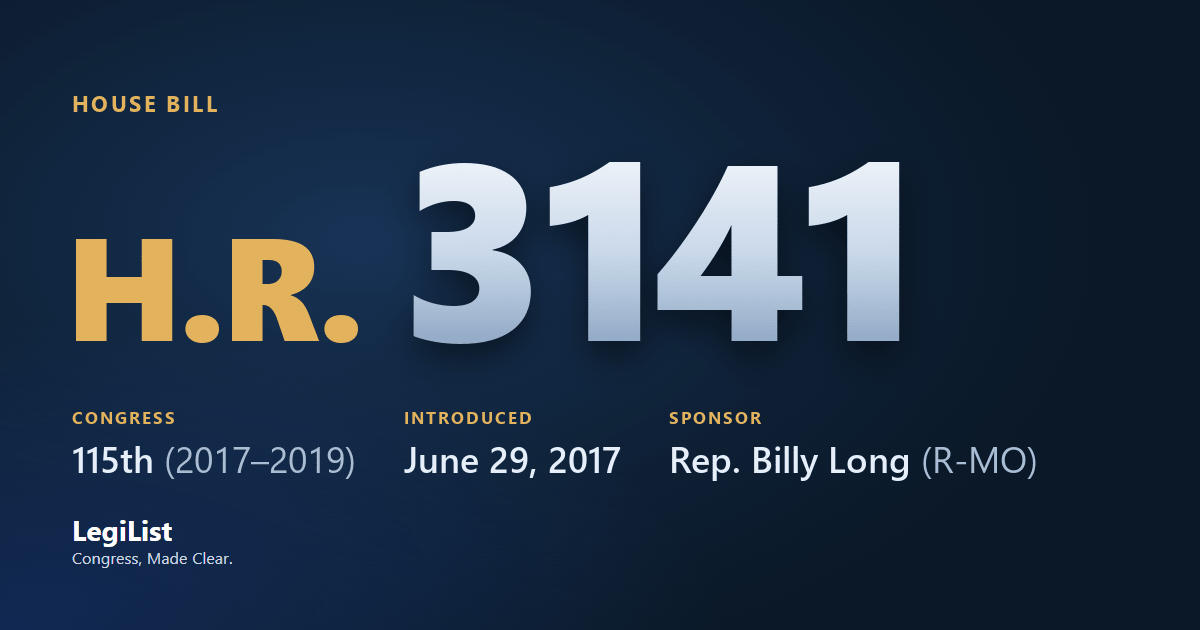
Taxpayer Transparency Act of 2017
Latest action · Jun 29, 2017 Referred to the House Committee on Oversight and Government Reform.
Progress
Where this bill reached, and when. A stage with no date was not reached; one that failed a vote and later carried shows the date it carried.
- IntroducedJun 29, 2017
- Passed HouseNot reached
- Passed SenateNot reached
- To the PresidentNot reached
- Became lawNot reached
Summary
Taxpayer Transparency Act of 2017
This bill requires each communication funded by a federal agency that is an advertisement, or that provides information about any federal program, benefit, or service, to clearly state: (1) in the case of a printed communication, including mass mailings, signs, and billboards, that the communication is printed or published at taxpayer expense; and (2) in the case of a communication transmitted through radio, television, or the Internet, that the communication is produced or disseminated at taxpayer expense. Such notification must state that a communication is provided by the U.S. government, rather than at taxpayer expense, if the communication is funded entirely by user fees or by other sources that do not include federal funds.
The bill requires any such printed communication to be of sufficient size to be clearly readable, to be contained in a printed box set apart from the other contents of the communication, and to be printed with a reasonable degree of color contrast between the background and the printed statement. The bill sets forth similar requirements for audio, video, and email communications.
The Office of Management and Budget must develop and issue guidance on implementing the requirements of this bill.
The bill prohibits judicial review of compliance with this bill.
Cosponsors 1
Members who signed on, in the order they did. All signed on Jun 29, 2017.
| Seat | Cosponsor | Signed on | |
|---|---|---|---|
| R-TX | Blake Farenthold | Original | Jun 29, 2017 |
Committees 1
Where it was sent and what each committee and subcommittee did with it, in order.
| Chamber | Committee | What it did |
|---|---|---|
| House | Oversight and Government Reform Committee | Referred Jun 29, 2017 |
Actions 2
Everything that happened, newest first.
- Jun 29, 2017Introduced in House
- Jun 29, 2017Referred to the House Committee on Oversight and Government Reform.
Research
What has been written about this bill: committee reports, cost estimates, the sponsor’s authority statement, printed hearings and the Congressional Research Service’s work.
Constitutional authority
The sponsor’s statement, as printed in the Congressional Record, vol. 163, no. 112, June 29, 2017, page H5378.
Titles 2
Every title it has carried, official and short, at each stage.
- Official Title as Introduced
- To require a Federal agency to include language in certain educational and advertising materials indicating that such materials are produced and disseminated at taxpayer expense, and for other purposes.
- Short Titles as Introduced
- Taxpayer Transparency Act of 2017
Subjects
Assigned by the Library of Congress. Policy area: Government Operations and Politics.
Text 1
Each version as it was printed, newest first.
- Jun 29, 2017Introduced in House
Support LegiList
This page is free, carries no paywall, and is built and maintained by one person. If the record here is useful to you, a few dollars keeps it going.
Everything here is as published by Congress: the summary is the Congressional Research Service's, the action wording is the clerks', and the subjects are the Library of Congress's. How far it got is read from the actions themselves, taking the most recent one of each kind, so a bill that failed a vote and later passed is shown as having passed. Records come from this bill on Congress.gov and govinfo.gov; cost estimates are the Congressional Budget Office's, and the hearings are the printed hearings GovInfo publishes, which can appear months after the hearing.