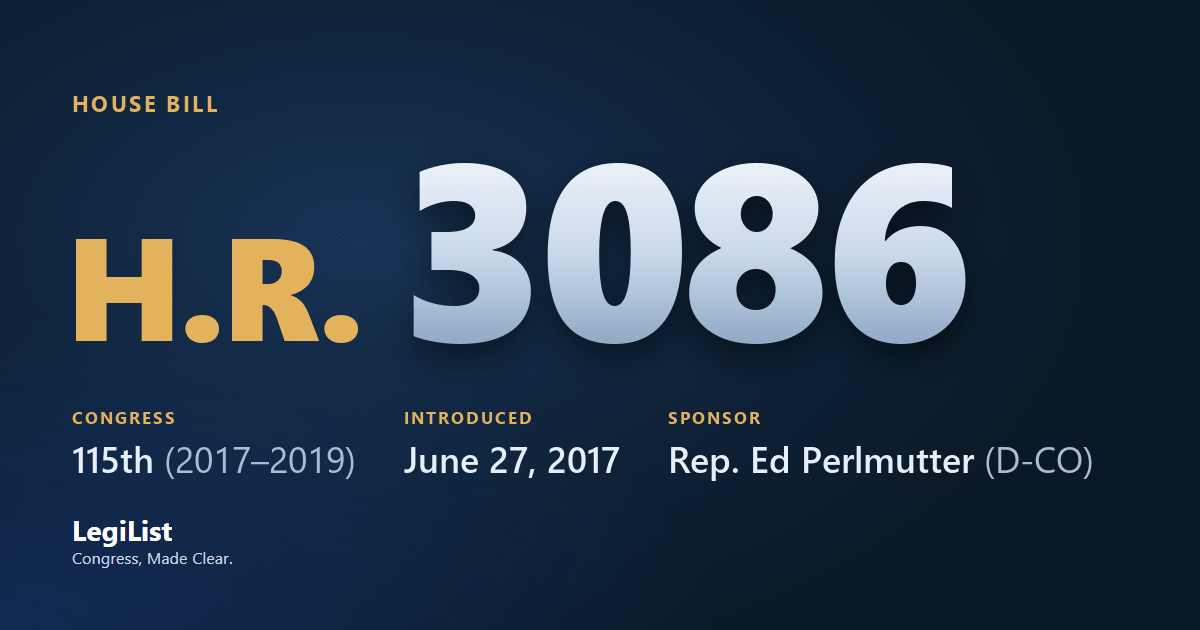
Space Weather Research and Forecasting Act
Latest action · May 22, 2018 Referred to the Subcommittee on Space.
Progress
Where this bill reached, and when. A stage with no date was not reached; one that failed a vote and later carried shows the date it carried.
- IntroducedJun 27, 2017
- Passed HouseNot reached
- Passed SenateNot reached
- To the PresidentNot reached
- Became lawNot reached
Summary
Space Weather Research and Forecasting Act
This bill directs the Office of Science and Technology Policy to:
- coordinate the development and implementation of federal government activities to improve the nation's ability to prepare, avoid, mitigate, respond to, and recover from potentially devastating impacts of space weather events;
- coordinate the activities of an interagency working group on space weather to be established by the National Science and Technology Council to continue coordination of executive branch efforts to understand, prepare, coordinate, and plan for space weather; and
- develop an integrated strategy for space and ground-based space weather observations.
The National Aeronautics and Space Administration (NASA) and the National Oceanic and Atmospheric Administration (NOAA) shall enter interagency agreements providing for cooperation and collaboration in the development of space weather spacecraft, instruments, and technologies and in the transition of research to operations.
NASA shall: (1) maintain operations of the Solar and Heliospheric Observatory/Large Angle and Spectrometric Coronagraph (SOHO/LASCO) for as long as the satellite continues to deliver quality observations; and (2) prioritize the reception of LASCO data.
NOAA shall: (1) secure reliable secondary capability for near real-time coronal mass ejection imagery; and (2) develop requirements and a plan for follow-on space-based observations for operational purposes.
The National Science Foundation (NSF), the Air Force, and the Navy shall each: (1)maintain and improve ground-based observations of the Sun, and (2) provide space weather data by means of ground-based facilities.
NOAA, the Air Force, and the Navy shall conduct a survey to prioritize the needs of space weather forecast users.
The NSF, NASA, and the Department of Defense (DOD) shall continue to carry out basic research activities on heliophysics, geospace science, and space weather and support merit-based proposals for research, modeling, and monitoring of space weather and its impacts.
The NSF and NOAA shall support basic research activities in the social, behavioral, and economic sciences that will lead to improving national preparedness and encouraging mitigation and protection measures before a space weather event.
The NSF, NOAA, and NASA shall pursue multidisciplinary research in subjects that further our understanding of solar physics, space physics, and space weather.
NASA shall seek to implement missions meeting science objectives identified in National Academy of Sciences (NAS) Solar and Space Physics Decadal surveys.
NASA, the NSF, NOAA, the Air Force, and the Navy shall: (1) develop a mechanism to transition NASA, NSF, Air Force, and Navy research findings, research needs, models, and capabilities to NOAA and DOD space weather operational forecasting centers; and (2) enhance coordination between research modeling centers and forecasting centers.
NASA and the NSF shall: (1) make space weather related data obtained for scientific research available to space weather forecasters and operations centers, and (2) support model development and applications to space weather forecasting.
NOAA shall arrange with the NAS to establish a Space Weather Government-Industry-University Roundtable to facilitate communication and knowledge transfer among government participants in the Space Weather Interagency Group, industry, and academia to facilitate advances in space weather prediction and forecasting, help enable the two-way coordination of research and operations, and improve preparedness for potential space weather events.
The space weather interagency working group shall develop benchmarks for measuring solar disturbances.
NOAA shall inform the Department of Homeland Security about space weather hazards to protect national critical infrastructure from space weather events.
The National Security Council shall develop mechanisms to protect national security assets from space weather threats.
The Federal Aviation Administration (FAA) shall: (1) assess the safety implications and vulnerability of the nation's airspace system by space weather events, and (2) develop methods to increase the interaction between the aviation community and the space weather research and service provider community.
Cosponsors 7
Members who signed on, in the order they did. Signatures ran from Jun 27, 2017 to Nov 9, 2018; 2 are original cosponsors, there from the day it was introduced.
| Seat | Cosponsor | Signed on | |
|---|---|---|---|
| D-TX | Eddie Bernice Johnson | Original | Jun 27, 2017 |
| R-OK | Jim Bridenstine | Original | Jun 27, 2017 |
| D-WA | Derek Kilmer | Jul 11, 2017 | |
| D-NH | Ann M. Kuster | Oct 31, 2017 | |
| R-AL | Mo Brooks | Jun 8, 2018 | |
| D-WI | Mark Pocan | Sep 26, 2018 | |
| D-CA | Anna G. Eshoo | Nov 9, 2018 |
Committees 5
Where it was sent and what each committee and subcommittee did with it, in order.
| Chamber | Committee | What it did |
|---|---|---|
| House | Science, Space, and Technology Committee | Referred Jun 27, 2017 |
| Environment Subcommittee | Referred May 22, 2018 | |
| Space and Aeronautics Subcommittee | Referred May 22, 2018 | |
| House | Armed Services Committee | Referred Jun 27, 2017 |
| Strategic Forces Subcommittee | Referred Jul 26, 2017 | |
| House | Intelligence (Permanent Select) Committee | Referred Jun 27, 2017 |
| House | Foreign Affairs Committee | Referred Jun 27, 2017 |
| House | Transportation and Infrastructure Committee | Referred Jun 27, 2017 |
| Aviation Subcommittee | Referred Jun 28, 2017 |
Actions 6
Everything that happened, newest first.
- May 22, 2018Referred to the Subcommittee on Environment.
- May 22, 2018Referred to the Subcommittee on Space.
- Jul 26, 2017Referred to the Subcommittee on Strategic Forces.
- Jun 28, 2017Referred to the Subcommittee on Aviation.
- Jun 27, 2017Introduced in House
- Jun 27, 2017Referred to the Committee on Science, Space, and Technology, and in addition to the Committees on Armed Services, Intelligence (Permanent Select), Foreign Affairs, and Transportation and Infrastructure, for a period to be subsequently determined by the Speaker, in each case for consideration of such provisions as fall within the jurisdiction of the committee concerned.
Research
What has been written about this bill: committee reports, cost estimates, the sponsor’s authority statement, printed hearings and the Congressional Research Service’s work.
Constitutional authority
The sponsor’s statement, as printed in the Congressional Record, vol. 163, no. 110, June 27, 2017, page H5232.
Printed hearings 2
Hearings whose printed record names this bill, newest first: hearings on it, and wider hearings where it came up.
| Number | Hearing | Committee | Held |
|---|---|---|---|
| Serial No. 115-56 | SURVEYING THE SPACE WEATHER LANDSCAPE143 pages | Science, Space, and Technology Committee | Apr 26, 2018 |
| — | PROCEEDINGS OF THE FULL COMMITTEE MARKUP ON H.R. 1224, NIST CYBERSECURITY FRAMEWORK, ASSESSMENT, AND AUDITING ACT OF 2017942 pages | Science, Space, and Technology Committee | Jan 10, 2017–Nov 15, 2017 |
Related bills 1
Companion bills and other measures the record links to this one.
| Bill | Title | Relationship | Latest action |
|---|---|---|---|
| S 141 | Space Weather Research and Forecasting Act | Related bill | Jan 3, 2019 |
Titles 2
Every title it has carried, official and short, at each stage.
- Official Title as Introduced
- To improve understanding and forecasting of space weather events, and for other purposes.
- Short Titles as Introduced
- Space Weather Research and Forecasting Act
Subjects
Assigned by the Library of Congress. Policy area: Science, Technology, Communications.
Text 1
Each version as it was printed, newest first.
- Jun 27, 2017Introduced in House
Support LegiList
This page is free, carries no paywall, and is built and maintained by one person. If the record here is useful to you, a few dollars keeps it going.
Everything here is as published by Congress: the summary is the Congressional Research Service's, the action wording is the clerks', and the subjects are the Library of Congress's. How far it got is read from the actions themselves, taking the most recent one of each kind, so a bill that failed a vote and later passed is shown as having passed. Records come from this bill on Congress.gov and govinfo.gov; cost estimates are the Congressional Budget Office's, and the hearings are the printed hearings GovInfo publishes, which can appear months after the hearing.