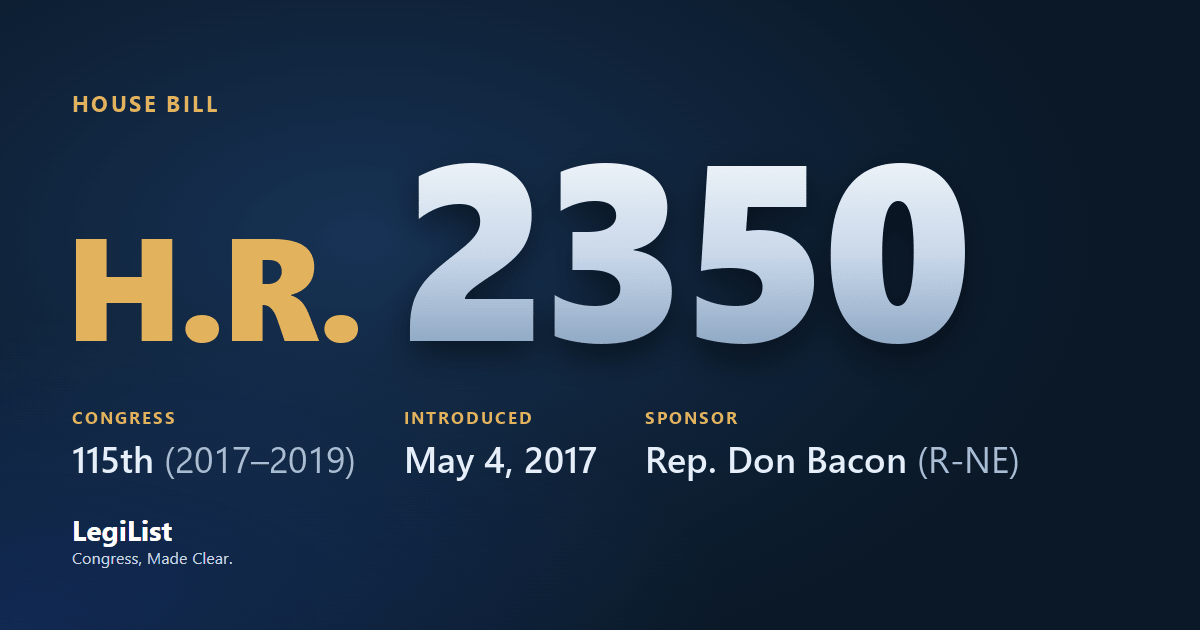
Small Business Know-Before-You-Bid Construction Transparency Act of 2017
Latest action · May 4, 2017 Referred to the House Committee on Small Business.
Progress
Where this bill reached, and when. A stage with no date was not reached; one that failed a vote and later carried shows the date it carried.
- IntroducedMay 4, 2017
- Passed HouseNot reached
- Passed SenateNot reached
- To the PresidentNot reached
- Became lawNot reached
Summary
Small Business Know-Before-You-Bid Construction Transparency Act of 2017
This bill amends the Small Business Act to require the Small Business Administration to make available a secured electronic system through which each agency shall provide access to documents relating to each construction contract it awards to a small business concern, including:
- any payment bond provided for the contract and any bond modification required by the agency; and
- the date and amount of each payment made to the prime contractor, any amounts withheld, and a general explanation of why an amount was withheld.
The bill requires that such documents be made available in such system within 15 days after they are included in the contract file.
For solicitations for the award of a construction contract anticipated to be awarded to a small business concern, the agency shall provide a notice along with the solicitation about the agency's required policies or practices relating to the timely definitization of requests for an equitable adjustment.
Cosponsors
Members who signed on, in the order they did.
Committees 1
Where it was sent and what each committee and subcommittee did with it, in order.
| Chamber | Committee | What it did |
|---|---|---|
| House | Small Business Committee | Referred May 4, 2017 |
Actions 2
Everything that happened, newest first.
- May 4, 2017Introduced in House
- May 4, 2017Referred to the House Committee on Small Business.
In the Congressional Record 1
Days the Record’s own index lists this bill, newest first, with the pages and the members it names. Pages starting H are the House, S the Senate, E Extensions of Remarks.
| Where | In the Record | Members | Date |
|---|---|---|---|
| House | Lists H4178–H4180H.R. 2350–2398 | — | May 4, 2017 |
Research
What has been written about this bill: committee reports, cost estimates, the sponsor’s authority statement, printed hearings and the Congressional Research Service’s work.
Constitutional authority
The sponsor’s statement, as printed in the Congressional Record, vol. 163, no. 77, May 4, 2017, page H4178.
Printed hearings 1
Hearings whose printed record names this bill, newest first: hearings on it, and wider hearings where it came up.
| Number | Hearing | Committee | Held |
|---|---|---|---|
| 115-22 | ALL WORK AND NO PAY: CHANGE ORDERS DELAYED FOR SMALL CONSTRUCTION CONTRACTORS56 pages | Small Business Committee | May 25, 2017 |
Titles 2
Every title it has carried, official and short, at each stage.
- Official Title as Introduced
- To amend the Small Business Act to foster greater transparency in and establish standards relating to the administration of construction contracts, to provide prospective construction contractors with information about an agency's policies on the administration of change orders to allow such contractors to make informed business decisions regarding the pricing of bids or proposals, and for other purposes.
- Short Titles as Introduced
- Small Business Know-Before-You-Bid Construction Transparency Act of 2017
Subjects
Assigned by the Library of Congress. Policy area: Commerce.
Text 1
Each version as it was printed, newest first.
- May 4, 2017Introduced in House
Support LegiList
This page is free, carries no paywall, and is built and maintained by one person. If the record here is useful to you, a few dollars keeps it going.
Everything here is as published by Congress: the summary is the Congressional Research Service's, the action wording is the clerks', and the subjects are the Library of Congress's. How far it got is read from the actions themselves, taking the most recent one of each kind, so a bill that failed a vote and later passed is shown as having passed. Records come from this bill on Congress.gov and govinfo.gov; cost estimates are the Congressional Budget Office's, and the hearings are the printed hearings GovInfo publishes, which can appear months after the hearing.