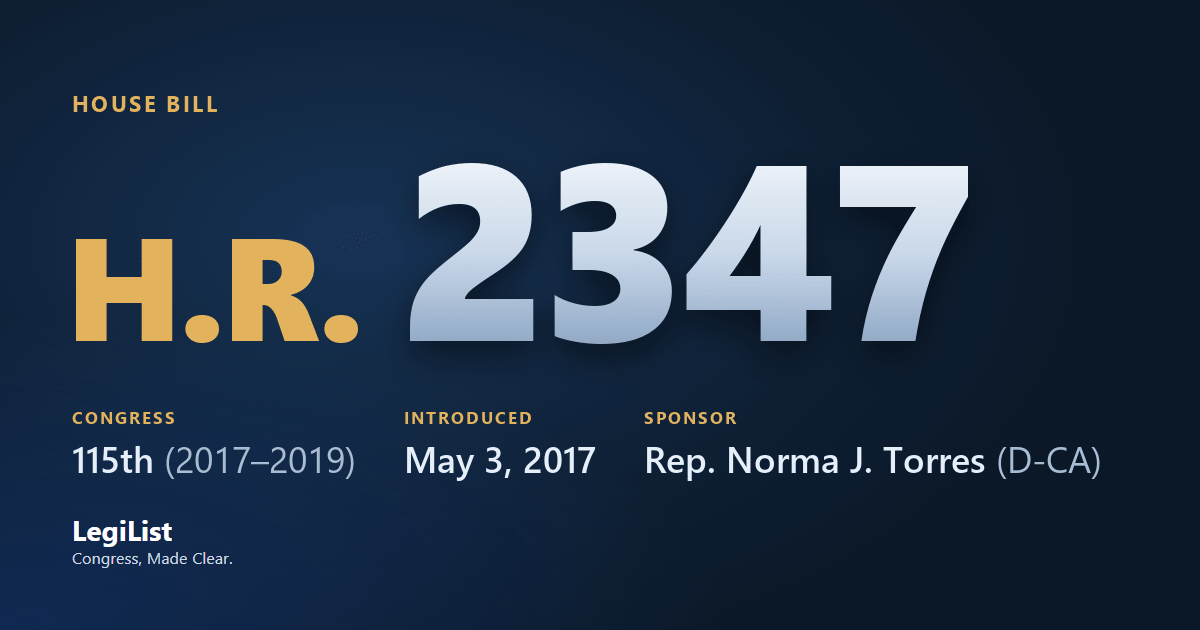
Regional Infrastructure Accelerator Act of 2017
Latest action · May 4, 2017 Referred to the Subcommittee on Water Resources and Environment.
Progress
Where this bill reached, and when. A stage with no date was not reached; one that failed a vote and later carried shows the date it carried.
- IntroducedMay 3, 2017
- Passed HouseNot reached
- Passed SenateNot reached
- To the PresidentNot reached
- Became lawNot reached
Summary
Regional Infrastructure Accelerator Act of 2017
This bill authorizes the Department of the Treasury to establish a regional infrastructure accelerator (RIA) program to provide initial and subsequent grants to RIAs to facilitate investment in, and long-term financing of, economically viable covered infrastructure projects.
An "RIA" is defined as a multi-jurisdictional organization dedicated to providing technical assistance, financing options, and resources for covered infrastructure projects within the represented jurisdictions. A "covered infrastructure project" is defined as a project sponsored by a state, local, or regional public entity that involves the construction, consolidation, alteration, or repair of rail, bus, or public transportation facilities or equipment, highway facilities (including bridges and tunnels), airports, port or marine facilities and equipment, pipelines, inland waterways, intermodal facilities and equipment, water treatment and solid waste disposal facilities, storm water management systems, dams and levees, and facilities or equipment for energy transmission, distribution, or storage.
From applications received, Treasury shall select five RIAs from geographically diverse regions to receive initial grants. An RIA shall use such a grant to:
- assess regional approaches for advancing innovative investment in covered infrastructure projects;
- develop strategies for transparency in the analysis of such projects to ensure protection of the public interest, for the bundling of smaller scale and rural projects into larger covered infrastructure projects to facilitate transactions and investments, and for reducing transaction costs associated with investments in such projects;
- facilitate the creation of a catalog of covered infrastructure projects available for investment; and
- analyze and apply project procurement methods for covered infrastructure projects.
Treasury shall review final reports submitted by RIAs and select four of them to receive subsequent grants. A selected RIA shall use such subsequent grant to make subgrants to public entities for costs associated with a covered infrastructure project.
Cosponsors 2
Members who signed on, in the order they did. Signatures ran from May 3, 2017 to May 18, 2017; 1 is an original cosponsor, there from the day it was introduced.
| Seat | Cosponsor | Signed on | |
|---|---|---|---|
| D-CA | Grace F. Napolitano | Original | May 3, 2017 |
| D-CA | Salud O. Carbajal | May 18, 2017 |
Committees 1
Where it was sent and what each committee and subcommittee did with it, in order.
| Chamber | Committee | What it did |
|---|---|---|
| House | Transportation and Infrastructure Committee | Referred May 3, 2017 |
| Aviation Subcommittee | Referred May 4, 2017 | |
| Coast Guard and Maritime Transportation Subcommittee | Referred May 4, 2017 | |
| Economic Development, Public Buildings, and Emergency Management Subcommittee | Referred May 4, 2017 | |
| Highways and Transit Subcommittee | Referred May 4, 2017 | |
| Railroads, Pipelines, and Hazardous Materials Subcommittee | Referred May 4, 2017 | |
| Water Resources and Environment Subcommittee | Referred May 4, 2017 |
Actions 8
Everything that happened, newest first.
- May 4, 2017Referred to the Subcommittee on Aviation.
- May 4, 2017Referred to the Subcommittee on Coast Guard and Maritime Transportation.
- May 4, 2017Referred to the Subcommittee on Economic Development, Public Buildings and Emergency Management.
- May 4, 2017Referred to the Subcommittee on Highways and Transit.
- May 4, 2017Referred to the Subcommittee on Railroads, Pipelines, and Hazardous Materials.
- May 4, 2017Referred to the Subcommittee on Water Resources and Environment.
- May 3, 2017Introduced in House
- May 3, 2017Referred to the House Committee on Transportation and Infrastructure.
Research
What has been written about this bill: committee reports, cost estimates, the sponsor’s authority statement, printed hearings and the Congressional Research Service’s work.
Constitutional authority
The sponsor’s statement, as printed in the Congressional Record, vol. 163, no. 76, May 3, 2017, page H3325.
Printed hearings 1
Hearings whose printed record names this bill, newest first: hearings on it, and wider hearings where it came up.
| Number | Hearing | Committee | Held |
|---|---|---|---|
| S. Hrg. 115-374 | NOMINATION HEARING FOR DEPUTY SECRETARY OF LABOR AND MEMBERS OF THE NATIONAL LABOR RELATIONS BOARD95 pages | Health, Education, Labor, and Pensions Committee | Jul 13, 2017 |
Titles 2
Every title it has carried, official and short, at each stage.
- Official Title as Introduced
- To direct the Secretary of the Treasury to establish a regional infrastructure accelerator program to facilitate investments in and the financing of certain infrastructure projects, and for other purposes.
- Short Titles as Introduced
- Regional Infrastructure Accelerator Act of 2017
Subjects
Assigned by the Library of Congress. Policy area: Transportation and Public Works.
- Aviation and airports
- Border security and unlawful immigration
- Congressional oversight
- Dams and canals
- Electric power generation and transmission
- Energy storage, supplies, demand
- Infrastructure development
- Marine and inland water transportation
- Navigation, waterways, harbors
- Pipelines
- Public contracts and procurement
- Public transit
- Railroads
- Regional and metropolitan planning
- Roads and highways
- Solid waste and recycling
- State and local government operations
- Transportation and Public Works
- Transportation programs funding
- Water quality
- Water use and supply
Text 1
Each version as it was printed, newest first.
- May 3, 2017Introduced in House
Everything here is as published by Congress: the summary is the Congressional Research Service's, the action wording is the clerks', and the subjects are the Library of Congress's. How far it got is read from the actions themselves, taking the most recent one of each kind, so a bill that failed a vote and later passed is shown as having passed. Records come from this bill on Congress.gov and govinfo.gov; cost estimates are the Congressional Budget Office's, and the hearings are the printed hearings GovInfo publishes, which can appear months after the hearing.