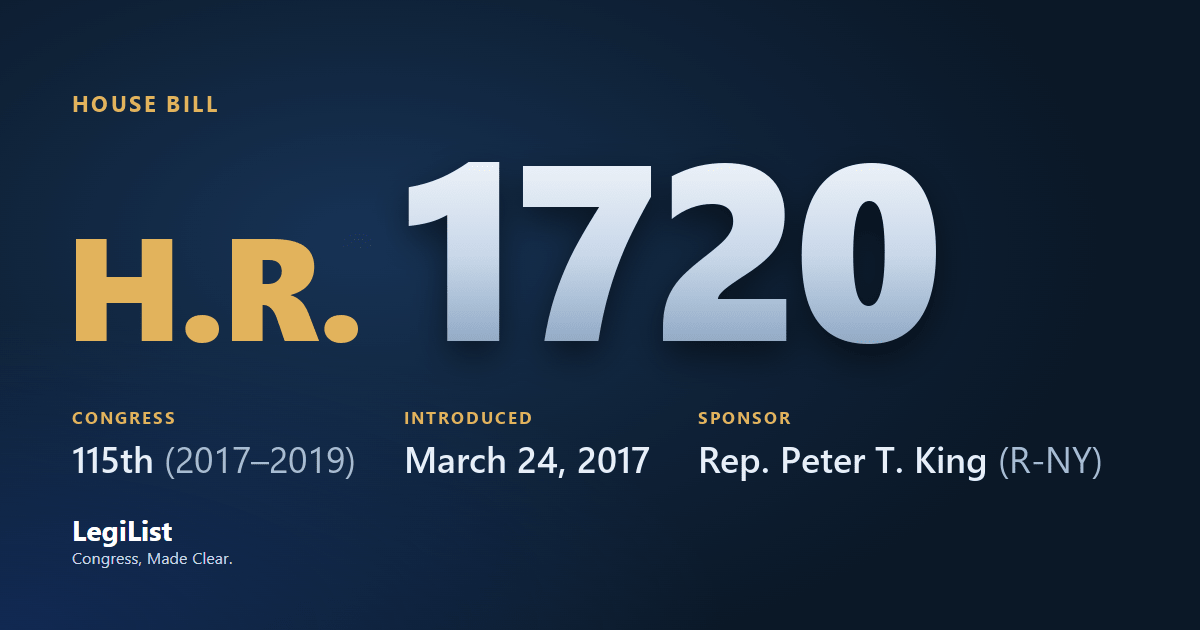
LOSAP CAP Act
Latest action · Mar 24, 2017 Referred to the House Committee on Ways and Means.
Progress
Where this bill reached, and when. A stage with no date was not reached; one that failed a vote and later carried shows the date it carried.
- IntroducedMar 24, 2017
- Passed HouseNot reached
- Passed SenateNot reached
- To the PresidentNot reached
- Became lawNot reached
Summary
Length of Service Award Program Cap Adjustment Priority Act or the LOSAP CAP Act
This bill amends the Internal Revenue Code, with respect to deferred compensation plans, to increase the limit on accruals that is required for length of service award plans (LOSAPs) for bona fide volunteers to be exempt from treatment as a deferred compensation plan.
(Under current law, plans paying solely length of service awards to bona fide volunteers or their beneficiaries on the account of firefighting and prevention services, emergency medical services, and ambulance services performed by the volunteers are not treated as deferred compensation plans if they meet certain requirements. One of the requirements is a limit on the aggregate amount of length of service awards that may accrue with respect to any year of service for any bona fide volunteer.)
The bill modifies the limit on accruals to: (1) increase the limit from $3,000 to $6,000; (2) provide for a cost-of-living adjustment to the limit after 2017; and (3) specify that, in the case of LOSAPs that are defined benefit plans, the limit applies to the actuarial present value of the aggregate amount of length of service awards accruing with respect to any year of service.
Cosponsors 3
Members who signed on, in the order they did. Signatures ran from Mar 24, 2017 to Sep 26, 2018; 1 is an original cosponsor, there from the day it was introduced.
| Seat | Cosponsor | Signed on | |
|---|---|---|---|
| D-NJ | Bill Pascrell, Jr. | Original | Mar 24, 2017 |
| R-NY | John J. Faso | Dec 13, 2017 | |
| R-VA | Barbara Comstock | Sep 26, 2018 |
Committees 1
Where it was sent and what each committee and subcommittee did with it, in order.
| Chamber | Committee | What it did |
|---|---|---|
| House | Ways and Means Committee | Referred Mar 24, 2017 |
Actions 2
Everything that happened, newest first.
- Mar 24, 2017Introduced in House
- Mar 24, 2017Referred to the House Committee on Ways and Means.
Research
What has been written about this bill: committee reports, cost estimates, the sponsor’s authority statement, printed hearings and the Congressional Research Service’s work.
Constitutional authority
The sponsor’s statement, as printed in the Congressional Record, vol. 163, no. 52, March 24, 2017, page H2444.
Related bills 2
Companion bills and other measures the record links to this one.
| Bill | Title | Relationship | Latest action |
|---|---|---|---|
| S 1 | An original bill to provide for reconciliation pursuant to title II of the concurrent resolution on the budget for fiscal year 2018. | Related bill | Nov 28, 2017 |
| S 1239 | LOSAP CAP Act | Related bill | May 25, 2017 |
Titles 3
Every title it has carried, official and short, at each stage.
- Official Title as Introduced
- To amend the Internal Revenue Code of 1986 to modify the rules applicable to length of service award plans.
- Short Titles as Introduced
- LOSAP CAP Act
- Length of Service Award Program Cap Adjustment Priority Act
Subjects
Assigned by the Library of Congress. Policy area: Taxation.
Text 1
Each version as it was printed, newest first.
- Mar 24, 2017Introduced in House
Support LegiList
This page is free, carries no paywall, and is built and maintained by one person. If the record here is useful to you, a few dollars keeps it going.
Everything here is as published by Congress: the summary is the Congressional Research Service's, the action wording is the clerks', and the subjects are the Library of Congress's. How far it got is read from the actions themselves, taking the most recent one of each kind, so a bill that failed a vote and later passed is shown as having passed. Records come from this bill on Congress.gov and govinfo.gov; cost estimates are the Congressional Budget Office's, and the hearings are the printed hearings GovInfo publishes, which can appear months after the hearing.