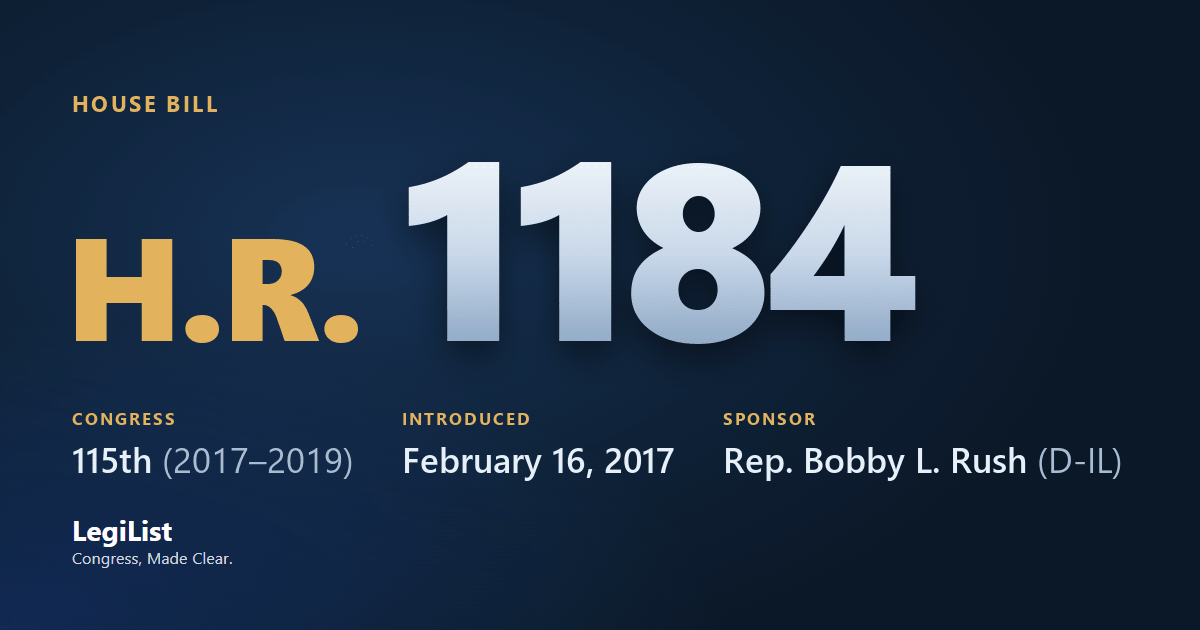
Family Telephone Connection Protection Act of 2017
Latest action · Feb 17, 2017 Referred to the Subcommittee on Communications and Technology.
Progress
Where this bill reached, and when. A stage with no date was not reached; one that failed a vote and later carried shows the date it carried.
- IntroducedFeb 16, 2017
- Passed HouseNot reached
- Passed SenateNot reached
- To the PresidentNot reached
- Became lawNot reached
Summary
Family Telephone Connection Protection Act of 2017
This bill amends the Communications Act of 1934 to direct the Federal Communications Commission to adopt or continue in force regulations on the use of inmate telephone and video services that enable persons incarcerated in correctional institutions to originate calls at payphones, telephones, or video kiosks designated for the personal use of inmates.
The regulations must: (1) prescribe variable maximum per-minute compensation rates depending on factors such as carrier costs and the size of the correctional facility, (2) prohibit per-call or per-connection charges, (3) require providers of inmate telephone and video service to offer both collect calling and prepaid debit account services, (4) prohibit or limit the payment of commissions by such providers to administrators of correctional facilities based upon the revenue of the service, (5) require such administrators to allow more than one service provider at a facility so that inmates have a choice, and (6) prohibit or substantially limit any ancillary fees that are in addition to the per-minute rate and connection charge.
Cosponsors 2
Members who signed on, in the order they did. All signed on Feb 16, 2017.
| Seat | Cosponsor | Signed on | |
|---|---|---|---|
| D-DC | Eleanor Holmes Norton | Original | Feb 16, 2017 |
| D-NC | G. K. Butterfield | Original | Feb 16, 2017 |
Committees 1
Where it was sent and what each committee and subcommittee did with it, in order.
| Chamber | Committee | What it did |
|---|---|---|
| House | Energy and Commerce Committee | Referred Feb 16, 2017 |
| Communications and Technology Subcommittee | Referred Feb 17, 2017 |
Actions 3
Everything that happened, newest first.
- Feb 17, 2017Referred to the Subcommittee on Communications and Technology.
- Feb 16, 2017Introduced in House
- Feb 16, 2017Referred to the House Committee on Energy and Commerce.
Research
What has been written about this bill: committee reports, cost estimates, the sponsor’s authority statement, printed hearings and the Congressional Research Service’s work.
Constitutional authority
The sponsor’s statement, as printed in the Congressional Record, vol. 163, no. 28, February 16, 2017, page H1305.
Titles 2
Every title it has carried, official and short, at each stage.
- Official Title as Introduced
- To amend the Communications Act of 1934 to require the Federal Communications Commission to prescribe rules regulating inmate telephone and video service rates, and for other purposes.
- Short Titles as Introduced
- Family Telephone Connection Protection Act of 2017
Subjects
Assigned by the Library of Congress. Policy area: Science, Technology, Communications.
- Administrative law and regulatory procedures
- Competition and antitrust
- Correctional facilities and imprisonment
- Federal Communications Commission (FCC)
- Internet and video services
- Internet, web applications, social media
- Science, Technology, Communications
- Telecommunication rates and fees
- Telephone and wireless communication
Text 1
Each version as it was printed, newest first.
- Feb 16, 2017Introduced in House
Everything here is as published by Congress: the summary is the Congressional Research Service's, the action wording is the clerks', and the subjects are the Library of Congress's. How far it got is read from the actions themselves, taking the most recent one of each kind, so a bill that failed a vote and later passed is shown as having passed. Records come from this bill on Congress.gov and govinfo.gov; cost estimates are the Congressional Budget Office's, and the hearings are the printed hearings GovInfo publishes, which can appear months after the hearing.