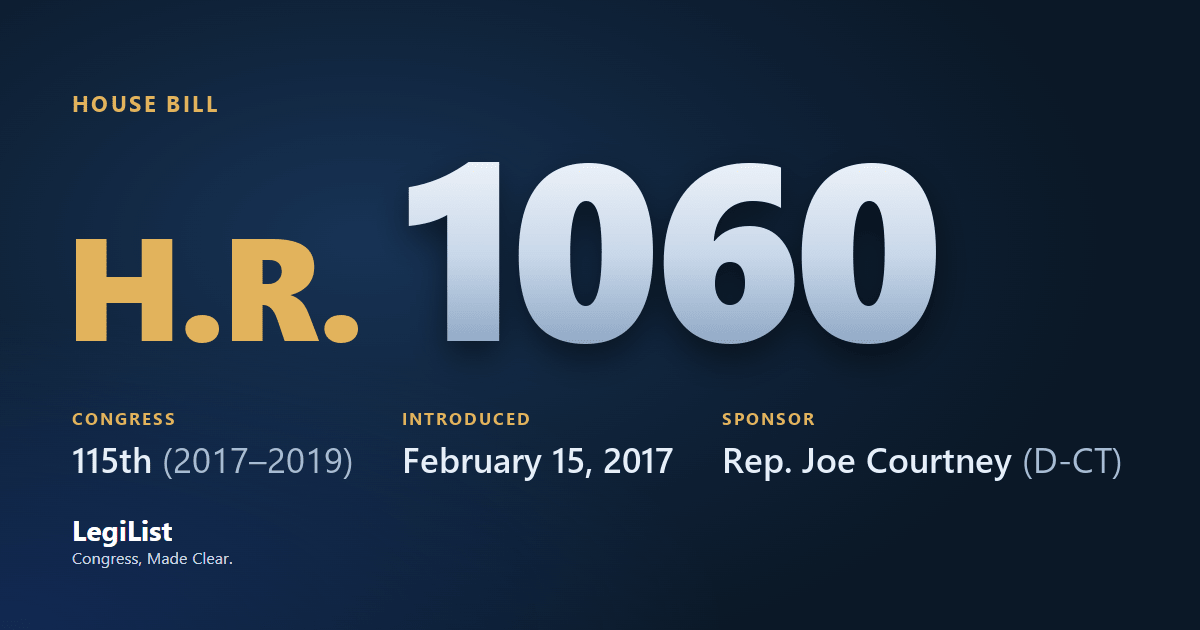
Young Farmer Success Act
Latest action · Feb 15, 2017 Referred to the House Committee on Education and the Workforce.
Progress
Where this bill reached, and when. A stage with no date was not reached; one that failed a vote and later carried shows the date it carried.
- IntroducedFeb 15, 2017
- Passed HouseNot reached
- Passed SenateNot reached
- To the PresidentNot reached
- Became lawNot reached
Summary
Young Farmer Success Act
This bill amends title IV (Student Assistance) of the Higher Education Act of 1965 to include a full-time job as an employee or manager of a qualified farm or ranch within the definition of "public service job" for purposes of the public service employee loan forgiveness program.
A "qualified farm or ranch" earns, from the sale of agricultural products, gross revenue of at least $35,000 in 2017, adjusted annually for inflation in subsequent years.
Cosponsors 8
Members who signed on, in the order they did. Signatures ran from Feb 15, 2017 to Feb 27, 2018, with 2 there on the day it was introduced.
| Seat | Cosponsor | Signed on | |
|---|---|---|---|
| R-PA | Glenn Thompson | Original | Feb 15, 2017 |
| R-NY | John J. Faso | Original | Feb 15, 2017 |
| R-NY | Lee M. Zeldin | Feb 28, 2017 | |
| D-MN | Richard M. Nolan | Feb 28, 2017 | |
| D-IL | Robin L. Kelly | Feb 28, 2017 | |
| D-VT | Peter Welch | Apr 25, 2017 | |
| D-DE | Lisa Blunt Rochester | Jul 27, 2017 | |
| D-ME | Chellie Pingree | Feb 27, 2018 |
Actions 2
Everything that happened, newest first.
- Feb 15, 2017Introduced in House
- Feb 15, 2017Referred to the House Committee on Education and the Workforce.
Subjects
Assigned by the Library of Congress. Policy area: Education.
Text 1
Each version as it was printed, newest first.
- Feb 15, 2017Introduced in House
Everything here is as published by Congress: the summary is the Congressional Research Service's, the action wording is the clerks', and the subjects are the Library of Congress's. How far it got is read from the actions themselves, taking the most recent one of each kind, so a bill that failed a vote and later passed is shown as having passed. Records come from this bill on Congress.gov and govinfo.gov.