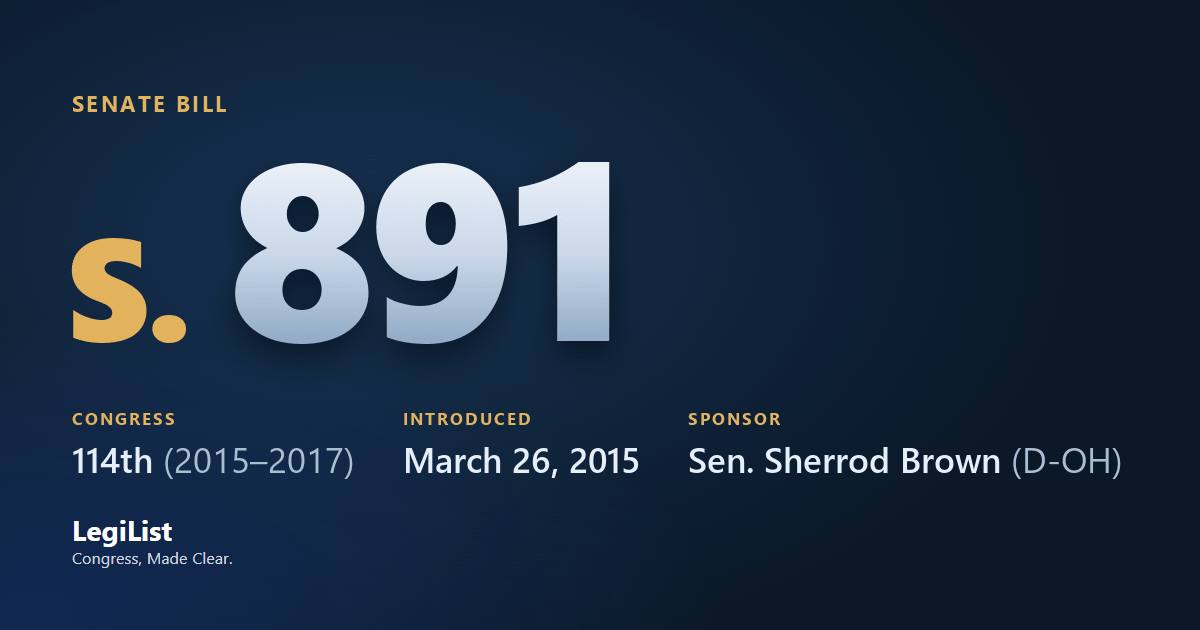
Leveling the Playing Field Act
Latest action · Mar 26, 2015 Read twice and referred to the Committee on Finance.
Progress
Where this bill reached, and when. A stage with no date was not reached; one that failed a vote and later carried shows the date it carried.
- IntroducedMar 26, 2015
- Passed SenateNot reached
- Passed HouseNot reached
- To the PresidentNot reached
- Became lawNot reached
Summary
Leveling the Playing Field Act
Amends the Tariff Act of 1930 with respect to the administration and enforcement of antidumping (AD) and countervailing duty (CVD) orders.
Declares that neither the administering authority (the Secretary of Commerce, or another U.S. officer given the responsibility by law) nor the U.S. International Trade Commission (USITC), as the case may be, is required to determine, or make any adjustments to, a countervailable subsidy rate or weighted average dumping margin based on any assumptions about information the interested party would have provided if it had complied with a request for information.
Prohibits the judicial review of any administering authority or USITC determination made in selecting facts or using an inference that is adverse to an interested party in AD and CVD proceedings.
Prescribes additional economic factors for the USITC to evaluate when determining whether imports have caused or threatened material injury to a domestic industry. Requires such factors to be evaluated within the context of the business cycle and conditions of competition that are distinct to the affected industry.
Repeals the requirement that, in the course of a review of an AD or CVD order for merchandise a new exporter or producer claims it did not export to the United States, the administering authority direct U.S. Customs and Border Protection to allow the importer to post a bond or security in lieu of a cash deposit for each entry of the subject merchandise.
Declares that an exporter or producer may be eligible for an individual weighted average dumping margin or individual countervailing duty rate in such a review only if the exporter or producer: (1) is not affiliated with an exporter or producer who exported subject merchandise during the review period or any period; and (2) demonstrates that sales of subject merchandise in the United States, or for exportation to the United States, during the period in question are bona fide and the buyer is not affiliated with that exporter or producer.
Authorizes the administering authority to require an importer of merchandise into the U.S. customs territory to provide a certification that such merchandise is not subject to an AD or CVD duty. Prescribes civil and criminal penalties for failure to comply with the requirement.
Specifies factors for the administering authority to consider when deciding, in CVD or AD investigations and reviews, whether it would be unduly burdensome to: (1) accept voluntary responses from exporters or producers not initially selected for examination, and so (2) determine not to establish an individual countervailable subsidy rate or an individual weighted average dumping margin for them.
Authorizes the administering authority, in valuing the factors of production to determine the normal value of merchandise exported from a nonmarket economy country, to disregard price or cost values if there is reason to believe or suspect that an input for the subject merchandise is subsidized or dumped.
Requires the administering authority to take into account, when determining whether a foreign country has a nonmarket economy, to consider the extent to which the country's government enforces and administers its laws, legal and administrative procedures, and other policies in an open and transparent manner that affords all parties, whether foreign or domestic, due process and equal and non-discriminatory treatment.
Applies the requirements of this Act to goods from Canada and Mexico.
Cosponsors 7
Members who signed on, in the order they did. Signatures ran from Mar 26, 2015 to Jun 24, 2015; 3 are original cosponsors, there from the day it was introduced.
| Seat | Cosponsor | Signed on | |
|---|---|---|---|
| D-MN | Al Franken | Original | Mar 26, 2015 |
| D-MO | Claire McCaskill | Original | Mar 26, 2015 |
| R-SC | Lindsey Graham | Original | Mar 26, 2015 |
| D-MN | Amy Klobuchar | Apr 27, 2015 | |
| D-MI | Debbie Stabenow | Jun 23, 2015 | |
| R-OH | Rob Portman | Jun 23, 2015 | |
| D-IN | Joe Donnelly | Jun 24, 2015 |
Committees 1
Where it was sent and what each committee and subcommittee did with it, in order.
| Chamber | Committee | What it did |
|---|---|---|
| Senate | Finance Committee | Referred Mar 27, 2015 |
Actions 2
Everything that happened, newest first.
- Mar 26, 2015Introduced in Senate
- Mar 26, 2015Read twice and referred to the Committee on Finance.
In the Congressional Record 2
Days the Record’s own index lists this bill, newest first, with the pages and the members it names. Pages starting H are the House, S the Senate, E Extensions of Remarks.
| Where | In the Record | Members | Date |
|---|---|---|---|
| Senate | Debate and remarks S2116 | Ron Wyden D-OR | Apr 18, 2016 |
| Senate | Debate and remarks S1897 | Joe Donnelly D-IN | Apr 12, 2016 |
Titles 2
Every title it has carried, official and short, at each stage.
- Official Title as Introduced
- A bill to amend the Tariff Act of 1930 to facilitate the administration and enforcement of antidumping and countervailing duty orders, and for other purposes.
- Short Titles as Introduced
- Leveling the Playing Field Act
Subjects
Assigned by the Library of Congress. Policy area: Foreign Trade and International Finance.
- Canada
- Competitiveness, trade promotion, trade deficits
- Corporate finance and management
- Customs enforcement
- Economic performance and conditions
- Foreign Trade and International Finance
- Free trade and trade barriers
- Government studies and investigations
- Inflation and prices
- Latin America
- Mexico
- Tariffs
- Trade agreements and negotiations
Text 1
Each version as it was printed, newest first.
- Mar 26, 2015Introduced in Senate
Everything here is as published by Congress: the summary is the Congressional Research Service's, the action wording is the clerks', and the subjects are the Library of Congress's. How far it got is read from the actions themselves, taking the most recent one of each kind, so a bill that failed a vote and later passed is shown as having passed. Records come from this bill on Congress.gov and govinfo.gov; cost estimates are the Congressional Budget Office's, and the hearings are the printed hearings GovInfo publishes, which can appear months after the hearing.