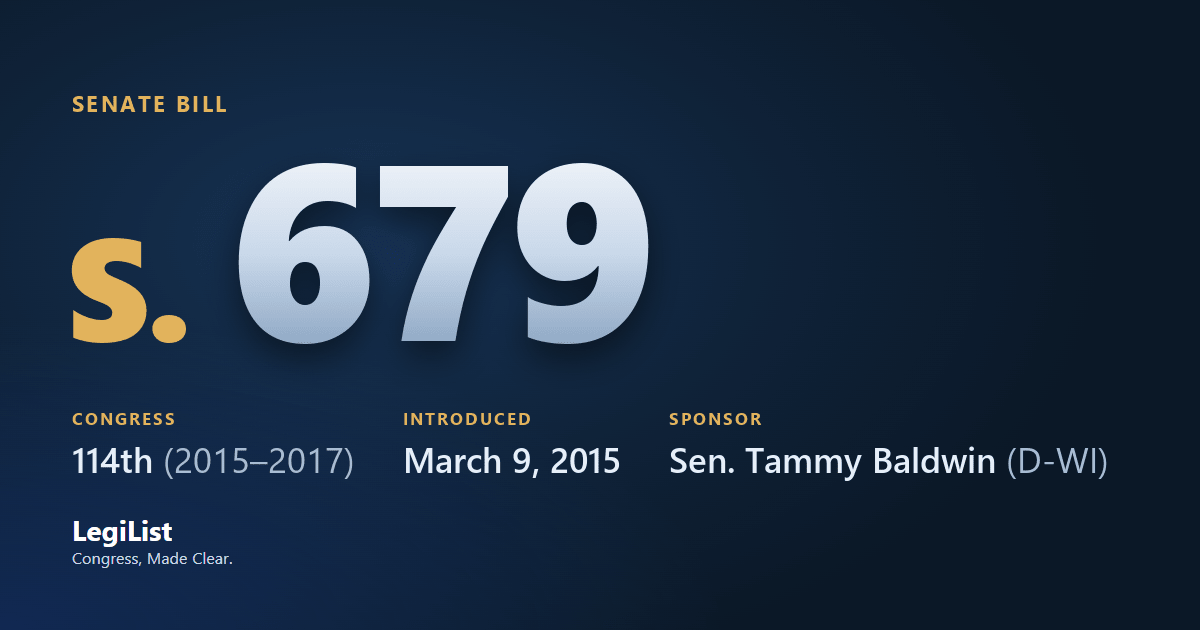
Quality Data, Quality Healthcare Act of 2015
Latest action · Mar 9, 2015 Read twice and referred to the Committee on Finance.
Progress
Where this bill reached, and when. A stage with no date was not reached; one that failed a vote and later carried shows the date it carried.
- IntroducedMar 9, 2015
- Passed SenateNot reached
- Passed HouseNot reached
- To the PresidentNot reached
- Became lawNot reached
Summary
Quality Data, Quality Healthcare Act of 2015
Amends title XVIII (Medicare) of the Social Security Act with respect to the use of certain data by qualified public or private entities to evaluate the performance of service providers and suppliers under Medicare insurance programs.
Authorizes a qualified entity to: (1) use Medicare data, and information derived from service provider and supplier performance evaluations, for additional non-public analyses; or (2) provide or sell such data and analyses to specified health care-related entities for non-public use (including for purposes of assisting service providers and suppliers to develop and participate in quality and patient care improvement activities, particularly development of new models of care).
Conditions such authorization upon a data use agreement between a qualified entity and a specified health care-related entity under which the latter: (1) may not re-sell such data or analyses, and (2) shall comply with the qualified entity's privacy and security policies in using such data or analyses.
Prescribes a civil money penalty for unauthorized use of data and analyses.
Requires the Secretary of Health and Human Services to provide Medicare claims data to qualified clinical data registries for purposes of linking it with clinical outcomes data and performing and disseminating risk-adjusted, scientifically valid research to support quality improvement.
Prohibits a qualified clinical data registry from reporting publicly any claims data thus made available that individually identifies a service provider or supplier without prior consent.
Cosponsors 2
Members who signed on, in the order they did. Signatures ran from Mar 9, 2015 to Mar 23, 2015; 1 is an original cosponsor, there from the day it was introduced.
| Seat | Cosponsor | Signed on | |
|---|---|---|---|
| R-SD | John Thune | Original | Mar 9, 2015 |
| D-CO | Michael F. Bennet | Mar 23, 2015 |
Committees 1
Where it was sent and what each committee and subcommittee did with it, in order.
| Chamber | Committee | What it did |
|---|---|---|
| Senate | Finance Committee | Referred Mar 9, 2015 |
Actions 2
Everything that happened, newest first.
- Mar 9, 2015Introduced in Senate
- Mar 9, 2015Read twice and referred to the Committee on Finance.
Research
What has been written about this bill: committee reports, cost estimates, the sponsor’s authority statement, printed hearings and the Congressional Research Service’s work.
Printed hearings 1
Hearings whose printed record names this bill, newest first: hearings on it, and wider hearings where it came up.
| Number | Hearing | Committee | Held |
|---|---|---|---|
| S. Hrg. 114-225 | BUSINESS MEETING395 pages | Environment and Public Works Committee | Apr 28, 2015–Apr 29, 2015 |
Titles 2
Every title it has carried, official and short, at each stage.
- Official Title as Introduced
- A bill to amend title XVIII of the Social Security Act to increase access to Medicare data.
- Short Titles as Introduced
- Quality Data, Quality Healthcare Act of 2015
Subjects
Assigned by the Library of Congress. Policy area: Health.
Text 1
Each version as it was printed, newest first.
- Mar 9, 2015Introduced in Senate
Everything here is as published by Congress: the summary is the Congressional Research Service's, the action wording is the clerks', and the subjects are the Library of Congress's. How far it got is read from the actions themselves, taking the most recent one of each kind, so a bill that failed a vote and later passed is shown as having passed. Records come from this bill on Congress.gov and govinfo.gov; cost estimates are the Congressional Budget Office's, and the hearings are the printed hearings GovInfo publishes, which can appear months after the hearing.