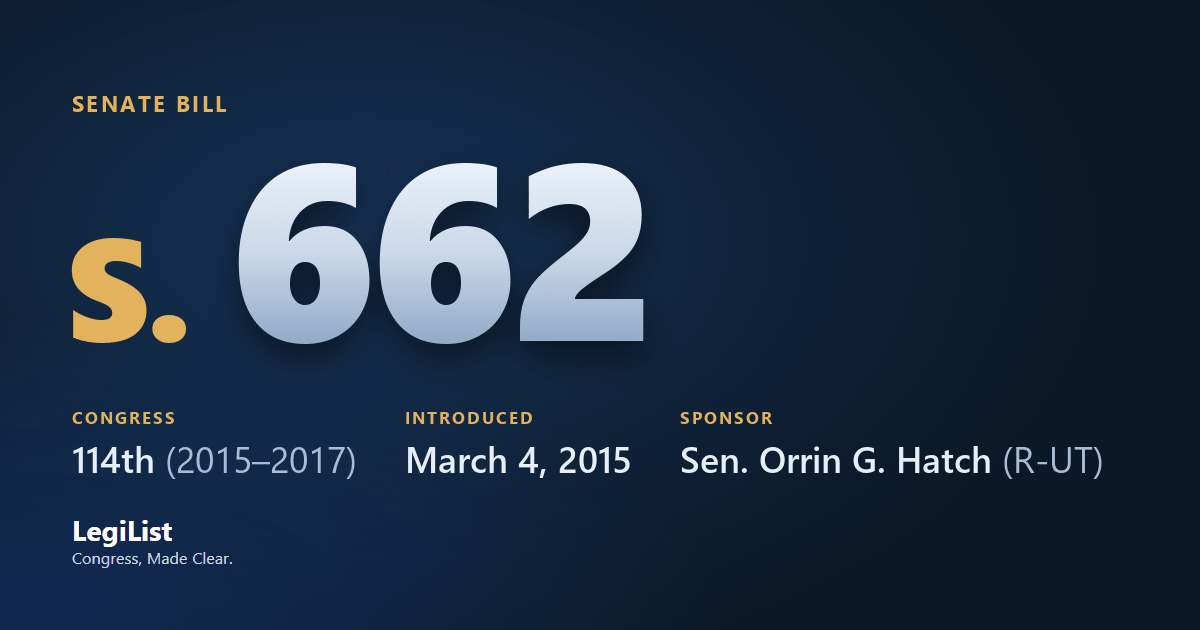
Songwriter Equity Act of 2015
Latest action · Mar 4, 2015 Read twice and referred to the Committee on the Judiciary.
Progress
Where this bill reached, and when. A stage with no date was not reached; one that failed a vote and later carried shows the date it carried.
- IntroducedMar 4, 2015
- Passed SenateNot reached
- Passed HouseNot reached
- To the PresidentNot reached
- Became lawNot reached
Summary
Songwriter Equity Act of 2015
Amends federal copyright law regarding the exclusive rights of sound recording copyright owners to remove a provision that prohibits license fees payable for the public performance of sound recordings, by means of a digital audio transmission, from being taken into account in any administrative, judicial, or other governmental proceeding to set or adjust the royalties payable to copyright owners of musical works for the public performance of their works.
Requires Copyright Royalty Judges (CRJs), when setting royalty rates under the compulsory license available for the reproduction and distribution of musical works (commonly referred to as a "mechanical license"), to establish rates and terms that most clearly represent the rates and terms that would have been negotiated in the marketplace between a willing buyer and seller.
Requires CRJs, in establishing such rates and terms, to base their decision on marketplace, economic, and use information presented by the participants. Allows consideration of comparable uses and circumstances under voluntary license agreements.
Cosponsors 5
Members who signed on, in the order they did. Signatures ran from Mar 4, 2015 to Sep 15, 2015; 3 are original cosponsors, there from the day it was introduced.
| Seat | Cosponsor | Signed on | |
|---|---|---|---|
| R-TN | Bob Corker | Original | Mar 4, 2015 |
| R-TN | Lamar Alexander | Original | Mar 4, 2015 |
| D-RI | Sheldon Whitehouse | Original | Mar 4, 2015 |
| D-CA | Barbara Boxer | Apr 14, 2015 | |
| R-GA | Johnny Isakson | Sep 15, 2015 |
Committees 1
Where it was sent and what each committee and subcommittee did with it, in order.
| Chamber | Committee | What it did |
|---|---|---|
| Senate | Judiciary Committee | Referred Mar 4, 2015 |
Actions 2
Everything that happened, newest first.
- Mar 4, 2015Introduced in Senate
- Mar 4, 2015Read twice and referred to the Committee on the Judiciary.
Research
What has been written about this bill: committee reports, cost estimates, the sponsor’s authority statement, printed hearings and the Congressional Research Service’s work.
Printed hearings 1
Hearings whose printed record names this bill, newest first: hearings on it, and wider hearings where it came up.
| Number | Hearing | Committee | Held |
|---|---|---|---|
| S. Hrg. 114-160 | PRESIDENT OBAMA'S 2015 TRADE POLICY AGENDA132 pages | Finance Committee | Jan 27, 2015 |
CRS reports 1
Congressional Research Service work that CRS links to this bill or the law it became, newest first.
Cite it 1
Products on other subjects that cite it, usually among other measures.
| Product | Title | Kind | Published |
|---|---|---|---|
| RL33631 | Copyright Licensing in Music Distribution, Reproduction, and Public Performance Archived | Report | Sep 22, 2015 |
Related bills 1
Companion bills and other measures the record links to this one.
| Bill | Title | Relationship | Latest action |
|---|---|---|---|
| HR 1283 | Songwriter Equity Act of 2015 | Identical bill | Mar 31, 2015 |
Titles 2
Every title it has carried, official and short, at each stage.
- Official Title as Introduced
- A bill to amend title 17, United States Code, to ensure fairness in the establishment of certain rates and fees under sections 114 and 115 of such title, and for other purposes.
- Short Titles as Introduced
- Songwriter Equity Act of 2015
Subjects
Assigned by the Library of Congress. Policy area: Commerce.
Text 1
Each version as it was printed, newest first.
- Mar 4, 2015Introduced in Senate
Everything here is as published by Congress: the summary is the Congressional Research Service's, the action wording is the clerks', and the subjects are the Library of Congress's. How far it got is read from the actions themselves, taking the most recent one of each kind, so a bill that failed a vote and later passed is shown as having passed. Records come from this bill on Congress.gov and govinfo.gov; cost estimates are the Congressional Budget Office's, and the hearings are the printed hearings GovInfo publishes, which can appear months after the hearing.