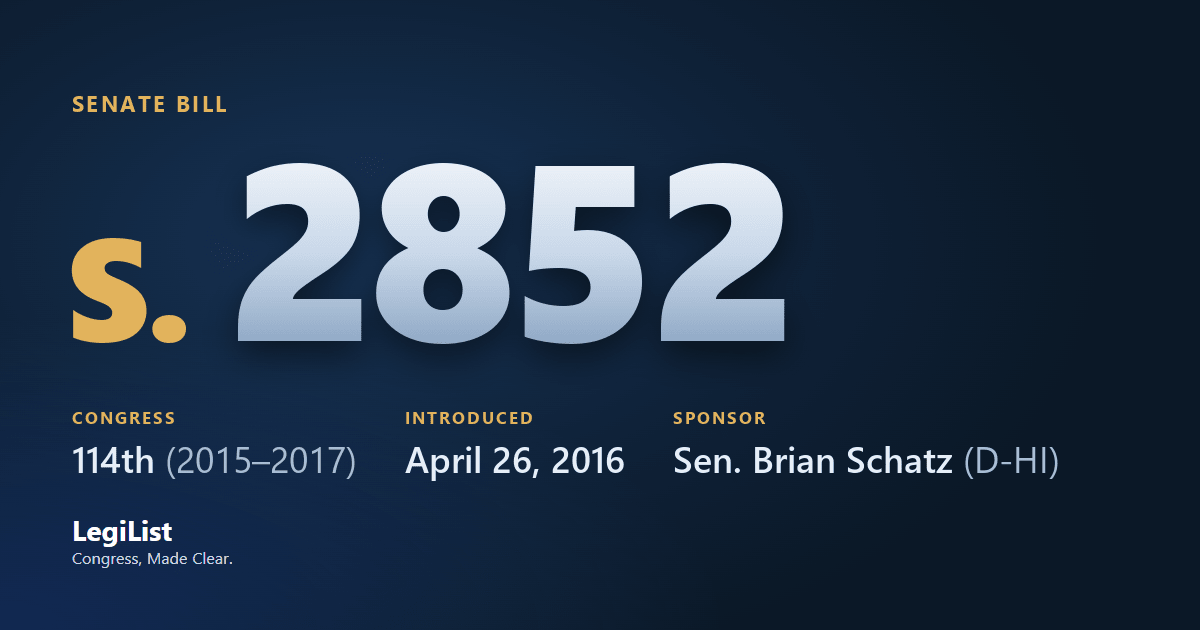
OPEN Government Data Act
Latest action · Dec 12, 2016 Held at the desk.
Progress
Where this bill reached, and when. A stage with no date was not reached; one that failed a vote and later carried shows the date it carried.
- IntroducedApr 26, 2016
- Passed SenateDec 10, 2016
- Passed HouseNot reached
- To the PresidentNot reached
- Became lawNot reached
Summary
Open, Public, Electronic, and Necessary Government Data Act or the OPEN Government Data Act
(Sec. 5) This bill requires government data assets made available by federal agencies to be published as machine-readable data. When not otherwise prohibited by law, and to the extent practicable, the data must be available: (1) in an open format that does not impede use or reuse and that has standards maintained by a standards organization; and (2) under open licenses with a legal guarantee that the data be available at no cost to the public with no restrictions on copying, publication, distribution, transmittal, citing, or adaptation.
These requirements do not apply to the Government Accountability Office (GAO), the Federal Election Commission, and certain other government entities.
If published government data assets are not available under an open license, the data must be considered part of the worldwide public domain. Agencies may engage with outside organizations and citizens to leverage public data assets for innovation in public and private sectors.
(Sec. 6) The Office of Management and Budget's (OMB's) Federal Chief Information Officer must coordinate with the Office of Information and Regulatory Affairs and the heads of other OMB offices to oversee and advise the OMB Director on federal information resources management policy.
The OMB must oversee the completeness and public availability of an "enterprise data inventory" that agencies must develop to account for any data assets that they create, collect, control, or maintain. The inventory must include: (1) data assets used in agency information systems, shared among agencies or across agency programs, or created by more than one agency; (2) an indication of data assets that can be made publicly available under the Freedom of Information Act; (3) a description of whether the agency has determined that an individual data asset may be made publicly available and whether it is currently publicly available; (4) nonpublic data assets; and (5) government data assets generated by applications, devices, networks, and equipment.
(Sec. 7) Agencies must: (1) make their enterprise data inventories available to the public on Data.gov; (2) use an open format when they create or obtain a new government data asset; and (3) consult with the OMB, the General Services Administration (GSA), and the National Archives and Records Administration to review their enterprise data inventories. For privacy, security, confidentiality, or regulatory reasons, agencies may maintain a nonpublic portion of their inventories.
Agencies must develop an open data plan as a part of their strategic information resources management plans to: (1) require new data collections to use an open format; (2) allow agencies to collaborate with nongovernment entities, researchers, businesses, and private citizens on data usage; and (3) designate a point of contact to assist the public and respond to complaints about adherence to open data requirements.
The OMB's Office of Electronic Government is renamed the Office of the Federal Chief Information Officer.
Agencies are not required to publish notices in the Federal Register about information collection that is focused on gathering input about the performance of, or public satisfaction with, the agency's service if the collection is: (1) online and electronic, (2) voluntary with no benefit to the provider of the information, and (3) an extremely low burden that is typically completed in five minutes or less. But agencies must publish representative summaries of such information collections.
The OMB must collaborate with the Office of Government Information Services and the GSA to develop an online repository of tools, best practices, and schema standards to facilitate the adoption of open data practices.
The OMB must report every two years on agency performance and compliance with this bill.
The GAO must report on the value of information made available to the public, whether public availability should be expanded to other data assets, and the completeness of each agency's enterprise data inventory.
(Sec. 8) The GSA must maintain a single public interface online as a point of entry dedicated to sharing open government data with the public.
(Sec. 9) Chief information officers are responsible for:
- data asset management, format standardization, the sharing and publication of data assets;
- the compilation and publication of the enterprise data inventory for their agency;
- conformity with open data practices;
- support for performance improvement officer functions;
- reduction of barriers that inhibit data asset accessibility;
- agencies' maximization of their own use of data to reduce costs, improve operations, and strengthen security and privacy protections; and
- identification of points of contact for roles and responsibilities related to open data use and implementation.
The Chief Information Officers Council must work with the Office of Government Information Services and the Office of Science and Technology Policy to promote data interoperability and comparability of data assets across the government.
(Sec. 10) Chief operating officers of agencies must report to Congress and the OMB with an assessment of the coverage, methods, effectiveness, and independence of their evaluation research and analysis efforts. The GAO must report on agency findings and make any appropriate recommendations to improve agency capacity to use evaluation techniques and data to support such efforts.
Cosponsors 2
Members who signed on, in the order they did. Signatures ran from Apr 26, 2016 to Jun 7, 2016; 1 is an original cosponsor, there from the day it was introduced.
| Seat | Cosponsor | Signed on | |
|---|---|---|---|
| R-NE | Ben Sasse | Original | Apr 26, 2016 |
| D-MI | Gary C. Peters | Jun 7, 2016 |
Committees 1
Where it was sent and what each committee and subcommittee did with it, in order.
| Chamber | Committee | What it did |
|---|---|---|
| Senate | Homeland Security and Governmental Affairs Committee | Referred Apr 26, 2016Markup May 25, 2016Reported Dec 8, 2016 |
Actions 9
Everything that happened, newest first.
- Dec 12, 2016Message on Senate action sent to the House.
- Dec 12, 2016Received in the House.
- Dec 12, 2016Held at the desk.
- Dec 10, 2016Passed/agreed to in Senate: Passed Senate with an amendment by Unanimous Consent. (consideration: CR S7132-7135; text of amendment in the nature of a substitute: CR S7132-7135)
- Dec 8, 2016Committee on Homeland Security and Governmental Affairs. Reported by Senator Johnson with an amendment in the nature of a substitute. With written report No. 114-396.
- Dec 8, 2016Placed on Senate Legislative Calendar under General Orders. Calendar No. 718.
- May 25, 2016Committee on Homeland Security and Governmental Affairs. Ordered to be reported with an amendment in the nature of a substitute favorably.
- Apr 26, 2016Introduced in Senate
- Apr 26, 2016Read twice and referred to the Committee on Homeland Security and Governmental Affairs.
In the Congressional Record 1
Days the Record’s own index lists this bill, newest first, with the pages and the members it names. Pages starting H are the House, S the Senate, E Extensions of Remarks.
| Where | In the Record | Members | Date |
|---|---|---|---|
| Senate | Debate and remarks S7132Text printed S7132–S7135 | Rob Portman R-OH | Dec 9, 2016 |
Research
What has been written about this bill: committee reports, cost estimates, the sponsor’s authority statement, printed hearings and the Congressional Research Service’s work.
Committee report
Congressional Budget Office cost estimate
- Dec 6, 2016S. 2852, OPEN Government Data ActAs ordered reported by the Senate Committee on Homeland Security and Governmental Affairs on May 25, 2016
CRS reports 1
Congressional Research Service work that CRS links to this bill or the law it became, newest first.
Cite it 1
Products on other subjects that cite it, usually among other measures.
| Product | Title | Kind | Published |
|---|---|---|---|
| R48954 | Data.gov: Implementation and Perspectives on Its Functions | Report | May 21, 2026 |
Related bills 1
Companion bills and other measures the record links to this one.
| Bill | Title | Relationship | Latest action |
|---|---|---|---|
| HR 5051 | OPEN Government Data Act | Identical bill | Apr 26, 2016 |
Titles 5
Every title it has carried, official and short, at each stage.
- Official Title as Introduced
- A bill to expand the Government's use and administration of data to facilitate transparency, effective governance, and innovation, and for other purposes.
- Short Titles as Introduced
- OPEN Government Data Act
- Open, Public, Electronic, and Necessary Government Data Act
- Short Titles as Passed Senate
- OPEN Government Data Act
- Open, Public, Electronic, and Necessary Government Data Act
Subjects
Assigned by the Library of Congress. Policy area: Government Operations and Politics.
- Administrative law and regulatory procedures
- Computers and information technology
- Congressional oversight
- Executive agency funding and structure
- Government information and archives
- Government Operations and Politics
- Government studies and investigations
- Internet and video services
- Internet, web applications, social media
- Office of Management and Budget (OMB)
- Performance measurement
- Public-private cooperation
Text 3
Each version as it was printed, newest first.
- Dec 10, 2016Engrossed in Senate
- Dec 8, 2016Reported to Senate
- Apr 26, 2016Introduced in Senate
Everything here is as published by Congress: the summary is the Congressional Research Service's, the action wording is the clerks', and the subjects are the Library of Congress's. How far it got is read from the actions themselves, taking the most recent one of each kind, so a bill that failed a vote and later passed is shown as having passed. Records come from this bill on Congress.gov and govinfo.gov; cost estimates are the Congressional Budget Office's, and the hearings are the printed hearings GovInfo publishes, which can appear months after the hearing.