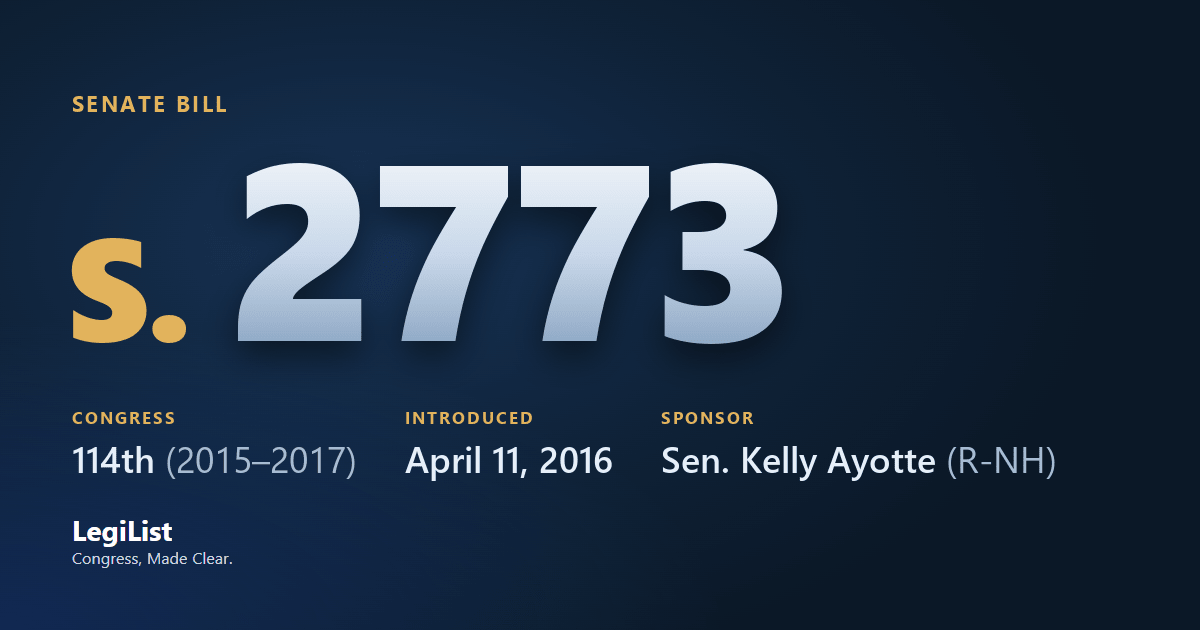
GAP Act
Latest action · Apr 11, 2016 Read twice and referred to the Committee on Health, Education, Labor, and Pensions.
Progress
Where this bill reached, and when. A stage with no date was not reached; one that failed a vote and later carried shows the date it carried.
- IntroducedApr 11, 2016
- Passed SenateNot reached
- Passed HouseNot reached
- To the PresidentNot reached
- Became lawNot reached
Summary
Gender Advancement in Pay Act or the GAP Act
This bill amends the Fair Labor Standards Act of 1938 to expand exceptions to the prohibition against sex discrimination to include payments pursuant to a differential based on expertise, shift, or a business-related factor other than sex, including but not limited to education, training, or experience.
The statute of limitations under the Portal-to-Portal Act of 1947 for a charge of prohibited sex discrimination, or an action by or on behalf of an employee for such discrimination, shall be tolled until the earlier of: (1) the date on which the Equal Employment Commission or the Department of Justice brings an action or notifies the employee concerned with respect to the charge under the Civil Rights Act of 1964, or (2) 270 days after the charge is filed.
Nonretaliation prohibitions are extended to cover inquiring about, discussing, or disclosing the wages of an employee or of another employee, or declining to discuss or disclose the employee's wages, with specified exceptions. An employer shall be considered to have committed an unlawful act if the employer requires an employee to sign a contract or waiver that would prohibit the employee from disclosing information about the employee's wages.
Civil penalties are established for violation of prohibitions against sex discrimination.
The Department of Labor, together with the Department of Education, shall conduct a multistate study, through a grant to a nonprofit research institution, that includes strategies to increase the participation of women in high-wage, high-demand occupations and industries in which women are underrepresented.
The Government Accountability Office shall also conduct a multistate study to develop such strategies.
Cosponsors 6
Members who signed on, in the order they did. Signatures ran from Apr 11, 2016 to Jun 8, 2016; 4 are original cosponsors, there from the day it was introduced.
| Seat | Cosponsor | Signed on | |
|---|---|---|---|
| R-NV | Dean Heller | Original | Apr 11, 2016 |
| R-NC | Richard Burr | Original | Apr 11, 2016 |
| R-OH | Rob Portman | Original | Apr 11, 2016 |
| R-WV | Shelley Moore Capito | Original | Apr 11, 2016 |
| R-AZ | John McCain | Jun 6, 2016 | |
| R-IL | Mark Kirk | Jun 8, 2016 |
Committees 1
Where it was sent and what each committee and subcommittee did with it, in order.
| Chamber | Committee | What it did |
|---|---|---|
| Senate | Health, Education, Labor, and Pensions Committee | Referred Apr 11, 2016 |
Actions 2
Everything that happened, newest first.
- Apr 11, 2016Introduced in Senate
- Apr 11, 2016Read twice and referred to the Committee on Health, Education, Labor, and Pensions.
Related bills 2
Companion bills and other measures the record links to this one.
| Bill | Title | Relationship | Latest action |
|---|---|---|---|
| S 2070 | GAP Act | Related bill | Sep 22, 2015 |
| HR 5237 | Workplace Advancement Act | Related bill | Sep 19, 2016 |
Titles 3
Every title it has carried, official and short, at each stage.
- Official Title as Introduced
- A bill to amend the Fair Labor Standards Act of 1938 to provide more effective remedies to victims of discrimination in the payment of wages on the basis of sex, and for other purposes.
- Short Titles as Introduced
- GAP Act
- Gender Advancement in Pay Act
Subjects
Assigned by the Library of Congress. Policy area: Labor and Employment.
Text 1
Each version as it was printed, newest first.
- Apr 11, 2016Introduced in Senate
Everything here is as published by Congress: the summary is the Congressional Research Service's, the action wording is the clerks', and the subjects are the Library of Congress's. How far it got is read from the actions themselves, taking the most recent one of each kind, so a bill that failed a vote and later passed is shown as having passed. Records come from this bill on Congress.gov and govinfo.gov; cost estimates are the Congressional Budget Office's, and the hearings are the printed hearings GovInfo publishes, which can appear months after the hearing.