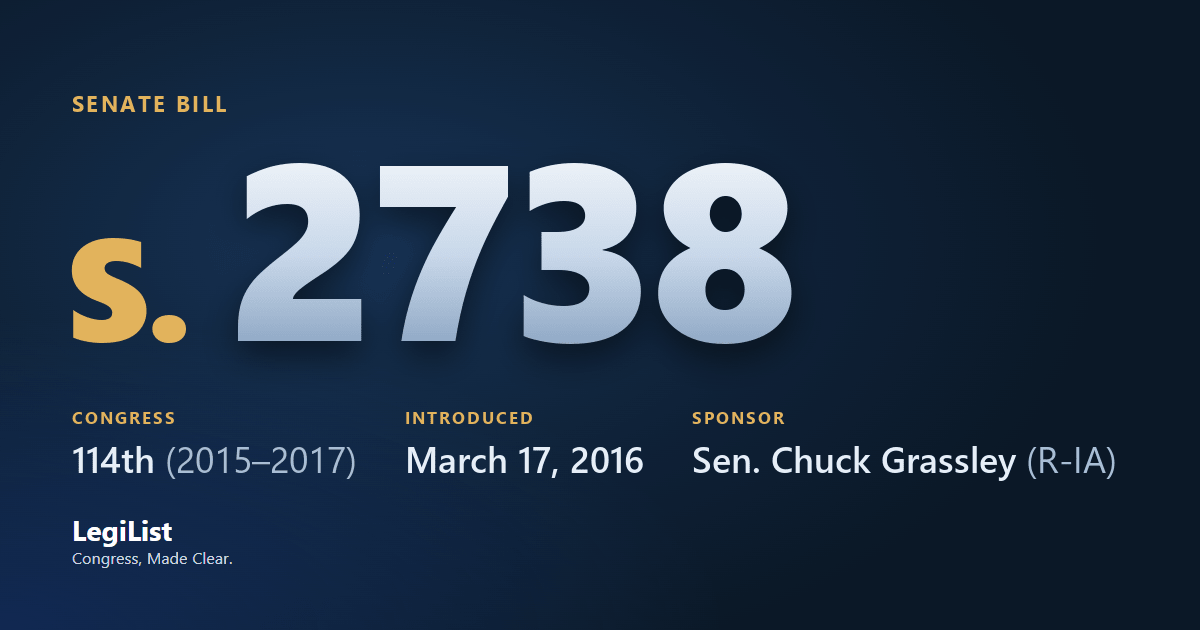
Political Intelligence Transparency Act of 2016
Latest action · Mar 17, 2016 Read twice and referred to the Committee on Homeland Security and Governmental Affairs.
Progress
Where this bill reached, and when. A stage with no date was not reached; one that failed a vote and later carried shows the date it carried.
- IntroducedMar 17, 2016
- Passed SenateNot reached
- Passed HouseNot reached
- To the PresidentNot reached
- Became lawNot reached
Summary
Political Intelligence Transparency Act of 2016
This bill amends the Lobbying Disclosure Act of 1995 (LDA) to require the disclosure of political intelligence activities, particularly relating to information useful for analyzing securities or commodities markets.
Political intelligence consultants or their employing organizations must register with the Secretary of the Senate and the Clerk of the House of Representatives and make quarterly reports on political intelligence activities. The bill exempts from such requirements an individual whose combined political intelligence and lobbying activities constitute less than 20% of the time engaged in such services to a client over a three-month period.
Persons or entities that make an oral or written political intelligence contact with a covered legislative branch or executive branch official must, on the official's request: (1) state whether such person or entity is registered under the LDA, (2) identify the client on behalf of whom the contact is made, and (3) state whether such client is a foreign entity and make any related disclosures.
The federal criminal code is amended to subject to a fine and/or imprisonment certain former officers, employees, and elected officials of the executive and legislative branches who knowingly make any communication to, or appearance before, any officer or employee of a federal or District of Columbia agency or court in violation of certain permanent or temporary restrictions and with the intent to gain information for use in: (1) analyzing securities or commodities markets, or (2) informing investment decisions in those markets.
The bill excludes from such prohibition any communication made by a representative of a media organization to gather and disseminate news and information to the public.
Cosponsors 1
Members who signed on, in the order they did. All signed on Apr 4, 2016.
| Seat | Cosponsor | Signed on | |
|---|---|---|---|
| D-NY | Kirsten E. Gillibrand | Apr 4, 2016 |
Committees 1
Where it was sent and what each committee and subcommittee did with it, in order.
| Chamber | Committee | What it did |
|---|---|---|
| Senate | Homeland Security and Governmental Affairs Committee | Referred Mar 17, 2016 |
Actions 2
Everything that happened, newest first.
- Mar 17, 2016Introduced in Senate
- Mar 17, 2016Read twice and referred to the Committee on Homeland Security and Governmental Affairs.
Related bills 1
Companion bills and other measures the record links to this one.
| Bill | Title | Relationship | Latest action |
|---|---|---|---|
| HR 4809 | Political Intelligence Transparency Act of 2016 | Related bill | Apr 1, 2016 |
Titles 2
Every title it has carried, official and short, at each stage.
- Official Title as Introduced
- A bill to amend the Lobbying Disclosure Act of 1995 to require the disclosure of political intelligence activities, to amend title 18, United States Code, to provide for restrictions on former officers, employees, and elected officials of the executive and legislative branches regarding political intelligence contacts, and for other purposes.
- Short Titles as Introduced
- Political Intelligence Transparency Act of 2016
Subjects
Assigned by the Library of Congress. Policy area: Government Operations and Politics.
- Commodities markets
- Congressional operations and organization
- Federal officials
- Financial services and investments
- Government employee pay, benefits, personnel management
- Government ethics and transparency, public corruption
- Government information and archives
- Government Operations and Politics
- Licensing and registrations
- Members of Congress
- Public participation and lobbying
- Securities
Text 1
Each version as it was printed, newest first.
- Mar 17, 2016Introduced in Senate
Support LegiList
This page is free, carries no paywall, and is built and maintained by one person. If the record here is useful to you, a few dollars keeps it going.
Everything here is as published by Congress: the summary is the Congressional Research Service's, the action wording is the clerks', and the subjects are the Library of Congress's. How far it got is read from the actions themselves, taking the most recent one of each kind, so a bill that failed a vote and later passed is shown as having passed. Records come from this bill on Congress.gov and govinfo.gov; cost estimates are the Congressional Budget Office's, and the hearings are the printed hearings GovInfo publishes, which can appear months after the hearing.