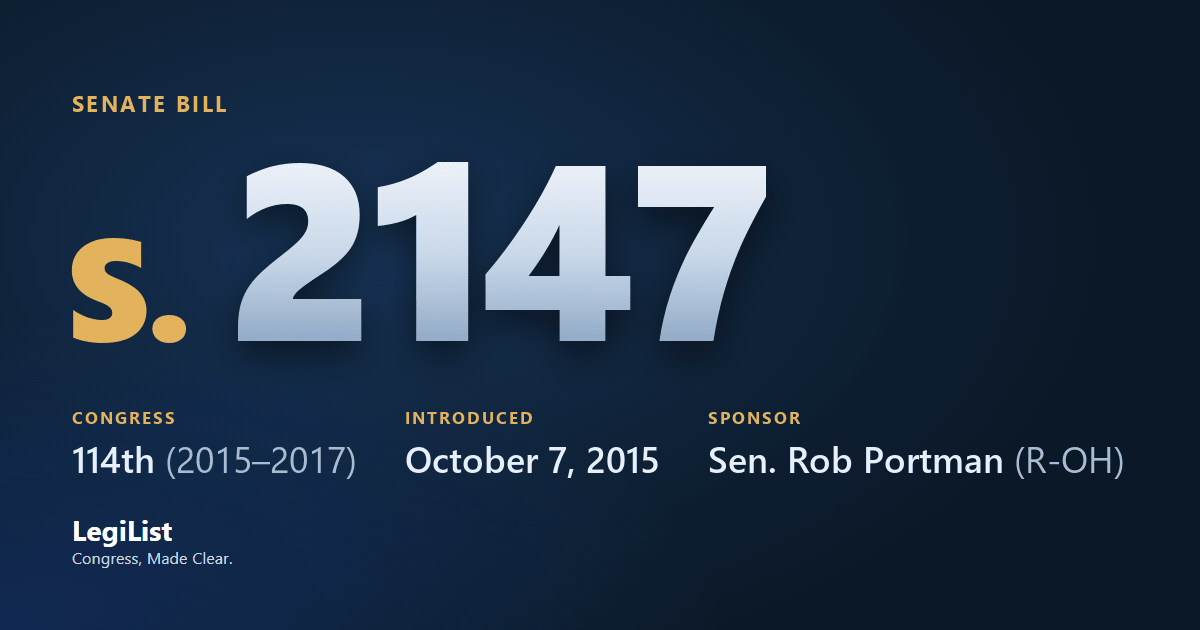
Pension Accountability Act
Latest action · Oct 7, 2015 Read twice and referred to the Committee on Health, Education, Labor, and Pensions.
Progress
Where this bill reached, and when. A stage with no date was not reached; one that failed a vote and later carried shows the date it carried.
- IntroducedOct 7, 2015
- Passed SenateNot reached
- Passed HouseNot reached
- To the PresidentNot reached
- Became lawNot reached
Summary
Pension Accountability Act
This bill amends the Employee Retirement Income Security Act of 1974 (ERISA) and the Internal Revenue Code to revise rules for voting on the suspension of pension benefits under multiemployer plans in endangered or critical status. The bill changes the voting procedure for suspending plan benefits to provide that a suspension shall go into effect unless a majority of plan participants and beneficiaries who cast a vote (currently, a majority of all plan participants and beneficiaries) reject the suspension. The bill also eliminates the authority of the Department of the Treasury, in the case of systemically important plans, to override a vote of plan participants to reject a suspension. A plan is systemically important if projected financial assistance to the plan will exceed $1 billion if suspensions are not implemented.
Cosponsors 4
Members who signed on, in the order they did. Signatures ran from Oct 7, 2015 to Apr 18, 2016; 1 is an original cosponsor, there from the day it was introduced.
| Seat | Cosponsor | Signed on | |
|---|---|---|---|
| R-NC | Richard Burr | Original | Oct 7, 2015 |
| R-NE | Deb Fischer | Nov 10, 2015 | |
| R-ND | John Hoeven | Mar 9, 2016 | |
| R-IL | Mark Kirk | Apr 18, 2016 |
Committees 1
Where it was sent and what each committee and subcommittee did with it, in order.
| Chamber | Committee | What it did |
|---|---|---|
| Senate | Health, Education, Labor, and Pensions Committee | Referred Oct 7, 2015 |
Actions 2
Everything that happened, newest first.
- Oct 7, 2015Introduced in Senate
- Oct 7, 2015Read twice and referred to the Committee on Health, Education, Labor, and Pensions.
In the Congressional Record 1
Days the Record’s own index lists this bill, newest first, with the pages and the members it names. Pages starting H are the House, S the Senate, E Extensions of Remarks.
| Where | In the Record | Members | Date |
|---|---|---|---|
| Senate | Debate and remarks S2521 | Rob Portman R-OH | Apr 28, 2016 |
Research
What has been written about this bill: committee reports, cost estimates, the sponsor’s authority statement, printed hearings and the Congressional Research Service’s work.
Printed hearings 1
Hearings whose printed record names this bill, newest first: hearings on it, and wider hearings where it came up.
| Number | Hearing | Committee | Held |
|---|---|---|---|
| S. Hrg. 114-541 | THE MULTIEMPLOYER PENSION PLAN SYSTEM: RECENT REFORMS AND CURRENT CHALLENGES117 pages | Finance Committee | Mar 1, 2016 |
CRS reports 1
Congressional Research Service work that CRS links to this bill or the law it became, newest first.
Cite it 1
Products on other subjects that cite it, usually among other measures.
| Product | Title | Kind | Published |
|---|---|---|---|
| R44355 | Benefit Reductions in the Central States Multiemployer DB Pension Plan: Frequently Asked Questions Archived | Report | Jan 28, 2016 |
Related bills 2
Companion bills and other measures the record links to this one.
| Bill | Title | Relationship | Latest action |
|---|---|---|---|
| S 489 | Pension Accountability Act | Reintroduced Bill | Mar 2, 2017 |
| HR 4029 | Pension Accountability Act | Identical bill | Mar 23, 2016 |
Titles 2
Every title it has carried, official and short, at each stage.
- Official Title as Introduced
- A bill to amend the Employee Retirement Income Security Act of 1974 and the Internal Revenue Code of 1986 with respect to participant votes on the suspension of benefits under multiemployer plans in critical and declining status.
- Short Titles as Introduced
- Pension Accountability Act
Subjects
Assigned by the Library of Congress. Policy area: Labor and Employment.
Text 1
Each version as it was printed, newest first.
- Oct 7, 2015Introduced in Senate
Support LegiList
This page is free, carries no paywall, and is built and maintained by one person. If the record here is useful to you, a few dollars keeps it going.
Everything here is as published by Congress: the summary is the Congressional Research Service's, the action wording is the clerks', and the subjects are the Library of Congress's. How far it got is read from the actions themselves, taking the most recent one of each kind, so a bill that failed a vote and later passed is shown as having passed. Records come from this bill on Congress.gov and govinfo.gov; cost estimates are the Congressional Budget Office's, and the hearings are the printed hearings GovInfo publishes, which can appear months after the hearing.