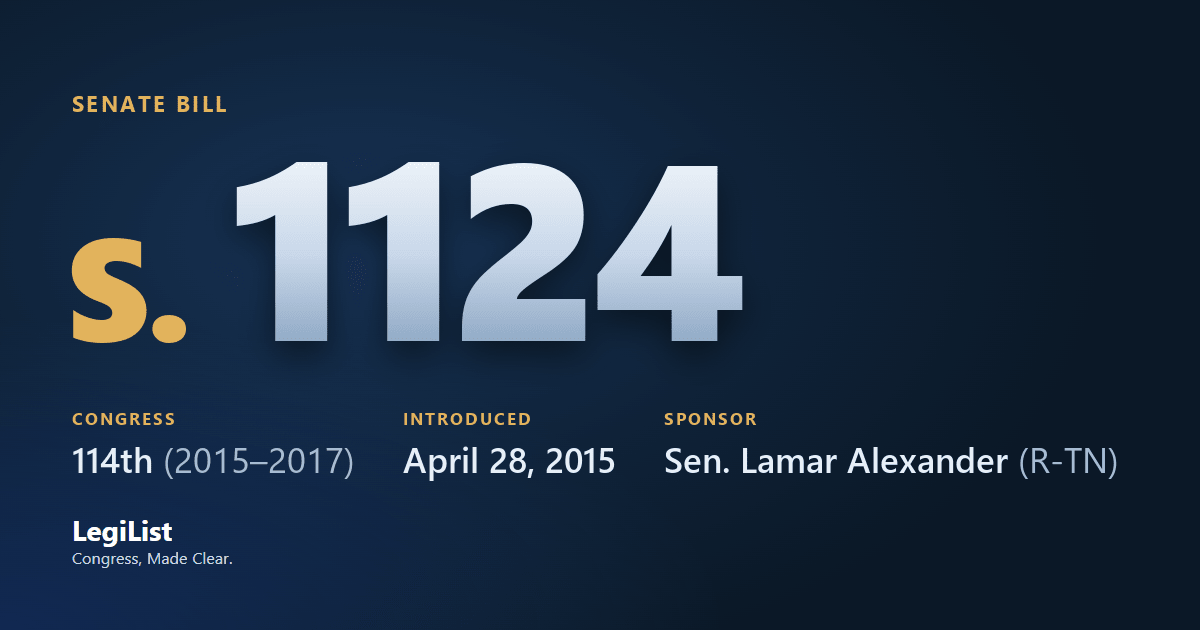
WIOA Technical Amendments Act
Latest action · May 22, 2015 Became Public Law No: 114-18.
Progress
Where this bill reached, and when. A stage with no date was not reached; one that failed a vote and later carried shows the date it carried.
- IntroducedApr 28, 2015
- Passed SenateMay 6, 2015
- Passed HouseMay 12, 2015
- To the PresidentMay 14, 2015
- Became lawMay 22, 2015Public Law 114-18
Summary
(This measure has not been amended since it was passed by the Senate on May 6, 2015. The summary of that version is repeated here.)
WIOA Technical Amendments Act
(Sec. 2) This bill amends the Workforce Innovation and Opportunity Act (WIOA) to revise requirements for local workforce development areas involved in statewide workforce investment activities as well as youth, adult, and dislocated worker employment and training activities.
The governor of a state may approve a request for local workforce development area designation of any area served by a rural concentrated employment program.
Local workforce development boards requirements are revised.
A state may use as an alternative workforce development board only a local entity (including a local council, regional workforce development board, or similar entity) that was in existence the day before enactment of the Workforce Investment Act of 1998. Currently such an alternative local entity is eligible for designation as a local workforce development board if it has been in existence as late as the day before the enactment of the WIOA on July 22, 2014.
Certain technical amendments are made to performance accountability requirements for statewide and local workforce investment programs.
The Department of Labor shall ensure that states receive an allotment for a fiscal year for adult employment and training activities and for dislocated worker employment and training activities and statewide workforce investment activities equal to at least 90% of the state's allotment for the preceding fiscal year.
(Sec. 3) This bill also amends the Rehabilitation Act of 1973 with respect to the terms of service requirements for members of the National Council on Disability, making them (unchanged in detail) effective only as of July 21, 2014.
Cosponsors
Members who signed on, in the order they did.
Committees 2
Where it was sent and what each committee and subcommittee did with it, in order.
| Chamber | Committee | What it did |
|---|---|---|
| Senate | Health, Education, Labor, and Pensions Committee | Reported as an original measure Apr 28, 2015 |
| House | Education and Workforce Committee | Referred May 8, 2015Discharged May 12, 2015 |
Actions 17
Everything that happened, newest first.
- May 22, 2015Signed by President.
- May 22, 2015Became Public Law No: 114-18.
- May 14, 2015Presented to President.
- May 12, 2015Ms. Foxx asked unanimous consent to discharge from committee and consider. (consideration: CR H2855)
- May 12, 2015Committee on Education and the Workforce discharged.(consideration: CR H2855)
- May 12, 2015Committee on Education and the Workforce discharged. (consideration: CR H2855)
- May 12, 2015Considered by unanimous consent. (consideration: CR H2855)
- May 12, 2015Passed/agreed to in House: On passage Passed without objection. (text: CR H2855)
- May 12, 2015Motion to reconsider laid on the table Agreed to without objection.
- May 8, 2015Received in the House.
- May 8, 2015Referred to the House Committee on Education and the Workforce.
- May 7, 2015Message on Senate action sent to the House.
- May 6, 2015Measure laid before Senate by unanimous consent. (consideration: CR S2696)
- May 6, 2015Passed/agreed to in Senate: Passed Senate with an amendment by Unanimous Consent.
- Apr 28, 2015Introduced in Senate
- Apr 28, 2015Committee on Health, Education, Labor, and Pensions. Original measure reported to Senate by Senator Alexander. Without written report.
- Apr 28, 2015Placed on Senate Legislative Calendar under General Orders. Calendar No. 61.
In the Congressional Record 2
Days the Record’s own index lists this bill, newest first, with the pages and the members it names. Pages starting H are the House, S the Senate, E Extensions of Remarks.
| Where | In the Record | Members | Date |
|---|---|---|---|
| House | Debate and remarks H2855Text printed H2855 | Virginia Foxx R-NC | May 12, 2015 |
| Senate | Debate and remarks S2696Amendments S2695, S2696 | James M. Inhofe R-OK, Lamar Alexander R-TN (amendment), Patty Murray D-WA (amendment) | May 6, 2015 |
Amendments 1
Amendments offered to this bill.
| Amendment | Description | Offered by | Status |
|---|---|---|---|
| SA 1215 | In the nature of a substitute. | Lamar Alexander R-TNfor James M. Inhofe | Amendment SA 1215 agreed to in Senate by Unanimous Consent. |
Related bills 1
Companion bills and other measures the record links to this one.
| Bill | Title | Relationship | Latest action |
|---|---|---|---|
| S 1031 | WIOA Technical Amendments Act | Identical bill | Apr 21, 2015 |
Titles 6
Every title it has carried, official and short, at each stage.
- Official Title as Introduced
- An original bill to amend the Workforce Innovation and Opportunity Act to improve the Act.
- Short Titles as Introduced
- WIOA Technical Amendments Act
- Short Titles as Reported to Senate
- WIOA Technical Amendments Act
- Short Titles as Passed House
- WIOA Technical Amendments Act
- Short Titles as Passed Senate
- WIOA Technical Amendments Act
- Short Titles as Enacted
- WIOA Technical Amendments Act
Subjects
Assigned by the Library of Congress. Policy area: Labor and Employment.
Text 4
Each version as it was printed, newest first.
- —Enrolled Bill
- May 8, 2015Referred in House
- May 6, 2015Engrossed in Senate
- Apr 28, 2015Placed on Calendar Senate
Everything here is as published by Congress: the summary is the Congressional Research Service's, the action wording is the clerks', and the subjects are the Library of Congress's. How far it got is read from the actions themselves, taking the most recent one of each kind, so a bill that failed a vote and later passed is shown as having passed. Records come from this bill on Congress.gov and govinfo.gov; cost estimates are the Congressional Budget Office's, and the hearings are the printed hearings GovInfo publishes, which can appear months after the hearing.