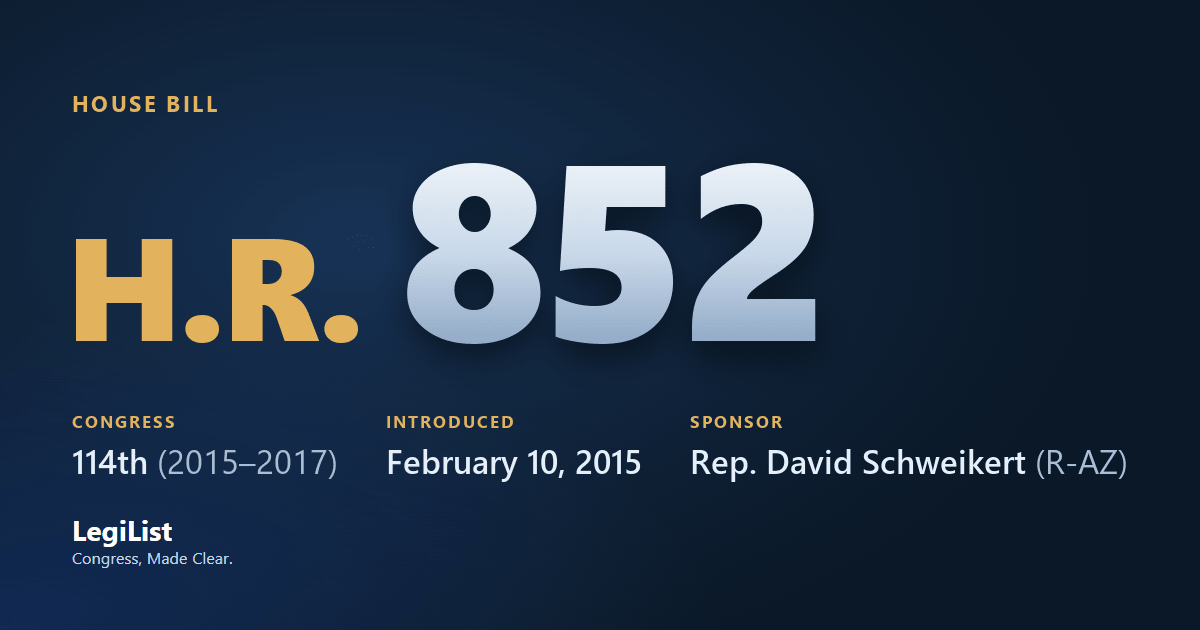
TIPS Act of 2015
Latest action · Feb 13, 2015 Referred to the Subcommittee on Health.
Progress
Where this bill reached, and when. A stage with no date was not reached; one that failed a vote and later carried shows the date it carried.
- IntroducedFeb 10, 2015
- Passed HouseNot reached
- Passed SenateNot reached
- To the PresidentNot reached
- Became lawNot reached
Summary
Transparency in Phone Solicitation Act of 2015 or the TIPS Act of 2015
Amends the Communications Act of 1934 to prohibit businesses, entities, or individuals from making live telephone solicitations unless the solicitor: (1) states the solicitor's identity, telephone number, and address; (2) states the address of a website that the called party may use to indicate that such party does not wish to receive calls from that solicitor; (3) transmits caller identification information, including a telephone number that the called party may use to return the call directly to such solicitor; and (4) releases the called party's line within five seconds after being notified that the called party has hung up to allow the called party to make or receive other calls.
Revises standards applicable to telephone transmissions of artificial or prerecorded voice messages to add comparable procedures requiring any such messages to: (1) state the telephone number and address (currently, telephone number or address) of the calling entity, (2) state the address of a website that the called party may use to indicate that such party does not wish to receive calls from that entity, and (3) transmit caller identification information. Retains the current law requirement that artificial or prerecorded messages must release the line within five seconds after the called party has hung up.
Cosponsors 2
Members who signed on, in the order they did. Signatures ran from Mar 16, 2015 to Mar 17, 2015.
| Seat | Cosponsor | Signed on | |
|---|---|---|---|
| R-TN | John J. Duncan, Jr. | Mar 16, 2015 | |
| R-NJ | Leonard Lance | Mar 17, 2015 |
Committees 1
Where it was sent and what each committee and subcommittee did with it, in order.
| Chamber | Committee | What it did |
|---|---|---|
| House | Energy and Commerce Committee | Referred Feb 10, 2015 |
| Health Subcommittee | Referred Feb 13, 2015 |
Actions 3
Everything that happened, newest first.
- Feb 13, 2015Referred to the Subcommittee on Health.
- Feb 10, 2015Introduced in House
- Feb 10, 2015Referred to the House Committee on Energy and Commerce.
Research
What has been written about this bill: committee reports, cost estimates, the sponsor’s authority statement, printed hearings and the Congressional Research Service’s work.
Constitutional authority
The sponsor’s statement, as printed in the Congressional Record, vol. 161, no. 22, February 10, 2015, page H918.
Titles 3
Every title it has carried, official and short, at each stage.
- Official Title as Introduced
- To amend the Communications Act of 1934 to provide for additional technical and procedural standards for artificial or prerecorded voice telephone messages and the establishment of such standards for live telephone solicitations.
- Short Titles as Introduced
- TIPS Act of 2015
- Transparency in Phone Solicitation Act of 2015
Subjects
Assigned by the Library of Congress. Policy area: Science, Technology, Communications.
Text 1
Each version as it was printed, newest first.
- Feb 10, 2015Introduced in House
Support LegiList
This page is free, carries no paywall, and is built and maintained by one person. If the record here is useful to you, a few dollars keeps it going.
Everything here is as published by Congress: the summary is the Congressional Research Service's, the action wording is the clerks', and the subjects are the Library of Congress's. How far it got is read from the actions themselves, taking the most recent one of each kind, so a bill that failed a vote and later passed is shown as having passed. Records come from this bill on Congress.gov and govinfo.gov; cost estimates are the Congressional Budget Office's, and the hearings are the printed hearings GovInfo publishes, which can appear months after the hearing.