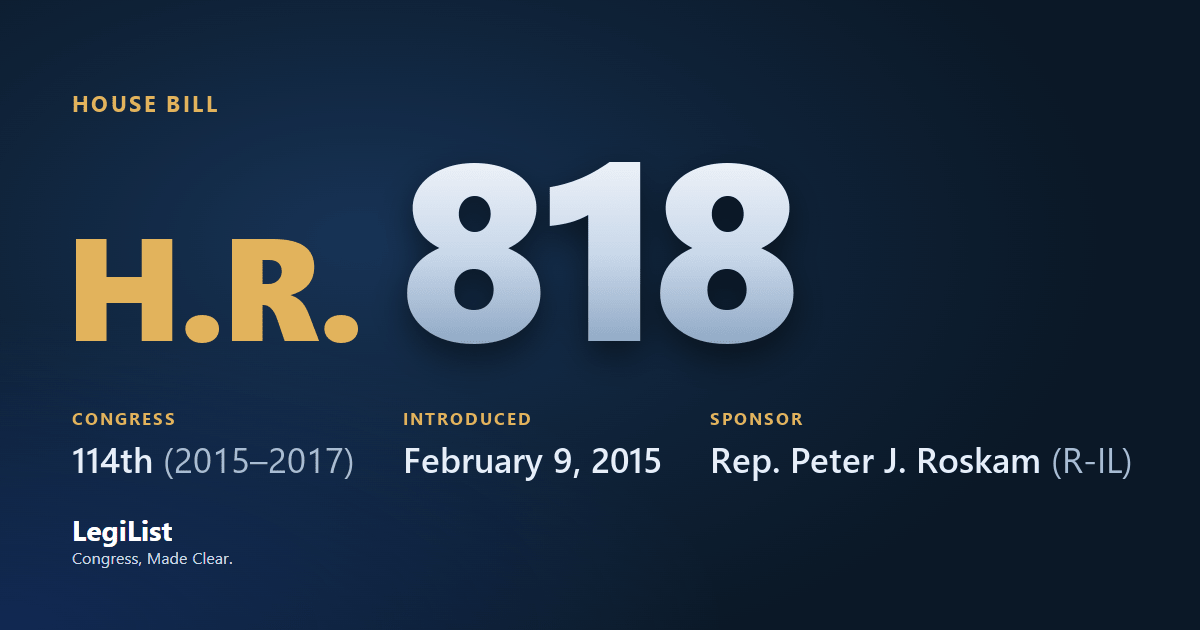
PRIME Act of 2015
Latest action · Feb 27, 2015 Referred to the Subcommittee on Health.
Progress
Where this bill reached, and when. A stage with no date was not reached; one that failed a vote and later carried shows the date it carried.
- IntroducedFeb 9, 2015
- Passed HouseNot reached
- Passed SenateNot reached
- To the PresidentNot reached
- Became lawNot reached
Summary
Preventing and Reducing Improper Medicare and Medicaid Expenditures Act of 2015 or the PRIME Act of 2015
Amends part D (Prescription Drug Benefits) of title XVIII (Medicare) of the Social Security Act (SSAct) to direct the Secretary of Health and Human Services (HHS) to prohibit sponsors of prescription drug plans from paying claims for prescription drugs that do not include the valid National Provider Identifier for the drug's prescriber.
Requires the Secretary's annual report to Congress on the use of recovery audit contractors under the Medicare Integrity Program to: (1) describe the types and financial cost of improper payment vulnerabilities identified by recovery audit contractors and how the Secretary is addressing them, and (2) assess the effectiveness of changes made to Medicare payment policies and procedures in order to address those vulnerabilities.
Requires the Secretary to address improper payment vulnerabilities in a timely manner, prioritized based on the risk to the Medicare program.
Authorizes the Secretary, under recovery audit contracts under both Medicare and Medicaid (SSAct title XIX), to retain a certain portion of the recovered amounts for a program management account for activities addressing problems that contribute to improper payments and fraud.
Requires the Secretary, under such contracts, to retain an additional 5% of the recovered amounts to be made available to the HHS Inspector General to investigate improper payments or audit internal controls associated with Medicare or Medicaid payments.
Directs the Secretary to develop a plan to revise the incentive program under the Health Insurance Portability and Accountability Act of 1996 for the reporting of fraud and abuse to encourage greater participation by individuals reporting Medicare fraud and abuse. Requires the plan to include certain recommendations for: (1) ways to enhance rewards for individuals reporting, and (2) extension of the incentive program to the Medicaid program.
Amends SSAct title XIX to cover the costs of equipment, salaries and benefits, and travel and training in appropriations for the Medicaid Integrity Program. Allows the Secretary to increase Centers for Medicare and Medicaid Services (CMS) staff whose duties consist solely of protecting the integrity of the Medicare program by a number determined necessary to carry out the Program (currently, by 100).
Directs the Secretary to provide incentives for Medicare administrative contractors to reduce the improper payment error rates in their jurisdictions.
Requires imprisonment for up to 10 years or a fine of up to $500,000 ($1 million in the case of a corporation), or both, for knowingly, intentionally, and with the intent to defraud purchasing, selling, distributing, or arranging for the purchase, sale, or distribution of a Medicare, Medicaid, or CHIP beneficiary identification number or billing privileges under SSAct titles XVIII, title XIX, or title XXI (Children's Health Insurance Program) (CHIP).
Amends SSAct title IV part D (Child Support and Establishment of Paternity) with respect to the Federal Parent Locator Service to give the CMS Administrator access to information in the National Directory of New Hires to determine the eligibility of an applicant for, or enrollee in, the Medicare program or an applicable state health subsidy program under the Patient Protection and Affordable Care Act (PPACA).
Requires the Secretary to disclose to the HHS Inspector General information on individuals and their employers in the National Directory of New Hires if the HHS Inspector General gives the Secretary their names and Social Security account numbers. Restricts the use of such information to: (1) determining the eligibility of an applicant for, or enrollee in, the Medicare program or an applicable state health subsidy program; or (2) evaluating the integrity of such programs. Sets forth rules for the use and disclosure of such information by state agencies.
Directs the Secretary to establish a plan to encourage and facilitate the participation of states in the Medicare-Medicaid Data Match Program (Medi-Medi Program). Revises Medi-Medi Data Match Program purposes.
Amends SSAct title XIX, as amended by PPACA, and SSAct XXI with respect to claims processing and detection of fraud within the Medicaid and CHIP programs.
Cosponsors 48
Members who signed on, in the order they did. Signatures ran from Feb 9, 2015 to Sep 11, 2015; 23 are original cosponsors, there from the day it was introduced.
| Seat | Cosponsor | Signed on | |
|---|---|---|---|
| D-CA | Ami Bera | Original | Feb 9, 2015 |
| R-FL | Carlos Curbelo | Original | Feb 9, 2015 |
| D-MD | Chris Van Hollen | Original | Feb 9, 2015 |
| D-IL | Daniel Lipinski | Original | Feb 9, 2015 |
| R-OH | David P. Joyce | Original | Feb 9, 2015 |
| R-TN | Diane Black | Original | Feb 9, 2015 |
| D-OR | Earl Blumenauer | Original | Feb 9, 2015 |
| D-CO | Ed Perlmutter | Original | Feb 9, 2015 |
| R-FL | Ileana Ros-Lehtinen | Original | Feb 9, 2015 |
| D-CT | James A. Himes | Original | Feb 9, 2015 |
| R-OH | James B. Renacci | Original | Feb 9, 2015 |
| D-TN | Jim Cooper | Original | Feb 9, 2015 |
| D-DE | John C. Carney, Jr. | Original | Feb 9, 2015 |
| D-MD | John K. Delaney | Original | Feb 9, 2015 |
| D-PA | Matt Cartwright | Original | Feb 9, 2015 |
Committees 2
Where it was sent and what each committee and subcommittee did with it, in order.
| Chamber | Committee | What it did |
|---|---|---|
| House | Energy and Commerce Committee | Referred Feb 9, 2015 |
| Health Subcommittee | Referred Feb 13, 2015 | |
| House | Ways and Means Committee | Referred Feb 9, 2015 |
| Health Subcommittee | Referred Feb 27, 2015 |
Actions 4
Everything that happened, newest first.
- Feb 27, 2015Referred to the Subcommittee on Health.
- Feb 13, 2015Referred to the Subcommittee on Health.
- Feb 9, 2015Introduced in House
- Feb 9, 2015Referred to the Committee on Energy and Commerce, and in addition to the Committee on Ways and Means, for a period to be subsequently determined by the Speaker, in each case for consideration of such provisions as fall within the jurisdiction of the committee concerned.
Research
What has been written about this bill: committee reports, cost estimates, the sponsor’s authority statement, printed hearings and the Congressional Research Service’s work.
Constitutional authority
The sponsor’s statement, as printed in the Congressional Record, vol. 161, no. 21, February 9, 2015, page H867.
Related bills 2
Companion bills and other measures the record links to this one.
| Bill | Title | Relationship | Latest action |
|---|---|---|---|
| S 861 | PRIME Act of 2015 | Related bill | Jul 30, 2015 |
| HR 3718 | Preventing and Reducing Improper Medicare and Medicaid Expenditures to Restore Integrity to Benefits Act of 2015 | Related bill | Oct 9, 2015 |
Titles 3
Every title it has carried, official and short, at each stage.
- Official Title as Introduced
- To amend titles XVIII and XIX of the Social Security Act to curb waste, fraud, and abuse in the Medicare and Medicaid programs.
- Short Titles as Introduced
- PRIME Act of 2015
- Preventing and Reducing Improper Medicare and Medicaid Expenditures Act of 2015
Subjects
Assigned by the Library of Congress. Policy area: Health.
- Accounting and auditing
- Child health
- Employee hiring
- Fraud offenses and financial crimes
- Government information and archives
- Government studies and investigations
- Health
- Health care costs and insurance
- Health programs administration and funding
- Medicaid
- Medicare
- Prescription drugs
- Public contracts and procurement
Text 1
Each version as it was printed, newest first.
- Feb 9, 2015Introduced in House
Everything here is as published by Congress: the summary is the Congressional Research Service's, the action wording is the clerks', and the subjects are the Library of Congress's. How far it got is read from the actions themselves, taking the most recent one of each kind, so a bill that failed a vote and later passed is shown as having passed. Records come from this bill on Congress.gov and govinfo.gov; cost estimates are the Congressional Budget Office's, and the hearings are the printed hearings GovInfo publishes, which can appear months after the hearing.