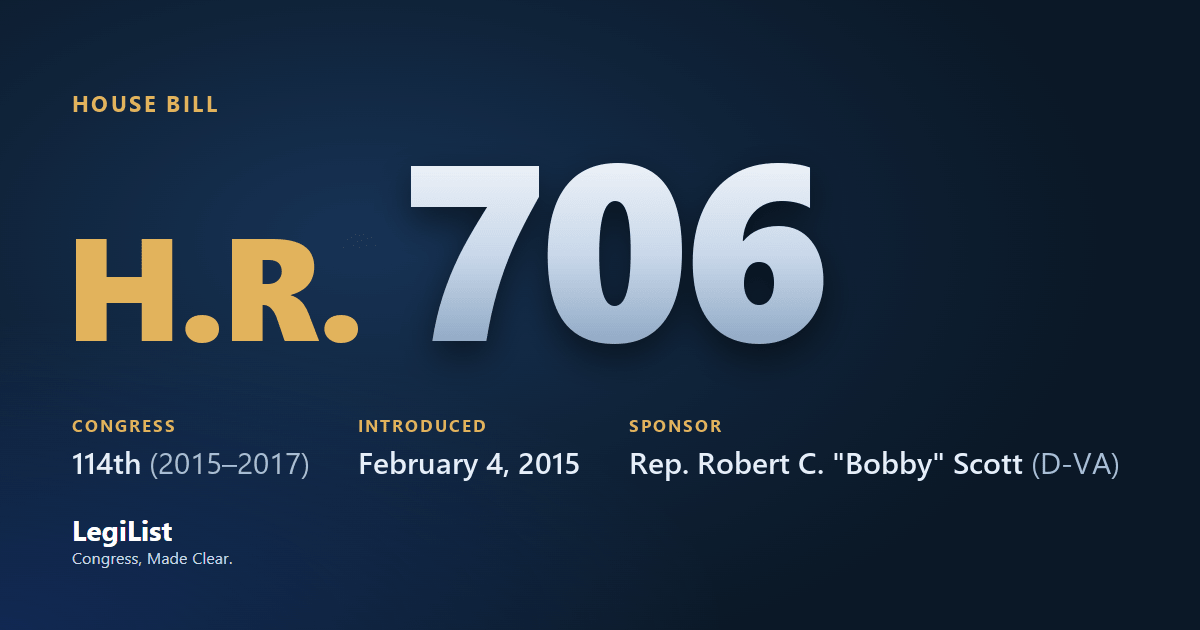
Justice Safety Valve Act of 2015
Latest action · Mar 16, 2015 Referred to the Subcommittee on Crime, Terrorism, Homeland Security, and Investigations.
Progress
Where this bill reached, and when. A stage with no date was not reached; one that failed a vote and later carried shows the date it carried.
- IntroducedFeb 4, 2015
- Passed HouseNot reached
- Passed SenateNot reached
- To the PresidentNot reached
- Became lawNot reached
Summary
Justice Safety Valve Act of 2015
This bill authorizes a federal court to impose a sentence in a criminal proceeding that is below the minimum sentence required by statute if the court finds that a lower sentence is necessary to avoid violating statutory factors that the court must consider in imposing a sentence. The court must give parties to the proceeding notice of its intent to impose a lower sentence and state in writing the factors requiring such a sentence. This bill does not limit any right to appeal that would otherwise exist.
Cosponsors 13
Members who signed on, in the order they did. Signatures ran from Feb 4, 2015 to May 11, 2016; 1 is an original cosponsor, there from the day it was introduced.
| Seat | Cosponsor | Signed on | |
|---|---|---|---|
| R-KY | Thomas Massie | Original | Feb 4, 2015 |
| D-NY | Charles B. Rangel | Feb 26, 2015 | |
| D-TN | Steve Cohen | Feb 26, 2015 | |
| D-CA | Barbara Lee | Mar 16, 2015 | |
| D-FL | Alcee L. Hastings | Mar 19, 2015 | |
| D-WA | Jim McDermott | Apr 23, 2015 | |
| D-IL | Janice D. Schakowsky | May 5, 2015 | |
| D-FL | Corrine Brown | Jun 1, 2015 | |
| D-VA | Donald S. Beyer, Jr. | Jun 15, 2015 | |
| D-WI | Mark Pocan | Jun 15, 2015 | |
| D-FL | Alan Grayson | Nov 30, 2015 | |
| R-ID | Raul R. Labrador | Jan 8, 2016 | |
| D-TX | Beto O'Rourke | May 11, 2016 |
Committees 1
Where it was sent and what each committee and subcommittee did with it, in order.
| Chamber | Committee | What it did |
|---|---|---|
| House | Judiciary Committee | Referred Feb 4, 2015 |
| Crime and Federal Government Surveillance Subcommittee | Referred Mar 16, 2015 |
Actions 3
Everything that happened, newest first.
- Mar 16, 2015Referred to the Subcommittee on Crime, Terrorism, Homeland Security, and Investigations.
- Feb 4, 2015Introduced in House
- Feb 4, 2015Referred to the House Committee on the Judiciary.
Research
What has been written about this bill: committee reports, cost estimates, the sponsor’s authority statement, printed hearings and the Congressional Research Service’s work.
Constitutional authority
The sponsor’s statement, as printed in the Congressional Record, vol. 161, no. 19, February 4, 2015, page H812.
CRS reports 1
Congressional Research Service work that CRS links to this bill or the law it became, newest first.
Cite it 1
Products on other subjects that cite it, usually among other measures.
| Product | Title | Kind | Published |
|---|---|---|---|
| R44006 | Mandatory Minimum Sentencing Legislation in the 114th Congress | Report | Apr 29, 2015 |
Related bills 2
Companion bills and other measures the record links to this one.
| Bill | Title | Relationship | Latest action |
|---|---|---|---|
| S 353 | Justice Safety Valve Act of 2015 | Identical bill | Feb 3, 2015 |
| HR 2435 | Justice Safety Valve Act of 2017 | Reintroduced Bill | Jun 7, 2017 |
Titles 2
Every title it has carried, official and short, at each stage.
- Official Title as Introduced
- To amend title 18, United States Code, to prevent unjust and irrational criminal punishments.
- Short Titles as Introduced
- Justice Safety Valve Act of 2015
Subjects
Assigned by the Library of Congress. Policy area: Crime and Law Enforcement.
Text 1
Each version as it was printed, newest first.
- Feb 4, 2015Introduced in House
Support LegiList
This page is free, carries no paywall, and is built and maintained by one person. If the record here is useful to you, a few dollars keeps it going.
Everything here is as published by Congress: the summary is the Congressional Research Service's, the action wording is the clerks', and the subjects are the Library of Congress's. How far it got is read from the actions themselves, taking the most recent one of each kind, so a bill that failed a vote and later passed is shown as having passed. Records come from this bill on Congress.gov and govinfo.gov; cost estimates are the Congressional Budget Office's, and the hearings are the printed hearings GovInfo publishes, which can appear months after the hearing.