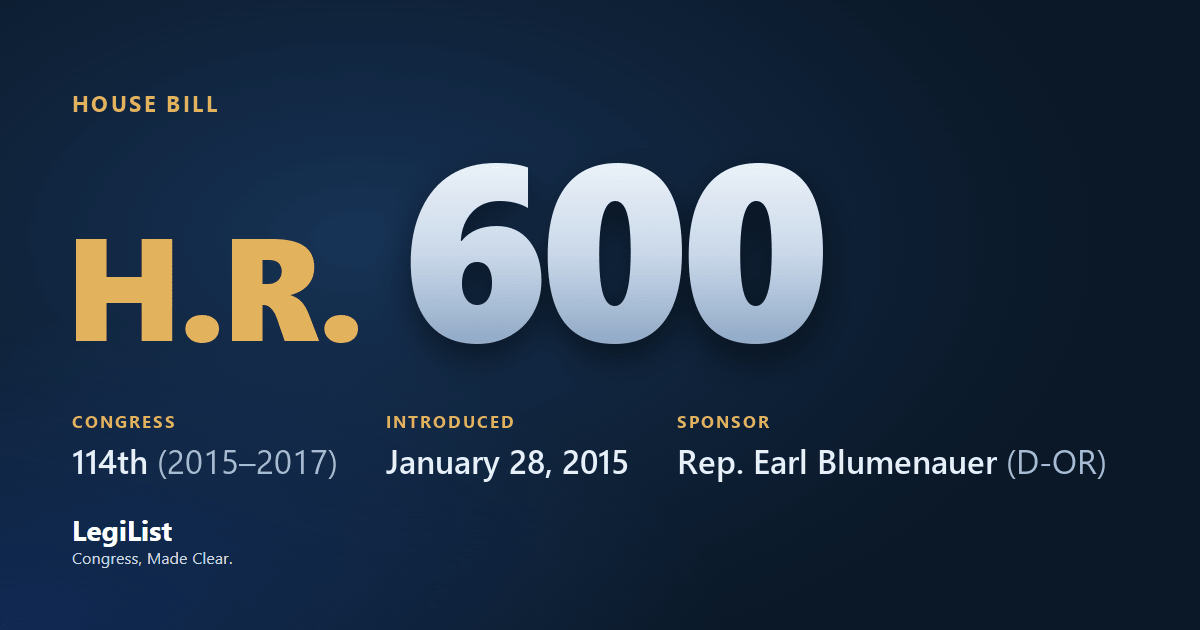
CIDER Act
Latest action · Jan 28, 2015 Referred to the House Committee on Ways and Means.
Progress
Where this bill reached, and when. A stage with no date was not reached; one that failed a vote and later carried shows the date it carried.
- IntroducedJan 28, 2015
- Passed HouseNot reached
- Passed SenateNot reached
- To the PresidentNot reached
- Became lawNot reached
Summary
Cider Industry Deserves Equal Regulation Act or the CIDER Act
Amends the Internal Revenue to revise the definition of "hard cider," for purposes of the excise tax on distilled spirits, wines, and beer, to mean any wine: (1) the carbonation level of which does not exceed 6.4 grams per liter; (2) which is derived primarily from apples, apple juice concentrate and water, pears, or pear juice concentrate and water; (3) which contains no fruit product or fruit flavoring other than apple or pear; and (4) which contains at least one-half of 1% and less than 8.5% alcohol by volume.
Cosponsors 24
Members who signed on, in the order they did. Signatures ran from Jan 28, 2015 to Nov 3, 2015; 1 is an original cosponsor, there from the day it was introduced.
| Seat | Cosponsor | Signed on | |
|---|---|---|---|
| R-NY | Chris Collins | Original | Jan 28, 2015 |
| D-OR | Peter A. DeFazio | Feb 24, 2015 | |
| R-NY | Richard L. Hanna | Feb 24, 2015 | |
| D-NY | Charles B. Rangel | Feb 25, 2015 | |
| D-WA | Denny Heck | Feb 25, 2015 | |
| R-MI | Fred Upton | Apr 14, 2015 | |
| R-WA | Jaime Herrera Beutler | Apr 14, 2015 | |
| R-MI | Dan Benishek | Apr 17, 2015 | |
| D-WA | Suzan K. DelBene | Apr 21, 2015 | |
| D-NY | Sean Patrick Maloney | Apr 29, 2015 | |
| R-MI | John R. Moolenaar | May 5, 2015 | |
| D-NY | Paul Tonko | May 5, 2015 | |
| R-WA | Dan Newhouse | May 22, 2015 | |
| R-PA | Mike Kelly | May 29, 2015 | |
| R-MI | Bill Huizenga | Jun 4, 2015 |
Committees 1
Where it was sent and what each committee and subcommittee did with it, in order.
| Chamber | Committee | What it did |
|---|---|---|
| House | Ways and Means Committee | Referred Jan 28, 2015 |
Actions 3
Everything that happened, newest first.
- Jan 28, 2015Introduced in House
- Jan 28, 2015Sponsor introductory remarks on measure. (CR E131-132)
- Jan 28, 2015Referred to the House Committee on Ways and Means.
In the Congressional Record 1
Days the Record’s own index lists this bill, newest first, with the pages and the members it names. Pages starting H are the House, S the Senate, E Extensions of Remarks.
| Where | In the Record | Members | Date |
|---|---|---|---|
| Extensions | Debate and remarks E131 | Earl Blumenauer D-OR | Jan 28, 2015 |
Research
What has been written about this bill: committee reports, cost estimates, the sponsor’s authority statement, printed hearings and the Congressional Research Service’s work.
Constitutional authority
The sponsor’s statement, as printed in the Congressional Record, vol. 161, no. 14, January 28, 2015, page H663.
Related bills 2
Companion bills and other measures the record links to this one.
| Bill | Title | Relationship | Latest action |
|---|---|---|---|
| S 906 | Cider Investment and Development through Excise Tax Reduction (CIDER) Act | Related bill | Apr 14, 2015 |
| S 1459 | Cider Investment and Development through Excise Tax Reduction (CIDER) Act | Related bill | May 22, 2015 |
Titles 3
Every title it has carried, official and short, at each stage.
- Official Title as Introduced
- To amend the Internal Revenue Code of 1986 to modify the taxation of hard cider.
- Short Titles as Introduced
- CIDER Act
- Cider Industry Deserves Equal Regulation Act
Subjects
Assigned by the Library of Congress. Policy area: Taxation.
Text 1
Each version as it was printed, newest first.
- Jan 28, 2015Introduced in House
Support LegiList
This page is free, carries no paywall, and is built and maintained by one person. If the record here is useful to you, a few dollars keeps it going.
Everything here is as published by Congress: the summary is the Congressional Research Service's, the action wording is the clerks', and the subjects are the Library of Congress's. How far it got is read from the actions themselves, taking the most recent one of each kind, so a bill that failed a vote and later passed is shown as having passed. Records come from this bill on Congress.gov and govinfo.gov; cost estimates are the Congressional Budget Office's, and the hearings are the printed hearings GovInfo publishes, which can appear months after the hearing.