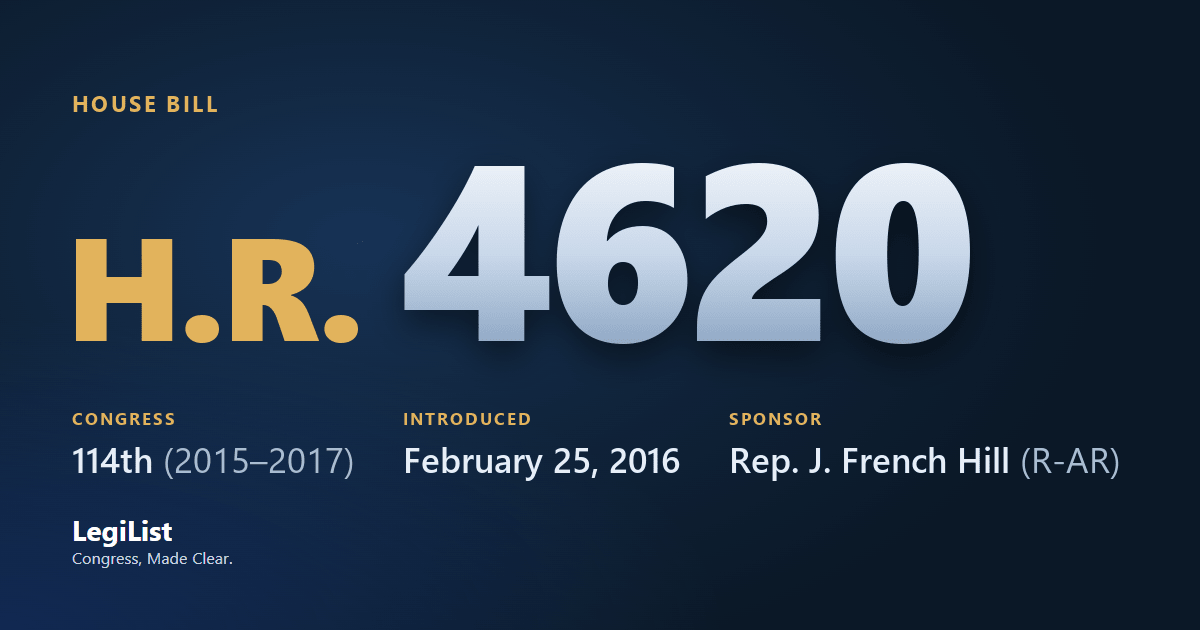
Preserving Access to CRE Capital Act of 2016
Latest action · May 26, 2016 Placed on the Union Calendar, Calendar No. 463.
Progress
Where this bill reached, and when. A stage with no date was not reached; one that failed a vote and later carried shows the date it carried.
- IntroducedFeb 25, 2016
- Passed HouseNot reached
- Passed SenateNot reached
- To the PresidentNot reached
- Became lawNot reached
Summary
(This measure has not been amended since it was introduced. The summary has been expanded because action occurred on the measure.)
Preserving Access to CRE Capital Act of 2016
(Sec. 2) This bill amends the Securities Exchange Act of 1934 concerning credit risk retention standards for commercial real estate loans to revise the optional standard that may include retention of the first-loss position by a third-party purchaser that specifically negotiates for the purchase of that first loss position, holds adequate financial resources to back losses, provides due diligence on all individual assets in the pool before issuance of the asset-backed securities, and meets the same standards for risk retention as the federal banking agencies and the Securities and Exchange Commission (SEC) require of the securitizer.
The revised specifications for retention of the first-loss position by a third-party purchaser shall mean the permissible risk retention of the first-loss position by a one or two party third-party purchaser, who may hold the retention obligation in either a senior-subordinate structure or pari passu (where two or more assets, securities, creditors or obligations are equally managed without any display of preference), as long as each party meets the requirements expressed above.
The bill exempts from risk retention requirements the securitization of a single commercial real estate loan or a group of cross-collateralized or cross-defaulted commercial real estate loans that represent the obligation of one or more related borrowers secured by commercial properties under direct or indirect common ownership or control.
The SEC and the federal banking agencies shall jointly maintain specified regulations which exempt qualified commercial real estate loans from risk retention requirements.
Cosponsors 7
Members who signed on, in the order they did. Signatures ran from Feb 26, 2016 to May 26, 2016.
| Seat | Cosponsor | Signed on | |
|---|---|---|---|
| R-IN | Luke Messer | Feb 26, 2016 | |
| D-DE | John C. Carney, Jr. | May 23, 2016 | |
| R-MO | Ann Wagner | May 25, 2016 | |
| R-MI | Bill Huizenga | May 25, 2016 | |
| R-TX | Randy Neugebauer | May 25, 2016 | |
| R-OH | Steve Stivers | May 25, 2016 | |
| R-KY | Andy Barr | May 26, 2016 |
Committees 2
Where it was sent and what each committee and subcommittee did with it, in order.
| Chamber | Committee | What it did |
|---|---|---|
| House | Financial Services Committee | Referred Feb 25, 2016Markup Mar 2, 2016Reported May 26, 2016 |
| Capital Markets Subcommittee | Hearings Feb 24, 2016 | |
| Senate | Banking, Housing, and Urban Affairs Committee | |
| Securities, Insurance, and Investment Subcommittee | Hearings May 19, 2016 |
Actions 8
Everything that happened, newest first.
- May 26, 2016Reported by the Committee on Financial Services. H. Rept. 114-597.
- May 26, 2016Placed on the Union Calendar, Calendar No. 463.
- May 19, 2016Committee on Banking, Housing, and Urban Affairs Subcommittee on Securities, Insurance, and Investment. Hearings held.
- Mar 2, 2016Committee Consideration and Mark-up Session Held.
- Mar 2, 2016Ordered to be Reported by the Yeas and Nays: 39 - 18.
- Feb 25, 2016Introduced in House
- Feb 25, 2016Referred to the House Committee on Financial Services.
- Feb 24, 2016Hearings Held by the Subcommittee on Capital Markets and Government Sponsored Enterprises Prior to Introduction and Referral.
Research
What has been written about this bill: committee reports, cost estimates, the sponsor’s authority statement, printed hearings and the Congressional Research Service’s work.
Committee report
Congressional Budget Office cost estimate
- May 23, 2016H.R. 4620, Preserving Access to CRE Capital Act of 2016As ordered reported by the House Committee on Financial Services on March 2, 2016
Constitutional authority
The sponsor’s statement, as printed in the Congressional Record, vol. 162, no. 30, February 25, 2016, page H949.
Printed hearings 1
Hearings whose printed record names this bill, newest first: hearings on it, and wider hearings where it came up.
| Number | Hearing | Committee | Held |
|---|---|---|---|
| S. Hrg. 114-388 | IMPROVING COMMUNITIES' AND BUSINESSES' ACCESS TO CAPITAL AND ECONOMIC DEVELOPMENT145 pages | Banking, Housing, and Urban Affairs Committee | May 19, 2016 |
Titles 3
Every title it has carried, official and short, at each stage.
- Official Title as Introduced
- To amend the Securities Exchange Act of 1934 to exempt certain commercial real estate loans from risk retention requirements, and for other purposes.
- Short Titles as Introduced
- Preserving Access to CRE Capital Act of 2016
- Short Titles as Reported to House
- Preserving Access to CRE Capital Act of 2016
Subjects
Assigned by the Library of Congress. Policy area: Finance and Financial Sector.
Text 2
Each version as it was printed, newest first.
- May 26, 2016Reported in House
- Feb 25, 2016Introduced in House
Support LegiList
This page is free, carries no paywall, and is built and maintained by one person. If the record here is useful to you, a few dollars keeps it going.
Everything here is as published by Congress: the summary is the Congressional Research Service's, the action wording is the clerks', and the subjects are the Library of Congress's. How far it got is read from the actions themselves, taking the most recent one of each kind, so a bill that failed a vote and later passed is shown as having passed. Records come from this bill on Congress.gov and govinfo.gov; cost estimates are the Congressional Budget Office's, and the hearings are the printed hearings GovInfo publishes, which can appear months after the hearing.