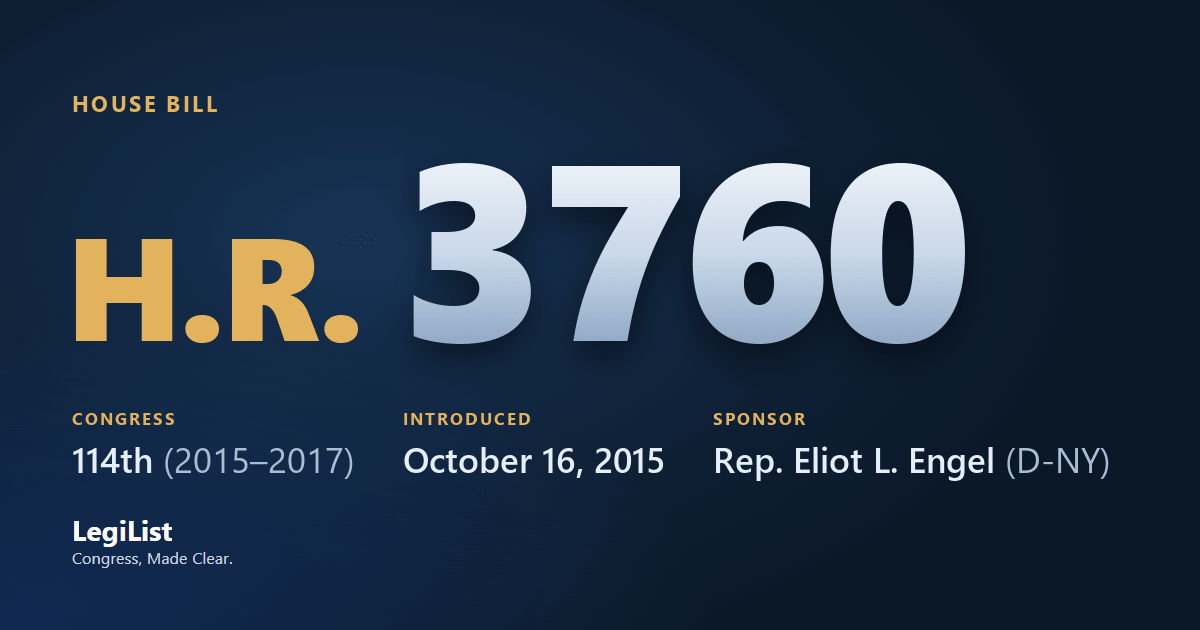
Offending Oil Polluters Act
Latest action · Oct 16, 2015 Referred to the House Committee on Ways and Means.
Progress
Where this bill reached, and when. A stage with no date was not reached; one that failed a vote and later carried shows the date it carried.
- IntroducedOct 16, 2015
- Passed HouseNot reached
- Passed SenateNot reached
- To the PresidentNot reached
- Became lawNot reached
Summary
Offending Oil Polluters Act
This bill amends the Internal Revenue Code to deny any tax credit or deduction to an offending oil polluter. The bill defines "offending oil polluter" as any person who is responsible for a vessel or facility from which oil or a hazardous substance is discharged and any person who is a member of the same expanded affiliated group as the offending oil polluter.
Specifically, the bill denies a tax benefit for any amount paid or incurred: (1) in connection with a discharge of oil or a hazardous substance, (2) for any attorney fees and court costs in connection with any legal action involving such discharge, (3) as a payment or restitution related to such discharge, and (4) for any costs or penalties required by federal law or certified in a settlement by a federal court.
The bill requires the Department of the Treasury to conduct, and report on, an annual study to determine: (1) the revenue loss as a result of tax deductions allowed for cleaning up oil that is discharged after April 19, 2010, and (2) the amount of revenue savings resulting from this Act.
Cosponsors 22
Members who signed on, in the order they did. Signatures ran from Oct 16, 2015 to Dec 17, 2015; 1 is an original cosponsor, there from the day it was introduced.
| Seat | Cosponsor | Signed on | |
|---|---|---|---|
| D-VT | Peter Welch | Original | Oct 16, 2015 |
| D-FL | Alan Grayson | Oct 29, 2015 | |
| D-NY | Jerrold Nadler | Oct 29, 2015 | |
| D-AZ | Raúl M. Grijalva | Nov 2, 2015 | |
| D-MN | Betty McCollum | Nov 4, 2015 | |
| D-CA | Alan S. Lowenthal | Nov 16, 2015 | |
| D-FL | Alcee L. Hastings | Nov 16, 2015 | |
| D-CA | Barbara Lee | Nov 16, 2015 | |
| D-DC | Eleanor Holmes Norton | Nov 16, 2015 | |
| D-CA | Maxine Waters | Nov 16, 2015 | |
| D-AZ | Ruben Gallego | Nov 16, 2015 | |
| D-VA | Gerald E. Connolly | Nov 17, 2015 | |
| D-IL | Janice D. Schakowsky | Nov 17, 2015 | |
| D-IL | Luis V. Gutierrez | Nov 17, 2015 | |
| D-WI | Mark Pocan | Nov 17, 2015 |
Committees 1
Where it was sent and what each committee and subcommittee did with it, in order.
| Chamber | Committee | What it did |
|---|---|---|
| House | Ways and Means Committee | Referred Oct 16, 2015 |
Actions 2
Everything that happened, newest first.
- Oct 16, 2015Introduced in House
- Oct 16, 2015Referred to the House Committee on Ways and Means.
Research
What has been written about this bill: committee reports, cost estimates, the sponsor’s authority statement, printed hearings and the Congressional Research Service’s work.
Constitutional authority
The sponsor’s statement, as printed in the Congressional Record, vol. 161, no. 151, October 16, 2015, page H6981.
Related bills 1
Companion bills and other measures the record links to this one.
| Bill | Title | Relationship | Latest action |
|---|---|---|---|
| HR 6658 | Offending Oil Polluters Act | Reintroduced Bill | Aug 7, 2018 |
Titles 2
Every title it has carried, official and short, at each stage.
- Official Title as Introduced
- To amend the Internal Revenue Code of 1986 to deny certain tax benefits to persons responsible for the discharge of oil or other hazardous substances into navigable waters of the United States.
- Short Titles as Introduced
- Offending Oil Polluters Act
Subjects
Assigned by the Library of Congress. Policy area: Taxation.
Text 1
Each version as it was printed, newest first.
- Oct 16, 2015Introduced in House
Support LegiList
This page is free, carries no paywall, and is built and maintained by one person. If the record here is useful to you, a few dollars keeps it going.
Everything here is as published by Congress: the summary is the Congressional Research Service's, the action wording is the clerks', and the subjects are the Library of Congress's. How far it got is read from the actions themselves, taking the most recent one of each kind, so a bill that failed a vote and later passed is shown as having passed. Records come from this bill on Congress.gov and govinfo.gov; cost estimates are the Congressional Budget Office's, and the hearings are the printed hearings GovInfo publishes, which can appear months after the hearing.