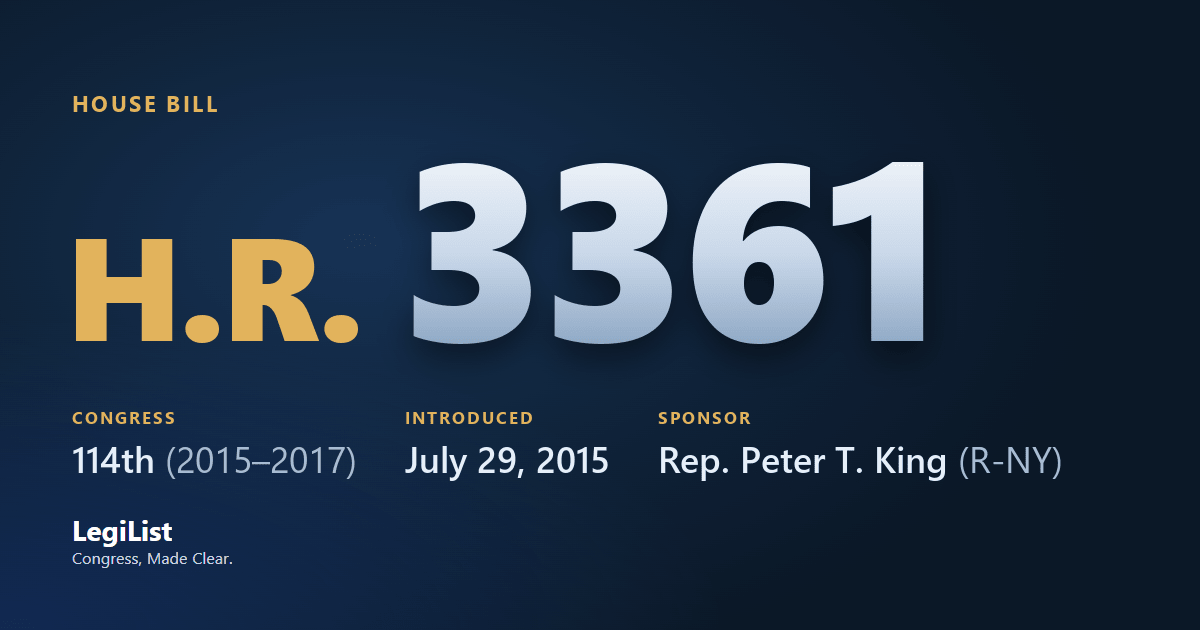
Department of Homeland Security Insider Threat and Mitigation Act of 2016
Latest action · Jul 12, 2016 Placed on Senate Legislative Calendar under General Orders. Calendar No. 553.
Progress
Where this bill reached, and when. A stage with no date was not reached; one that failed a vote and later carried shows the date it carried.
- IntroducedJul 29, 2015
- Passed HouseNov 2, 2015
- Passed SenateNot reached
- To the PresidentNot reached
- Became lawNot reached
Summary
Department of Homeland Security Insider Threat and Mitigation Act of 2016
(Sec. 2) This bill amends the Homeland Security Act of 2002 (HSA) to direct the Department of Homeland Security (DHS) to establish an Insider Threat Program, which shall: (1) provide training and education for DHS employees to identify, prevent, mitigate, and respond to insider threat risks to DHS's critical assets; (2) provide investigative support regarding such threats; and (3) conduct risk mitigation activities for such threats.
DHS shall establish a Steering Committee. The Under Secretary for Intelligence and Analysis, who shall serve as the Chair of the Committee, and the Chief Security Officer, who shall serve as the Vice Chair, shall, in coordination with the Committee:
- develop a holistic strategy for DHS-wide efforts to identify, prevent, mitigate, and respond to insider threats to DHS's critical assets;
- develop a plan to implement the strategy across DHS components and offices;
- document insider threat policies and controls;
- conduct a baseline risk assessment of such threats;
- examine programmatic and technology best practices adopted by the federal government, industry, and research institutions;
- develop a timeline for deploying workplace monitoring technologies, employee awareness campaigns, and education and training programs related to potential insider threats;
- consult with the the Under Secretary for Science and Technology and other stakeholders to ensure that the program is informed by current information regarding threats, best practices, and available technology; and
- develop, collect, and report metrics on the effectiveness of DHS's insider threat mitigation efforts.
An agency employing a person who has access to classified national security information (insider employee) shall propose: (1) removing such employee whom an appropriate entity determines knowingly or recklessly engaged in insider misconduct, and (2) taking an adverse action of at least a 12-day suspension of such employee for the first instance of negligently engaging in insider misconduct and removal for any subsequent instance.
An insider employee who is notified that he or she is the subject of a proposed adverse action is entitled to 14 days to answer and furnish evidence in support of such answer. If such employee does not furnish such evidence or if the agency determines that such evidence is not sufficient for reversal, such agency shall carry out the adverse action. An agency that carries out an adverse action against an insider employee for insider misconduct under another provision of law may carry out an additional adverse action under the Insider Threat Program based on the same insider misconduct.
DHS must submit to specified congressional committees a biennial report on:
- how DHS and its components and offices have implemented such strategy,
- the status of DHS's risk assessment of critical assets,
- the types of insider threat training conducted,
- the number of DHS employees who have received such training, and
- information on the effectiveness of the Insider Threat Program.
The Steering Committee shall not seek to, and the authorities provided under this bill shall not be used to, deter, detect, or mitigate disclosures of information by government employees or contractors that are lawful under and protected by any whistleblower statute, regulation, or policy. Any activity carried out under the bill shall be subject to provisions of the Whistleblower Protection Enhancement Act of 2012, and any activity to implement or enforce any insider threat or authority of this bill or Executive Order 13587 shall include a statement required by such Act that preserves rights under whistleblower laws and provisions protecting communications with Congress.
Cosponsors 5
Members who signed on, in the order they did. Signatures ran from Jul 29, 2015 to Sep 24, 2015; 4 are original cosponsors, there from the day it was introduced.
| Seat | Cosponsor | Signed on | |
|---|---|---|---|
| D-NY | Brian Higgins | Original | Jul 29, 2015 |
| R-NY | Daniel M. Donovan, Jr. | Original | Jul 29, 2015 |
| R-NY | John Katko | Original | Jul 29, 2015 |
| R-PA | Lou Barletta | Original | Jul 29, 2015 |
| R-TX | Michael T. McCaul | Sep 24, 2015 |
Committees 2
Where it was sent and what each committee and subcommittee did with it, in order.
| Chamber | Committee | What it did |
|---|---|---|
| House | Homeland Security Committee | Referred Jul 29, 2015Markup Sep 30, 2015Reported Nov 2, 2015 |
| Counterterrorism and Intelligence Subcommittee | Referred Aug 11, 2015Markup Sep 17, 2015Reported Sep 17, 2015 | |
| Senate | Homeland Security and Governmental Affairs Committee | Referred Nov 3, 2015Markup Feb 10, 2016Reported Jul 12, 2016 |
Actions 18
Everything that happened, newest first.
- Jul 12, 2016Committee on Homeland Security and Governmental Affairs. Reported by Senator Johnson with an amendment in the nature of a substitute. With written report No. 114-297.
- Jul 12, 2016Placed on Senate Legislative Calendar under General Orders. Calendar No. 553.
- Feb 10, 2016Committee on Homeland Security and Governmental Affairs. Ordered to be reported with an amendment in the nature of a substitute favorably.
- Nov 3, 2015Received in the Senate and Read twice and referred to the Committee on Homeland Security and Governmental Affairs.
- Nov 2, 2015Reported (Amended) by the Committee on Homeland Security. H. Rept. 114-321.
- Nov 2, 2015Placed on the Union Calendar, Calendar No. 244.
- Nov 2, 2015Mr. King (NY) moved to suspend the rules and pass the bill, as amended.
- Nov 2, 2015Considered under suspension of the rules. (consideration: CR H7351-7353)
- Nov 2, 2015DEBATE - The House proceeded with forty minutes of debate on H.R. 3361.
- Nov 2, 2015Passed/agreed to in House: On motion to suspend the rules and pass the bill, as amended Agreed to by voice vote. (text: CR H7351-7352)
- Nov 2, 2015Motion to reconsider laid on the table Agreed to without objection.
- Sep 30, 2015Committee Consideration and Mark-up Session Held.
- Sep 30, 2015Ordered to be Reported (Amended) by Voice Vote.
- Sep 17, 2015Subcommittee Consideration and Mark-up Session Held.
- Sep 17, 2015Forwarded by Subcommittee to Full Committee (Amended) by Voice Vote .
- Aug 11, 2015Referred to the Subcommittee on Counterterrorism and Intelligence.
- Jul 29, 2015Introduced in House
- Jul 29, 2015Referred to the House Committee on Homeland Security.
In the Congressional Record 1
Days the Record’s own index lists this bill, newest first, with the pages and the members it names. Pages starting H are the House, S the Senate, E Extensions of Remarks.
| Where | In the Record | Members | Date |
|---|---|---|---|
| House | Debate and remarks H7351–H7353Text printed H7351 | Bennie G. Thompson D-MS, Peter T. King R-NY, Sheila Jackson Lee D-TX | Nov 2, 2015 |
Research
What has been written about this bill: committee reports, cost estimates, the sponsor’s authority statement, printed hearings and the Congressional Research Service’s work.
Committee reports
Congressional Budget Office cost estimates 2
- Mar 21, 2016H.R. 3361, Department of Homeland Security Insider Threat and Mitigation Act of 2016As ordered reported by the Senate Committee on Homeland Security and Governmental Affairs on February 10, 2016
- Oct 26, 2015H.R. 3361, Department of Homeland Security Insider Threat and Mitigation Act of 2015As ordered reported by the House Committee on Homeland Security on September 30, 2015
Constitutional authority
The sponsor’s statement, as printed in the Congressional Record, vol. 161, no. 121, July 29, 2015, page H5773.
Titles 4
Every title it has carried, official and short, at each stage.
- Official Title as Introduced
- To amend the Homeland Security Act of 2002 to establish the Insider Threat Program, and for other purposes.
- Short Titles as Introduced
- Department of Homeland Security Insider Threat and Mitigation Act of 2015
- Short Titles as Reported to Senate
- Department of Homeland Security Insider Threat and Mitigation Act of 2016
- Short Titles as Passed House
- Department of Homeland Security Insider Threat and Mitigation Act of 2015
Subjects
Assigned by the Library of Congress. Policy area: Emergency Management.
- Computer security and identity theft
- Computers and information technology
- Congressional oversight
- Department of Homeland Security
- Emergency Management
- Espionage and treason
- Executive agency funding and structure
- Government employee pay, benefits, personnel management
- Government studies and investigations
- Intelligence activities, surveillance, classified information
- Performance measurement
- Public contracts and procurement
- Technology assessment
- Terrorism
Text 5
Each version as it was printed, newest first.
- Jul 12, 2016Reported to Senate
- Nov 3, 2015Referred in Senate
- Nov 2, 2015Engrossed in House
- Nov 2, 2015Reported in House
- Jul 29, 2015Introduced in House
Everything here is as published by Congress: the summary is the Congressional Research Service's, the action wording is the clerks', and the subjects are the Library of Congress's. How far it got is read from the actions themselves, taking the most recent one of each kind, so a bill that failed a vote and later passed is shown as having passed. Records come from this bill on Congress.gov and govinfo.gov; cost estimates are the Congressional Budget Office's, and the hearings are the printed hearings GovInfo publishes, which can appear months after the hearing.