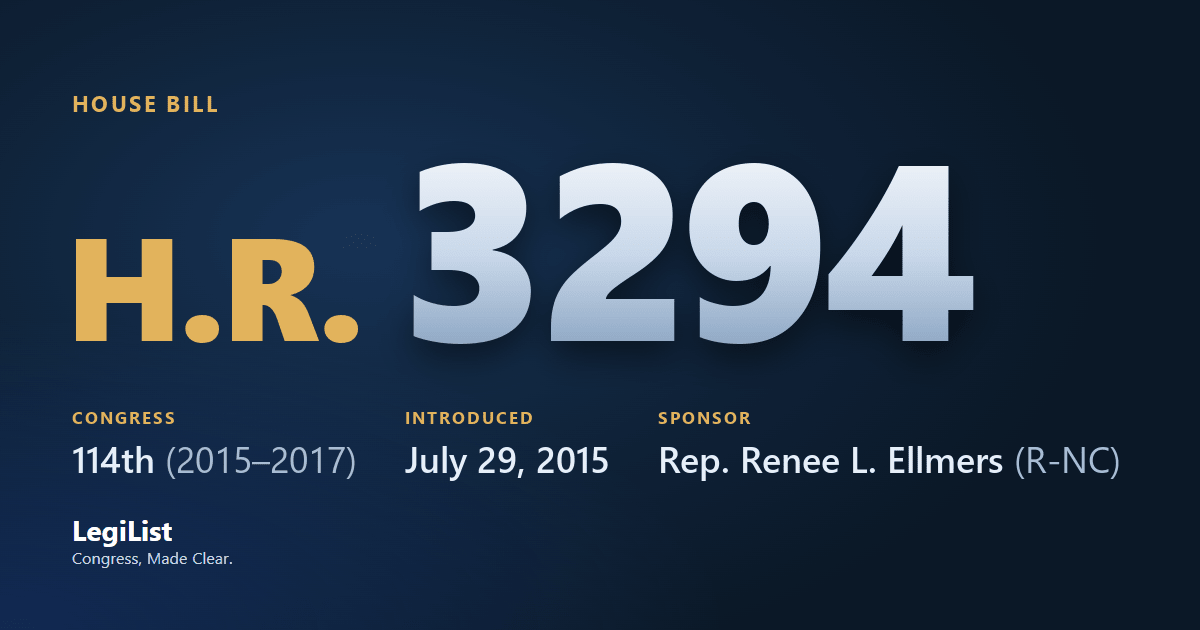
Sanctuary Regulatory Fairness Act of 2015
Latest action · Jul 31, 2015 Referred to the Subcommittee on Health.
Progress
Where this bill reached, and when. A stage with no date was not reached; one that failed a vote and later carried shows the date it carried.
- IntroducedJul 29, 2015
- Passed HouseNot reached
- Passed SenateNot reached
- To the PresidentNot reached
- Became lawNot reached
Summary
Sanctuary Regulatory Fairness Act of 2015
Directs the Department of Health and Human Services to promulgate a final rule revising federal regulations regarding the importation of nonhuman primates (i.e. chimpanzees, gorillas, orangutans, macaques, and numerous other species) to expand the categories of uses for which nonhuman primates may be imported and distributed to include live nonhuman primates imported into the United States by a certified primate sanctuary for purposes of providing lifetime shelter and care.
Requires such rule to establish a process for the certification of facilities as primate sanctuaries for purposes of the importation, shelter, and care of nonhuman primates.
Cosponsors 21
Members who signed on, in the order they did. Signatures ran from Jul 29, 2015 to Jul 12, 2016; 2 are original cosponsors, there from the day it was introduced.
| Seat | Cosponsor | Signed on | |
|---|---|---|---|
| D-OR | Peter A. DeFazio | Original | Jul 29, 2015 |
| R-FL | Thomas J. Rooney | Original | Jul 29, 2015 |
| R-NV | Joseph J. Heck | Sep 10, 2015 | |
| R-NJ | Rodney P. Frelinghuysen | Sep 11, 2015 | |
| D-CA | Zoe Lofgren | Sep 11, 2015 | |
| D-CA | Jackie Speier | Sep 24, 2015 | |
| R-AZ | Martha McSally | Sep 24, 2015 | |
| D-WA | Denny Heck | Oct 7, 2015 | |
| R-OH | Bill Johnson | Oct 9, 2015 | |
| D-CA | Ted Lieu | Nov 16, 2015 | |
| D-CA | Grace F. Napolitano | Nov 19, 2015 | |
| R-WI | F. James Sensenbrenner, Jr. | Feb 12, 2016 | |
| R-NY | John Katko | Feb 12, 2016 | |
| R-OH | James B. Renacci | Feb 29, 2016 | |
| R-CO | Mike Coffman | Apr 12, 2016 | |
| R-IL | Rodney Davis | Apr 12, 2016 | |
| R-CO | Scott R. Tipton | Apr 20, 2016 | |
| D-AZ | Raúl M. Grijalva | May 6, 2016 | |
| D-NY | Carolyn B. Maloney | May 11, 2016 | |
| D-CA | Barbara Lee | Jul 6, 2016 | |
| R-NY | Christopher P. Gibson | Jul 12, 2016 |
Committees 1
Where it was sent and what each committee and subcommittee did with it, in order.
| Chamber | Committee | What it did |
|---|---|---|
| House | Energy and Commerce Committee | Referred Jul 29, 2015 |
| Health Subcommittee | Referred Jul 31, 2015 |
Actions 3
Everything that happened, newest first.
- Jul 31, 2015Referred to the Subcommittee on Health.
- Jul 29, 2015Introduced in House
- Jul 29, 2015Referred to the House Committee on Energy and Commerce.
Research
What has been written about this bill: committee reports, cost estimates, the sponsor’s authority statement, printed hearings and the Congressional Research Service’s work.
Constitutional authority
The sponsor’s statement, as printed in the Congressional Record, vol. 161, no. 121, July 29, 2015, page H5771.
Related bills 1
Companion bills and other measures the record links to this one.
| Bill | Title | Relationship | Latest action |
|---|---|---|---|
| S 1898 | Sanctuary Regulatory Fairness Act of 2015 | Identical bill | Jul 29, 2015 |
Titles 2
Every title it has carried, official and short, at each stage.
- Official Title as Introduced
- To establish a program to assist in the importation and care of abused, injured, or abandoned nonhuman primates.
- Short Titles as Introduced
- Sanctuary Regulatory Fairness Act of 2015
Subjects
Assigned by the Library of Congress. Policy area: Animals.
Text 1
Each version as it was printed, newest first.
- Jul 29, 2015Introduced in House
Everything here is as published by Congress: the summary is the Congressional Research Service's, the action wording is the clerks', and the subjects are the Library of Congress's. How far it got is read from the actions themselves, taking the most recent one of each kind, so a bill that failed a vote and later passed is shown as having passed. Records come from this bill on Congress.gov and govinfo.gov; cost estimates are the Congressional Budget Office's, and the hearings are the printed hearings GovInfo publishes, which can appear months after the hearing.