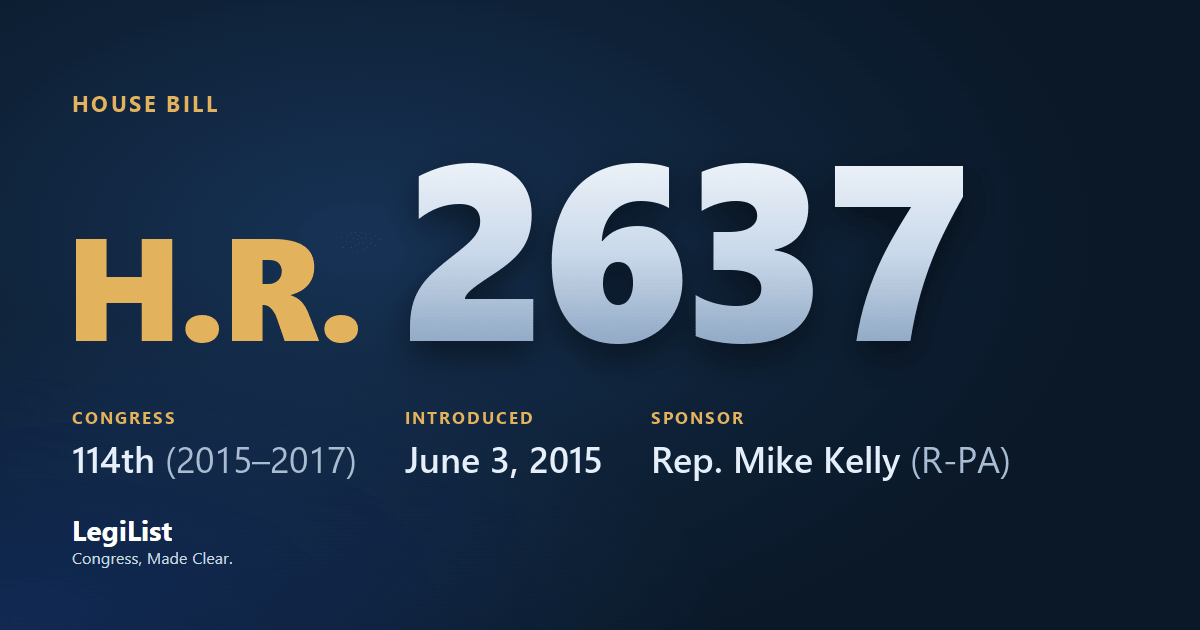
Coal Country Protection Act
Latest action · Jun 5, 2015 Referred to the Subcommittee on Energy and Power.
Progress
Where this bill reached, and when. A stage with no date was not reached; one that failed a vote and later carried shows the date it carried.
- IntroducedJun 3, 2015
- Passed HouseNot reached
- Passed SenateNot reached
- To the PresidentNot reached
- Became lawNot reached
Summary
Coal Country Protection Act or the Protecting Jobs, Families, and the Economy From EPA Overreach Act
This bill amends the Clean Air Act to prohibit the Environmental Protection Agency from promulgating any regulation or guidance that limits or prohibits new carbon dioxide emissions from a fossil fuel-fired power plant until it is certified:
- by the Department of Labor that the regulation or guidance will not generate a loss of employment,
- by the Congressional Budget Office that it will not result in a loss in the gross domestic product,
- by the Energy Information Administration that it will not generate an increase in electricity rates, and
- by the Federal Energy Regulatory Commission and the North American Electric Reliability Corporation that it will not effect the reliability of electricity delivery.
Cosponsors 2
Members who signed on, in the order they did. All signed on Jun 3, 2015.
| Seat | Cosponsor | Signed on | |
|---|---|---|---|
| R-KY | Brett Guthrie | Original | Jun 3, 2015 |
| R-OH | Robert E. Latta | Original | Jun 3, 2015 |
Committees 1
Where it was sent and what each committee and subcommittee did with it, in order.
| Chamber | Committee | What it did |
|---|---|---|
| House | Energy and Commerce Committee | Referred Jun 3, 2015 |
| Energy Subcommittee | Referred Jun 5, 2015 |
Actions 3
Everything that happened, newest first.
- Jun 5, 2015Referred to the Subcommittee on Energy and Power.
- Jun 3, 2015Introduced in House
- Jun 3, 2015Referred to the House Committee on Energy and Commerce.
In the Congressional Record 1
Days the Record’s own index lists this bill, newest first, with the pages and the members it names. Pages starting H are the House, S the Senate, E Extensions of Remarks.
| Where | In the Record | Members | Date |
|---|---|---|---|
| House | Debate and remarks H5576 | Mike Kelly R-PA | Jul 28, 2015 |
Research
What has been written about this bill: committee reports, cost estimates, the sponsor’s authority statement, printed hearings and the Congressional Research Service’s work.
Constitutional authority
The sponsor’s statement, as printed in the Congressional Record, vol. 161, no. 88, June 3, 2015, page H3878.
CRS reports 1
Congressional Research Service work that CRS links to this bill or the law it became, newest first.
Cite it 1
Products on other subjects that cite it, usually among other measures.
| Product | Title | Kind | Published |
|---|---|---|---|
| R44265 | EPA’s Clean Power Plan: Implications for the Electric Power Sector Archived | Report | Nov 5, 2015 |
Titles 3
Every title it has carried, official and short, at each stage.
- Official Title as Introduced
- To amend the Clean Air Act to prohibit the regulation of emissions of carbon dioxide from new or existing power plants under certain circumstances.
- Short Titles as Introduced
- Protecting Jobs, Families, and the Economy From EPA Overreach Act
- Coal Country Protection Act
Subjects
Assigned by the Library of Congress. Policy area: Environmental Protection.
- Administrative law and regulatory procedures
- Air quality
- Climate change and greenhouse gases
- Coal
- Economic performance and conditions
- Electric power generation and transmission
- Energy prices
- Environmental Protection
- Environmental Protection Agency (EPA)
- Environmental regulatory procedures
- Oil and gas
- Public utilities and utility rates
- Unemployment
Text 1
Each version as it was printed, newest first.
- Jun 3, 2015Introduced in House
Support LegiList
This page is free, carries no paywall, and is built and maintained by one person. If the record here is useful to you, a few dollars keeps it going.
Everything here is as published by Congress: the summary is the Congressional Research Service's, the action wording is the clerks', and the subjects are the Library of Congress's. How far it got is read from the actions themselves, taking the most recent one of each kind, so a bill that failed a vote and later passed is shown as having passed. Records come from this bill on Congress.gov and govinfo.gov; cost estimates are the Congressional Budget Office's, and the hearings are the printed hearings GovInfo publishes, which can appear months after the hearing.