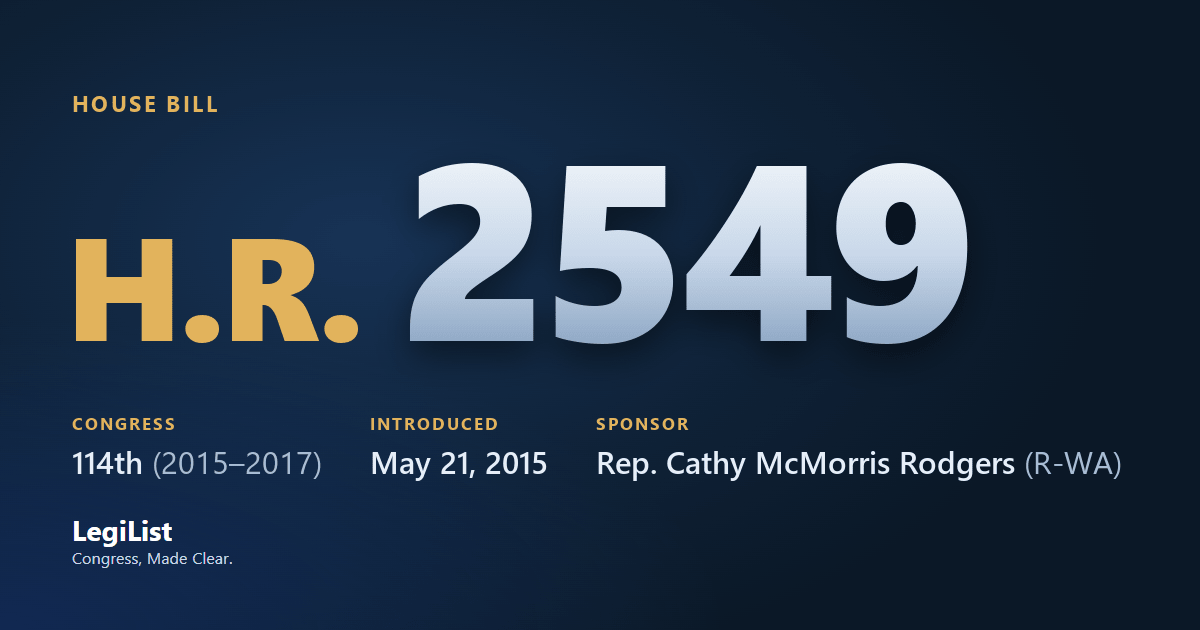
To amend the HITECH Act with respect to accessing, sharing, and using health data for research purposes.
Latest action · May 22, 2015 Referred to the Subcommittee on Health.
Progress
Where this bill reached, and when. A stage with no date was not reached; one that failed a vote and later carried shows the date it carried.
- IntroducedMay 21, 2015
- Passed HouseNot reached
- Passed SenateNot reached
- To the PresidentNot reached
- Became lawNot reached
Summary
This bill amends the HITECH Act to require the Department of Health and Human Services (HHS) to revise or clarify the privacy rule established under the Health Insurance Portability and Accountability Act of 1996 (HIPAA) to allow the use and disclosure of protected health information for research purposes without the individual's authorization, approval from an Institutional Review Board or Privacy Board, or representations from the researcher regarding limited use of the information.
These disclosures may only be made to entities subject to HIPAA for health care operations or to business associates that are complying with the privacy rule for health care operations or data aggregation.
There is no limitation on payments for these disclosures. Currently, payment is limited to the cost to prepare and transmit the information.
An individual's protected health information may be disclosed without the authorization or agreement of the individual for research related to a product or activity that is regulated by the Food and Drug Administration.
A researcher is allowed remote access to protected health information if security and privacy safeguards are maintained and the researcher does not retain the information.
An individual's authorization to use protected health information for future research is sufficient for a research purpose if the authorization reasonably describes the research and provides instruction to the individual on how to revoke the authorization.Cosponsors
Members who signed on, in the order they did.
Committees 1
Where it was sent and what each committee and subcommittee did with it, in order.
| Chamber | Committee | What it did |
|---|---|---|
| House | Energy and Commerce Committee | Referred May 21, 2015 |
| Health Subcommittee | Referred May 22, 2015 |
Actions 3
Everything that happened, newest first.
- May 22, 2015Referred to the Subcommittee on Health.
- May 21, 2015Introduced in House
- May 21, 2015Referred to the House Committee on Energy and Commerce.
Research
What has been written about this bill: committee reports, cost estimates, the sponsor’s authority statement, printed hearings and the Congressional Research Service’s work.
Constitutional authority
The sponsor’s statement, as printed in the Congressional Record, vol. 161, no. 79, May 21, 2015, page H3564.
Related bills 1
Companion bills and other measures the record links to this one.
| Bill | Title | Relationship | Latest action |
|---|---|---|---|
| HR 6 | 21st Century Cures Act | Related bill | Jul 13, 2015 |
Titles 1
Every title it has carried, official and short, at each stage.
- Official Title as Introduced
- To amend the HITECH Act with respect to accessing, sharing, and using health data for research purposes.
Subjects
Assigned by the Library of Congress. Policy area: Health.
Text 1
Each version as it was printed, newest first.
- May 21, 2015Introduced in House
Everything here is as published by Congress: the summary is the Congressional Research Service's, the action wording is the clerks', and the subjects are the Library of Congress's. How far it got is read from the actions themselves, taking the most recent one of each kind, so a bill that failed a vote and later passed is shown as having passed. Records come from this bill on Congress.gov and govinfo.gov; cost estimates are the Congressional Budget Office's, and the hearings are the printed hearings GovInfo publishes, which can appear months after the hearing.