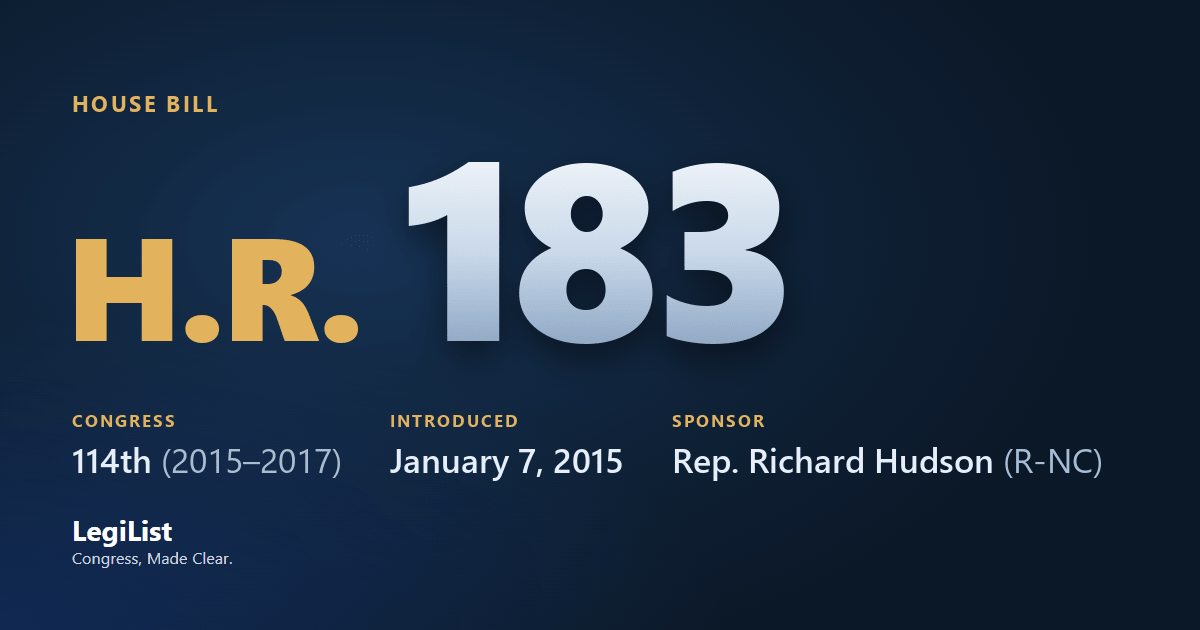
Federal Sunset Act of 2015
Latest action · Jan 7, 2015 Referred to the House Committee on Oversight and Government Reform.
Progress
Where this bill reached, and when. A stage with no date was not reached; one that failed a vote and later carried shows the date it carried.
- IntroducedJan 7, 2015
- Passed HouseNot reached
- Passed SenateNot reached
- To the PresidentNot reached
- Became lawNot reached
Summary
Federal Sunset Act of 2015
Establishes the Federal Agency Sunset Commission to: (1) submit to Congress a schedule for review by the Commission, at least once every 12 years, of the abolishment or reorganization of each federal executive agency, including advisory committees; (2) review and evaluate the efficiency and public need for each agency using specified criteria; (3) recommend whether each agency should be abolished or reorganized; and (4) report to Congress on all legislation introduced that would establish a new agency or a new program to be carried out by an existing agency. Requires the abolishment of any agency within one year of the Commission's review, unless the agency is reauthorized by Congress. Authorizes the deadline for abolishing an agency to be extended for an additional two years by legislation enacted by a super majority of the House of Representatives and the Senate.
Terminates the Commission on December 31, 2034.
Directs the Comptroller General and the Director of the Congressional Budget Office, in cooperation with the Director of the Congressional Research Service, to prepare an inventory of federal programs within each agency, including the budget authority for each such program, to assist Congress and the Commission in carrying out the requirements of this Act.
Cosponsors 13
Members who signed on, in the order they did. Signatures ran from Jan 13, 2015 to May 24, 2016.
| Seat | Cosponsor | Signed on | |
|---|---|---|---|
| R-KS | Mike Pompeo | Jan 13, 2015 | |
| R-TX | Pete Olson | Jan 13, 2015 | |
| R-NC | David Rouzer | Feb 2, 2015 | |
| R-TX | Randy Neugebauer | Feb 2, 2015 | |
| R-WI | Reid J. Ribble | Jul 23, 2015 | |
| R-KS | Lynn Jenkins | Mar 14, 2016 | |
| R-WA | Cathy McMorris Rodgers | Apr 21, 2016 | |
| R-TX | Pete Sessions | Apr 21, 2016 | |
| R-FL | Ted S. Yoho | Apr 21, 2016 | |
| R-UT | Chris Stewart | Apr 26, 2016 | |
| R-SC | Tom Rice | Apr 26, 2016 | |
| R-AR | Bruce Westerman | May 11, 2016 | |
| R-TX | Michael T. McCaul | May 24, 2016 |
Committees 1
Where it was sent and what each committee and subcommittee did with it, in order.
| Chamber | Committee | What it did |
|---|---|---|
| House | Oversight and Government Reform Committee | Referred Jan 7, 2015 |
Actions 2
Everything that happened, newest first.
- Jan 7, 2015Introduced in House
- Jan 7, 2015Referred to the House Committee on Oversight and Government Reform.
Research
What has been written about this bill: committee reports, cost estimates, the sponsor’s authority statement, printed hearings and the Congressional Research Service’s work.
Constitutional authority
The sponsor’s statement, as printed in the Congressional Record, vol. 161, no. 2, January 7, 2015, page H104.
Related bills 1
Companion bills and other measures the record links to this one.
| Bill | Title | Relationship | Latest action |
|---|---|---|---|
| HR 31 | Federal Sunset Act of 2017 | Reintroduced Bill | Jan 3, 2017 |
Titles 2
Every title it has carried, official and short, at each stage.
- Official Title as Introduced
- To provide for the periodic review of the efficiency and public need for Federal agencies, to establish a commission for the purpose of reviewing the efficiency and public need of such agencies, and to provide for the abolishment of agencies for which a public need does not exist.
- Short Titles as Introduced
- Federal Sunset Act of 2015
Subjects
Assigned by the Library of Congress. Policy area: Government Operations and Politics.
Text 1
Each version as it was printed, newest first.
- Jan 7, 2015Introduced in House
Everything here is as published by Congress: the summary is the Congressional Research Service's, the action wording is the clerks', and the subjects are the Library of Congress's. How far it got is read from the actions themselves, taking the most recent one of each kind, so a bill that failed a vote and later passed is shown as having passed. Records come from this bill on Congress.gov and govinfo.gov; cost estimates are the Congressional Budget Office's, and the hearings are the printed hearings GovInfo publishes, which can appear months after the hearing.