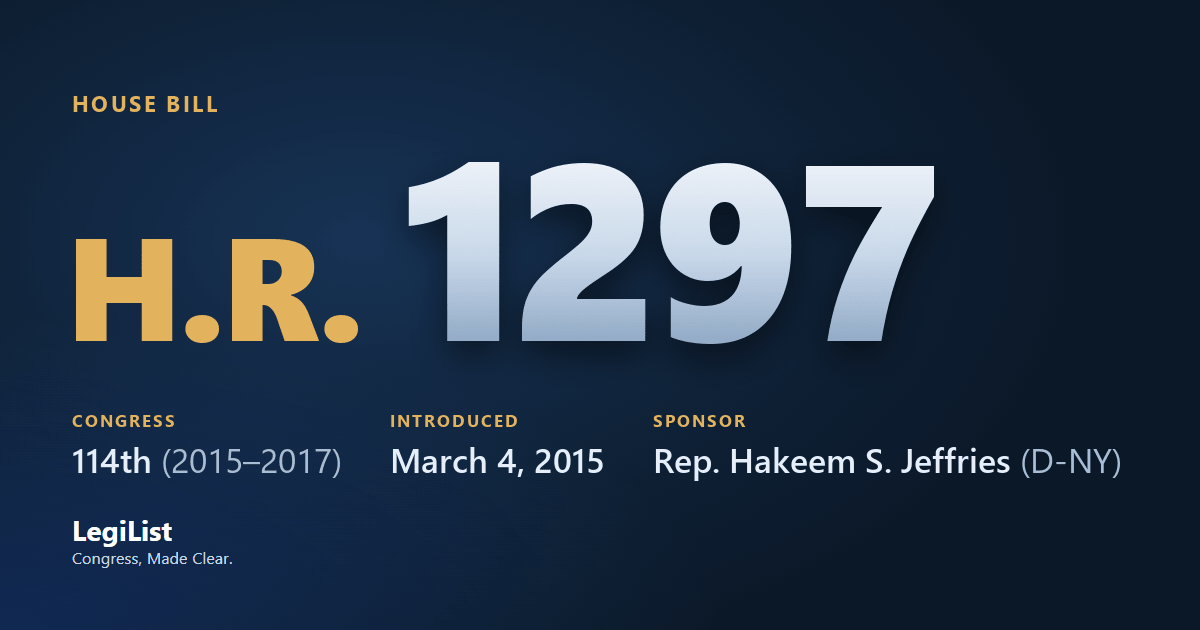
Disaster Response Reform Act of 2015
Latest action · Mar 5, 2015 Referred to the Subcommittee on Economic Development, Public Buildings and Emergency Management.
Progress
Where this bill reached, and when. A stage with no date was not reached; one that failed a vote and later carried shows the date it carried.
- IntroducedMar 4, 2015
- Passed HouseNot reached
- Passed SenateNot reached
- To the PresidentNot reached
- Became lawNot reached
Summary
Disaster Response Reform Act of 2015
Amends the Robert T. Stafford Disaster Relief and Emergency Assistance Act to require the President, in providing repair or replacement assistance to owner-occupied private residences damaged by a major disaster declared after enactment of this Act, to: (1) treat an owner-occupied housing unit of a housing cooperative in the same manner as an owner-occupied private residence, and (2) provide financial assistance for such units on a unit-by-unit basis. Authorizes the President to provide such assistance in connection with essential living items that are owned by the association for a housing cooperative and located in an owner-occupied housing unit of the cooperative.
Directs the President to provide such repair or replacement assistance in connection with damaged personal property that is located in the basement of an owner-occupied private residence in the same manner and to the same extent as personal property that is is located in any other portion of the residence.
Requires the Department of Housing and Urban Development (HUD) (for a covered mortgage that is owned or guaranteed by the Federal National Mortgage Association [Fannie Mae] or the Federal Home Loan Mortgage Corporation [Freddie Mac]) and the Federal Housing Finance Agency (FHFA) to prohibit mortgagees and servicers from initiating or taking action to further any foreclosure with respect to a covered mortgage for 90 days after a presidential declaration of the disaster. Defines a "covered mortgage" as a mortgage that: (1) is secured by a one- to four-family dwelling that is the mortgagor's principal residence and is located within a major disaster area declared by the President; and (2) is insured by the Federal Housing Administration or owned or guaranteed by Fannie Mae or Freddie Mac.
Sets forth requirements for: (1) notification by mortgagees to mortgagors regarding such forbearance relief, (2) requests by mortgagors to mortgagees for such relief; and (3) determinations by mortgagees regarding a mortgagor's eligibility for relief. Requires a mortgagee who determines, pursuant to a mortgagor's request, that such mortgagor is an eligible homeowner, to submit to the eligible homeowner:
- a written offer for forbearance that meets the requirements of this Act;
- explanations of the terms of such offer, when it will expire, and what action the mortgagor must take to accept it; and
- notification that the mortgagor and the mortgagee can agree to terms of forbearance in lieu of or in addition to forbearance relief required to be offered under this Act and how to contact the mortgagee regarding such relief.
Sets forth required terms of such forbearance, including: (1) a suspension of mortgage payments for at least six months, and (2) recoupment of any resulting arrearage by increasing the monthly payments due after the forbearance period by an not more than 5% of the monthly amount that would otherwise be due.
Directs HUD to enforce compliance by mortgagees with this Act and the guidelines issued under it.
Requires the FHFA, upon determining that a mortgagee has violated this Act, to prohibit Fannie Mae and Freddie Mac from acquiring or otherwise newly dealing in any mortgage of or originated by such mortgagee for 12 months.
Cosponsors
Members who signed on, in the order they did.
Committees 2
Where it was sent and what each committee and subcommittee did with it, in order.
| Chamber | Committee | What it did |
|---|---|---|
| House | Financial Services Committee | Referred Mar 4, 2015 |
| House | Transportation and Infrastructure Committee | Referred Mar 4, 2015 |
| Economic Development, Public Buildings, and Emergency Management Subcommittee | Referred Mar 5, 2015 |
Actions 3
Everything that happened, newest first.
- Mar 5, 2015Referred to the Subcommittee on Economic Development, Public Buildings and Emergency Management.
- Mar 4, 2015Introduced in House
- Mar 4, 2015Referred to the Committee on Financial Services, and in addition to the Committee on Transportation and Infrastructure, for a period to be subsequently determined by the Speaker, in each case for consideration of such provisions as fall within the jurisdiction of the committee concerned.
Research
What has been written about this bill: committee reports, cost estimates, the sponsor’s authority statement, printed hearings and the Congressional Research Service’s work.
Constitutional authority
The sponsor’s statement, as printed in the Congressional Record, vol. 161, no. 37, March 4, 2015, page H1616.
Titles 2
Every title it has carried, official and short, at each stage.
- Official Title as Introduced
- To amend the Robert T. Stafford Disaster Relief and Emergency Assistance Act to provide assistance for housing cooperatives damaged by a major disaster, to provide relief to homeowners affected by major disasters who have mortgages insured by the FHA or owned or guaranteed by Fannie Mae or Freddie Mac, and for other purposes.
- Short Titles as Introduced
- Disaster Response Reform Act of 2015
Subjects
Assigned by the Library of Congress. Policy area: Emergency Management.
Text 1
Each version as it was printed, newest first.
- Mar 4, 2015Introduced in House
Everything here is as published by Congress: the summary is the Congressional Research Service's, the action wording is the clerks', and the subjects are the Library of Congress's. How far it got is read from the actions themselves, taking the most recent one of each kind, so a bill that failed a vote and later passed is shown as having passed. Records come from this bill on Congress.gov and govinfo.gov; cost estimates are the Congressional Budget Office's, and the hearings are the printed hearings GovInfo publishes, which can appear months after the hearing.