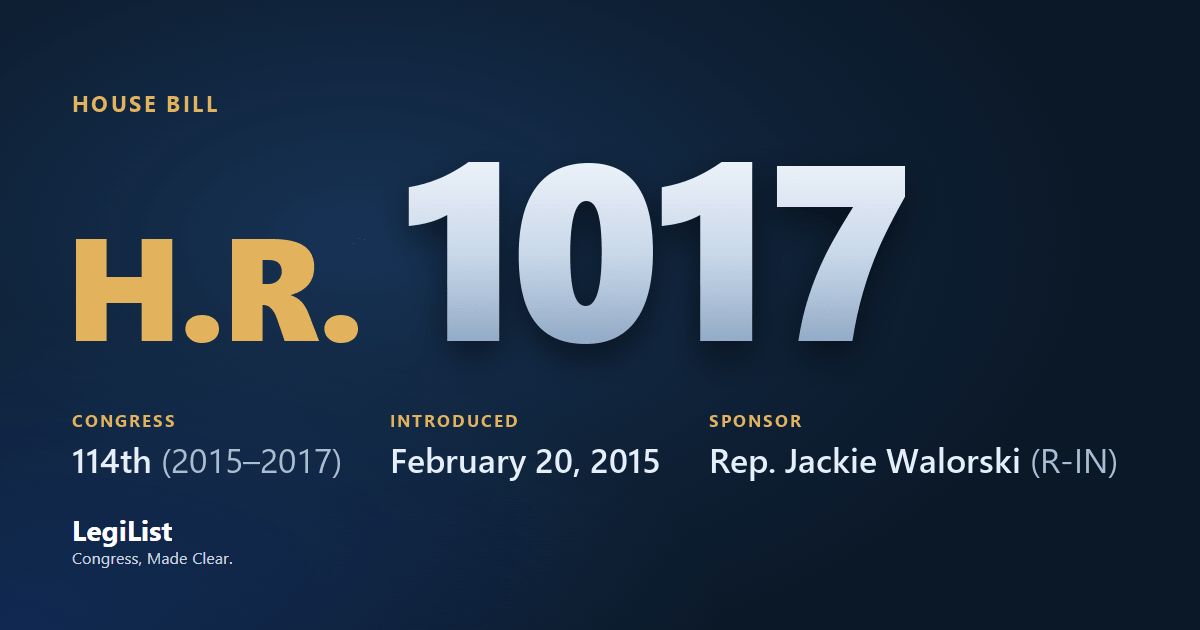
Veterans Information Security Improvement Act
Latest action · Apr 21, 2015 Forwarded by Subcommittee to Full Committee in the Nature of a Substitute (Amended) by Voice Vote .
Progress
Where this bill reached, and when. A stage with no date was not reached; one that failed a vote and later carried shows the date it carried.
- IntroducedFeb 20, 2015
- Passed HouseNot reached
- Passed SenateNot reached
- To the PresidentNot reached
- Became lawNot reached
Summary
Veterans Information Security Improvement Act
Directs the Secretary of Veterans Affairs to: (1) carry out certain information security activities, (2) ensure that officials and staff of the Department of Veterans Affairs (VA) possess specified qualifications in such areas, and (3) coordinate the staffing of related information technology and security offices.
Requires the Secretary to ensure that: (1) the Assistant Secretary for Information and Technology, the head of the Office of Information Security (OIS), and relevant field staff possess certain levels of information technology education, certifications, and experience; (2) Office of Information and Technology (OIT) staff are assigned to the OIS; and (3) subordinate OIT offices maintain appropriate information security functions.
Directs the Secretary to ensure that subordinate OIT offices maintain functions to: (1) integrate the VA's security architecture into the VA's overall enterprise architecture strategy, (2) restrict the development of new data warehouses and data marts holding sensitive personal information of veterans, (3) reduce the number of data marts holding such personal information, and (4) deploy an incident response capability.
Defines:
- "data mart" as a subset of a data warehouse that contains information for a specific entity of an organization rather than the entire organization, and
- "data warehouse" as a collection of data designed to support management decision making that contains a wide variety of data presenting a coherent picture of business conditions for an entire organization at a single point in time and whose development includes systems to extract data from operating systems plus installation of a warehouse database system that provides managers with flexible data access.
Requires the Secretary to safeguard VA network infrastructure, computers, and servers.
Directs the Secretary to protect the confidentiality of sensitive personal information of veterans by:
- providing upgrades or phaseouts of outdated or unsupported operating systems to protect against harmful viruses and malicious software; and
- securing VA web applications and the Veterans Health Information Systems and Technology Architecture (commonly referred to as the "Vista system," which allows for an integrated inpatient and outpatient electronic health record for patients and provides administrative tools to VA employees).
Directs the Secretary to submit certifications to Congress regarding the VA's compliance with information security requirements, including actions required by the National Institute of Standards and Technology and the Office of Management and Budget.
Requires the Secretary to submit monthly reports to Congress regarding security vulnerabilities discovered after performing regular scans of VA computers and servers.
Cosponsors 9
Members who signed on, in the order they did. Signatures ran from Feb 25, 2015 to Mar 13, 2015.
| Seat | Cosponsor | Signed on | |
|---|---|---|---|
| R-NV | Mark E. Amodei | Feb 25, 2015 | |
| R-PA | Mike Kelly | Feb 25, 2015 | |
| R-SD | Kristi L. Noem | Mar 4, 2015 | |
| R-AZ | Matt Salmon | Mar 4, 2015 | |
| R-IN | Susan W. Brooks | Mar 4, 2015 | |
| R-FL | Richard B. Nugent | Mar 10, 2015 | |
| R-OH | David P. Joyce | Mar 13, 2015 | |
| R-TX | Jeb Hensarling | Mar 13, 2015 | |
| R-PA | Ryan A. Costello | Mar 13, 2015 |
Committees 1
Where it was sent and what each committee and subcommittee did with it, in order.
| Chamber | Committee | What it did |
|---|---|---|
| House | Veterans' Affairs Committee | Referred Feb 20, 2015 |
| Oversight and Investigations Subcommittee | Referred Mar 13, 2015Hearings Mar 19, 2015Markup Apr 21, 2015Reported Apr 21, 2015 |
Actions 6
Everything that happened, newest first.
- Apr 21, 2015Subcommittee Consideration and Mark-up Session Held.
- Apr 21, 2015Forwarded by Subcommittee to Full Committee in the Nature of a Substitute (Amended) by Voice Vote .
- Mar 19, 2015Subcommittee Hearings Held.
- Mar 13, 2015Referred to the Subcommittee on Oversight and Investigations.
- Feb 20, 2015Introduced in House
- Feb 20, 2015Referred to the House Committee on Veterans' Affairs.
Research
What has been written about this bill: committee reports, cost estimates, the sponsor’s authority statement, printed hearings and the Congressional Research Service’s work.
Constitutional authority
The sponsor’s statement, as printed in the Congressional Record, vol. 161, no. 29, February 20, 2015, page H1084.
Printed hearings 1
Hearings whose printed record names this bill, newest first: hearings on it, and wider hearings where it came up.
| Number | Hearing | Committee | Held |
|---|---|---|---|
| Serial No. 114-11 | LEGISLATIVE HEARING ON H.R. 571, H.R. 593, H.R. 1015, H.R. 1016, H.R. 1017, H.R. 1128, AND H.R. 112979 pages | Veterans' Affairs Committee | Mar 19, 2015 |
Titles 2
Every title it has carried, official and short, at each stage.
- Official Title as Introduced
- To improve the information security of the Department of Veterans Affairs by directing the Secretary of Veterans Affairs to carry out certain actions to improve the transparency and the governance of the information security program of the Department, and for other purposes.
- Short Titles as Introduced
- Veterans Information Security Improvement Act
Subjects
Assigned by the Library of Congress. Policy area: Armed Forces and National Security.
- Advanced technology and technological innovations
- Armed Forces and National Security
- Computer security and identity theft
- Computers and information technology
- Department of Veterans Affairs
- Federal officials
- Government information and archives
- Health information and medical records
- Internet and video services
- Internet, web applications, social media
- Right of privacy
- Veterans' medical care
Text 1
Each version as it was printed, newest first.
- Feb 20, 2015Introduced in House
Support LegiList
This page is free, carries no paywall, and is built and maintained by one person. If the record here is useful to you, a few dollars keeps it going.
Everything here is as published by Congress: the summary is the Congressional Research Service's, the action wording is the clerks', and the subjects are the Library of Congress's. How far it got is read from the actions themselves, taking the most recent one of each kind, so a bill that failed a vote and later passed is shown as having passed. Records come from this bill on Congress.gov and govinfo.gov; cost estimates are the Congressional Budget Office's, and the hearings are the printed hearings GovInfo publishes, which can appear months after the hearing.