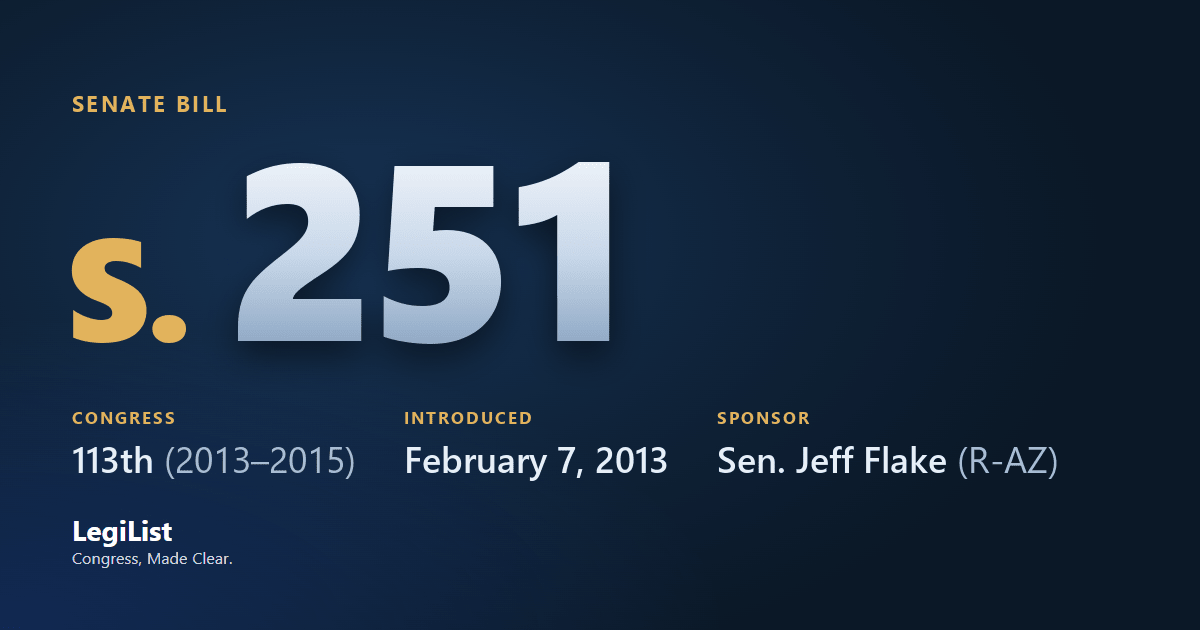
Phantom Fuel Reform Act
Latest action · Feb 7, 2013 Read twice and referred to the Committee on Environment and Public Works.
Progress
Where this bill reached, and when. A stage with no date was not reached; one that failed a vote and later carried shows the date it carried.
- IntroducedFeb 7, 2013
- Passed SenateNot reached
- Passed HouseNot reached
- To the PresidentNot reached
- Became lawNot reached
Summary
Phantom Fuel Reform Act - Amends the Clean Air Act to revise the renewable fuel program by requiring the Administrator of the Energy Information Administration, in estimating the projected volume of cellulosic biofuel to be sold or introduced into commerce in the next year, to determine for each facility producing such biofuel during the current year: (1) the average monthly volume of biofuel produced by such facility based on the actual volume produced through October 31, and (2) the estimated annualized volume of biofuel production for such facility for the current year based on such average monthly production. Requires the estimate of cellulosic biofuel projected to be sold or introduced into commerce in the following year to equal the total of the estimated annual volumes of cellulosic biofuel production for all such facilities.
Requires (currently, authorizes) the Administrator, in any year in which the Administrator reduces the applicable volume of cellulosic biofuel required in gasoline, to also reduce the applicable volume of renewable fuel and advanced biofuels required by the same (currently, by the same or a lesser) volume.
Cosponsors 2
Members who signed on, in the order they did. All signed on Feb 7, 2013.
| Seat | Cosponsor | Signed on | |
|---|---|---|---|
| R-LA | David Vitter | Original | Feb 7, 2013 |
| R-ID | Mike Crapo | Original | Feb 7, 2013 |
Committees 1
Where it was sent and what each committee and subcommittee did with it, in order.
| Chamber | Committee | What it did |
|---|---|---|
| Senate | Environment and Public Works Committee | Referred Feb 7, 2013 |
Actions 2
Everything that happened, newest first.
- Feb 7, 2013Introduced in Senate
- Feb 7, 2013Read twice and referred to the Committee on Environment and Public Works.
Research
What has been written about this bill: committee reports, cost estimates, the sponsor’s authority statement, printed hearings and the Congressional Research Service’s work.
CRS reports 4
Congressional Research Service work that CRS links to this bill or the law it became, newest first.
Cite it 4
Products on other subjects that cite it, usually among other measures.
| Product | Title | Kind | Published |
|---|---|---|---|
| R41106 | The Renewable Fuel Standard (RFS): Cellulosic Biofuels Archived | Report | Aug 31, 2015 |
| R40155 | Renewable Fuel Standard (RFS): Overview and Issues Archived | Report | Nov 22, 2013 |
| R41282 | Agriculture-Based Biofuels: Overview and Emerging Issues Archived | Report | May 1, 2013 |
| R42954 | Animal Agriculture: Selected Issues in the 113th Congress Archived | Report | Feb 11, 2013 |
Related bills 2
Companion bills and other measures the record links to this one.
| Bill | Title | Relationship | Latest action |
|---|---|---|---|
| HR 550 | Phantom Fuel Reform Act of 2013 | Related bill | Feb 8, 2013 |
| HR 1462 | RFS Reform Act of 2013 | Related bill | Apr 12, 2013 |
Titles 2
Every title it has carried, official and short, at each stage.
- Official Title as Introduced
- A bill to amend the renewable fuel program under section 211(o) of the Clean Air Act to require the cellulosic biofuel requirement to be based on actual production.
- Short Titles as Introduced
- Phantom Fuel Reform Act
Subjects
Assigned by the Library of Congress. Policy area: Energy.
Text 1
Each version as it was printed, newest first.
- Feb 7, 2013Introduced in Senate
Everything here is as published by Congress: the summary is the Congressional Research Service's, the action wording is the clerks', and the subjects are the Library of Congress's. How far it got is read from the actions themselves, taking the most recent one of each kind, so a bill that failed a vote and later passed is shown as having passed. Records come from this bill on Congress.gov and govinfo.gov; cost estimates are the Congressional Budget Office's, and the hearings are the printed hearings GovInfo publishes, which can appear months after the hearing.