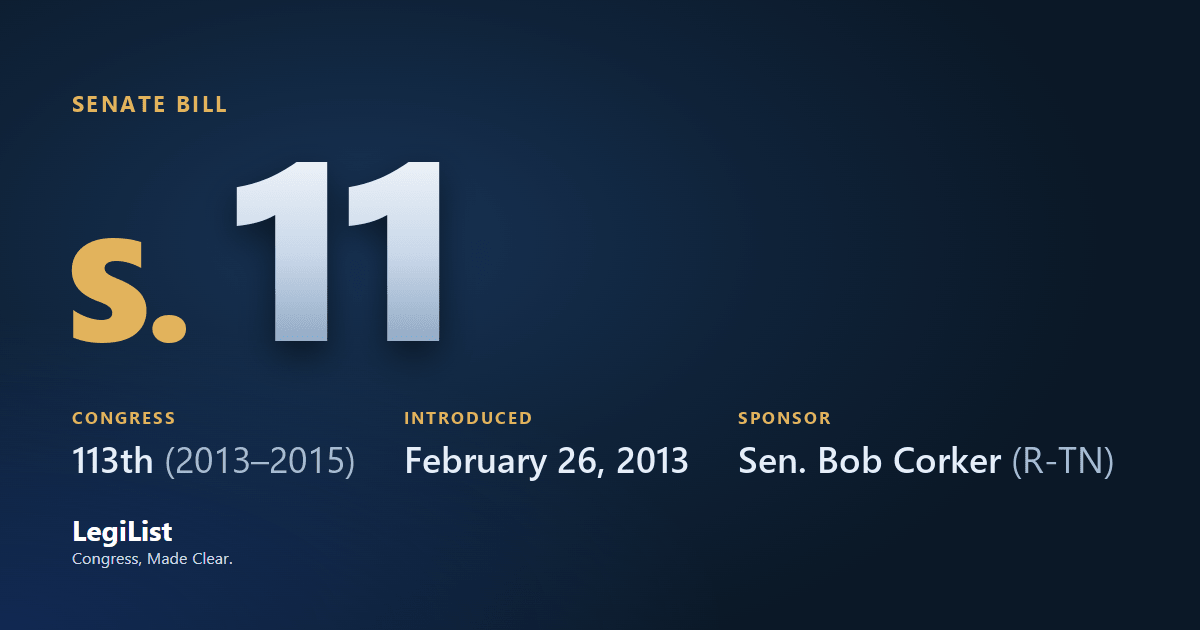
Fiscal Sustainability Act of 2013
Latest action · Feb 26, 2013 Read twice and referred to the Committee on Finance.
Progress
Where this bill reached, and when. A stage with no date was not reached; one that failed a vote and later carried shows the date it carried.
- IntroducedFeb 26, 2013
- Passed SenateNot reached
- Passed HouseNot reached
- To the PresidentNot reached
- Became lawNot reached
Summary
Fiscal Sustainability Act of 2013 - Amends title XI of the Social Security Act (SSA) to authorize a five-year renewable comprehensive Medicaid waiver to allow a state to elect to provide medical assistance under SSA title XIX (Medicaid), directly or by contract, to eligible individuals pursuant to the comprehensive waiver in lieu of providing such assistance under an approved state plan or an approved waiver.
Allows a state to elect also to treat under the same comprehensive Medicaid waiver individuals eligible for child health assistance under SSA title XXI (State Children's Health Insurance Program) (CHIP).
Makes a state conducting a comprehensive Medicaid waiver eligible for a shared savings bonus of 25% of the waiver savings.
Directs the Secretary of Health and Human Services (HHS) to establish a template for determining the aggregate spending cap for each state for each period for which the state conducts a comprehensive Medicaid waiver.
Amends SSA title XIX to phase-in elimination of allowable provider taxes under the Medicaid program.
Medicare Total Health Act of 2013 - Amends SSA title XVIII (Medicare) to establish the Medicare Total Health Program. Sunsets Medicare Advantage (Medicare+Choice) plans under SSA title XVIII part C on January 1, 2017.
Includes in a qualified Total Health benefits package: (1) standard health benefits coverage (as under the original Medicare fee-for-service program option) with access to negotiated process, and (2) alternative Total Health benefits coverage with at least actuarially equivalent benefits and access to negotiated prices. Allows a qualified Total Health benefits package to include supplemental health benefits coverage consisting of either or both of certain reductions in cost-sharing or additional benefits not covered under the original Medicare fee-for-service program option, which might be prescription drug coverage under Medicare part D (Voluntary Prescription Drug Benefits Program).
Directs the Secretary to establish larger-than-county Total Health regions as service areas according to a specified procedure.
Prescribes requirements for Total Health sponsors, premiums, directs subsidies and cost-sharing, special rules for employer-sponsored programs, and coordination with state Medicaid programs.
Replaces the Medicare part B (Supplementary Medical Insurance Benefits for the Aged and Disabled) premium with a Medicare total health program plan premium.
Establishes thresholds and caps for out-of-pocket expenses.
Establishes a unified Medicare deductible of $550 for 2015 (adjusted for any subsequent year by the percentage change in the Chained Consumer Price Index for All Urban Consumers for the 12-month period ending with June of such preceding year).
Establishes a uniform Medicare coinsurance rate of 20%.
Directs the Secretary to request the National Association of Insurance Commissions to review and revise the standards for benefit packages, updating them to include requirements for specified cost-sharing.
Prohibits issuance of Medicare supplemental (Medigap) policies to an individual after December 31, 2006, unless the individual was covered under a Medigap policy as of such date.
Amends the Statutory Pay-As-You-Go-Act of 2010 to eliminate the exemption of Medicare payments to physicians from estimates of budgetary effects.
Reduces from $80,000 to $50,000 the threshold amount for 2013 and subsequent years for determining the monthly amount of the premium subsidy (for high-income beneficiaries) applicable to Medicare part B and part D premiums.
Extends temporary adjustments to income thresholds.
Increases the Medicare eligibility age (currently age 65) to: (1) 65 and 2 months for an individual who attains age 65 bet wen 2013 and 2025, and (3) 67 for an individual who attains age 65 after 2024.
Limits Medicare payments for direct graduate medical education (GME).
Reduces the Medicare indirect GME payments.
Accelerates: (1) application of productivity adjustment to Medicare home health prospective payment amounts, and (2) rebasing of Medicare home health prospective payments.
Increases the percentage reduction of bad debt as an allowable cost in hospital, skilled nursing facility, and other provider services attributable to the deductibles and coinsurance amounts from FY2014 through FY 2018 (when bad debt will be eliminated as an allowable cost).
Amends SSA title II (Old Age, Survivors, and Disability Insurance) (OASDI) to make adjustments to: (1) bend points in determining the primary insurance amount; and (2) calculation of benefit computation years.
Establishes a minimum monthly Social Security insurance benefit.
Increases monthly Social Security insurance benefit after 20 years of initial eligibility.
Revises requirements for normal and early retirement age.
Entitles disabled beneficiaries who attain early retirement age to only the larger or, if the individual so elects, only the smaller of disability or old age benefits.
Directs the Commissioner of Social Security to establish: (1) an option for a fully insured individual to elect to receive a reduced monthly benefit after such individual attains age 62, and (2) a public information campaign to provide information and education regarding the implications on personal financial security of early and other retirement decisions and the need for greater retirement savings.
Revises requirements for the coverage of state and local government employees.
Amends the Internal Revenue Code to revise the formula for determining the cost-of-living adjustment for any calendar year. Modifies the cost-of-living indexation of Social Security benefits.
Cosponsors 1
Members who signed on, in the order they did. All signed on Feb 26, 2013.
| Seat | Cosponsor | Signed on | |
|---|---|---|---|
| R-TN | Lamar Alexander | Original | Feb 26, 2013 |
Actions 2
Everything that happened, newest first.
- Feb 26, 2013Introduced in Senate
- Feb 26, 2013Read twice and referred to the Committee on Finance.
Related bills 1
Companion bills and other measures the record links to this one.
| Bill | Title | Relationship | Latest action |
|---|---|---|---|
| S 1198 | Medicare Fair Share Act of 2013 | Related bill | Jun 20, 2013 |
Subjects
Assigned by the Library of Congress. Policy area: Economics and Public Finance.
- Administrative law and regulatory procedures
- Administrative remedies
- Budget deficits and national debt
- Budget process
- Child health
- Congressional oversight
- Economics and Public Finance
- Education programs funding
- Employee benefits and pensions
- Employment taxes
- Government employee pay, benefits, personnel management
- Government information and archives
- Health care costs and insurance
- Health care coverage and access
- Health care quality
- Health personnel
- Health programs administration and funding
- Health promotion and preventive care
- Home and outpatient care
- Inflation and prices
- Judicial review and appeals
- Medicaid
- Medical education
- Medicare
- Performance measurement
- Poverty and welfare assistance
- Sales and excise taxes
- Social Security Administration
- Social security and elderly assistance
- State and local government operations
- Wages and earnings
Text 1
Each version as it was printed, newest first.
- Feb 26, 2013Introduced in Senate
Everything here is as published by Congress: the summary is the Congressional Research Service's, the action wording is the clerks', and the subjects are the Library of Congress's. How far it got is read from the actions themselves, taking the most recent one of each kind, so a bill that failed a vote and later passed is shown as having passed. Records come from this bill on Congress.gov and govinfo.gov.