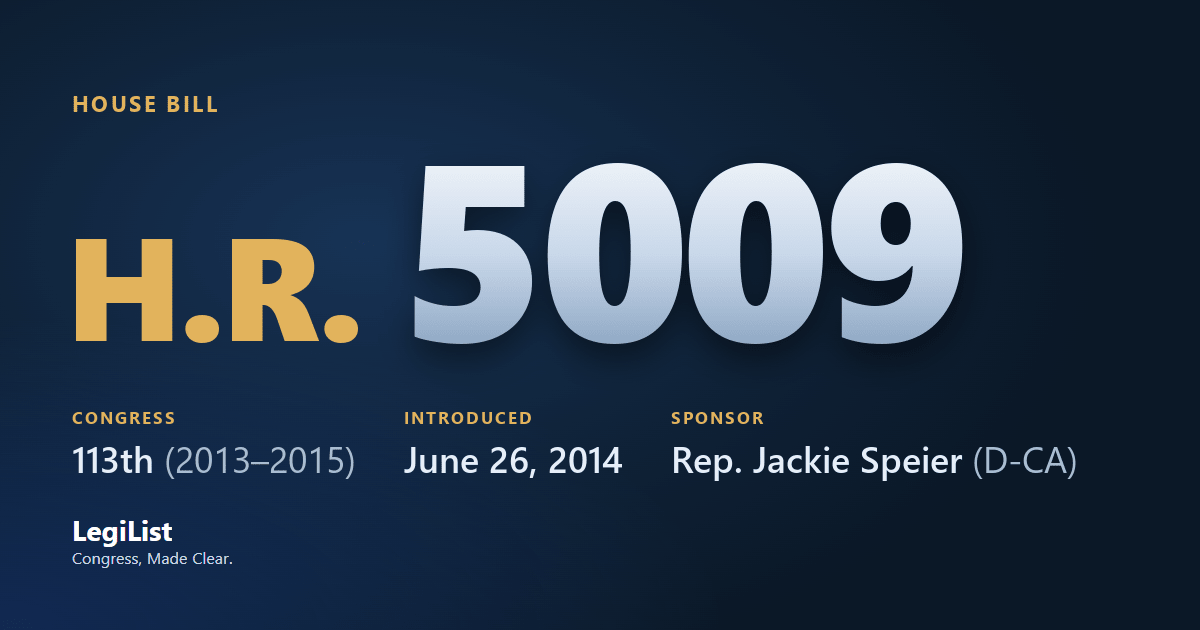
Military Separation Pay Fairness Act of 2014
Latest action · Jun 26, 2014 Referred to the House Committee on Armed Services.
Progress
Where this bill reached, and when. A stage with no date was not reached; one that failed a vote and later carried shows the date it carried.
- IntroducedJun 26, 2014
- Passed HouseNot reached
- Passed SenateNot reached
- To the PresidentNot reached
- Became lawNot reached
Summary
Military Separation Pay Fairness Act of 2014 - Directs the Secretary of Defense (DOD) to determine whether former members of the Armed Forces who were separated for a violation of the policy concerning homosexuality in the Armed Forces as in effect before the effective date of the Don't Ask, Don't Tell Repeal Act of 2010 were paid: (1) the full amount of separation pay to which they should have been entitled under standard military separation pay laws, or (2) a reduced amount because of homosexuality pursuant to administrative instructions in place at the time of the separation.
Requires the Secretary to pay such a former member who has not received the full military separation pay: (1) the amount of the difference between the full amount and the amount actually paid, and (2) interest on the amount of the difference.
Excludes former members who joined the class-action settlement in Collins v. United States from receiving additional payments for the difference in amounts under such procedures, but provides for former members in such settlement to receive payment for interest on such amount.
Cosponsors 53
Members who signed on, in the order they did. Signatures ran from Jul 3, 2014 to Dec 1, 2014.
| Seat | Cosponsor | Signed on | |
|---|---|---|---|
| D-TX | Al Green | Jul 3, 2014 | |
| D-CA | Alan S. Lowenthal | Jul 3, 2014 | |
| D-NH | Ann M. Kuster | Jul 3, 2014 | |
| D-CA | Anna G. Eshoo | Jul 3, 2014 | |
| D-MN | Betty McCollum | Jul 3, 2014 | |
| D-NY | Brian Higgins | Jul 3, 2014 | |
| D-NY | Carolyn B. Maloney | Jul 3, 2014 | |
| D-RI | David N. Cicilline | Jul 3, 2014 | |
| D-NV | Dina Titus | Jul 3, 2014 | |
| D-OR | Earl Blumenauer | Jul 3, 2014 | |
| D-CA | George Miller | Jul 3, 2014 | |
| D-GA | Henry C. "Hank" Johnson, Jr. | Jul 3, 2014 | |
| D-VA | James P. Moran | Jul 3, 2014 | |
| D-RI | James R. Langevin | Jul 3, 2014 | |
| D-CA | Janice Hahn | Jul 3, 2014 |
Committees 1
Where it was sent and what each committee and subcommittee did with it, in order.
| Chamber | Committee | What it did |
|---|---|---|
| House | Armed Services Committee | Referred Jun 26, 2014 |
Actions 2
Everything that happened, newest first.
- Jun 26, 2014Introduced in House
- Jun 26, 2014Referred to the House Committee on Armed Services.
Research
What has been written about this bill: committee reports, cost estimates, the sponsor’s authority statement, printed hearings and the Congressional Research Service’s work.
Constitutional authority
The sponsor’s statement, as printed in the page H5819.
Titles 2
Every title it has carried, official and short, at each stage.
- Official Title as Introduced
- To require the payment of the full amount of separation pay otherwise due to former members of the Armed Forces who were separated under the former Don't Ask, Don't Tell Policy of the Department of Defense and were only paid a portion of the full amount.
- Short Titles as Introduced
- Military Separation Pay Fairness Act of 2014
Subjects
Assigned by the Library of Congress. Policy area: Armed Forces and National Security.
Text 1
Each version as it was printed, newest first.
- Jun 26, 2014Introduced in House
Everything here is as published by Congress: the summary is the Congressional Research Service's, the action wording is the clerks', and the subjects are the Library of Congress's. How far it got is read from the actions themselves, taking the most recent one of each kind, so a bill that failed a vote and later passed is shown as having passed. Records come from this bill on Congress.gov and govinfo.gov; cost estimates are the Congressional Budget Office's, and the hearings are the printed hearings GovInfo publishes, which can appear months after the hearing.