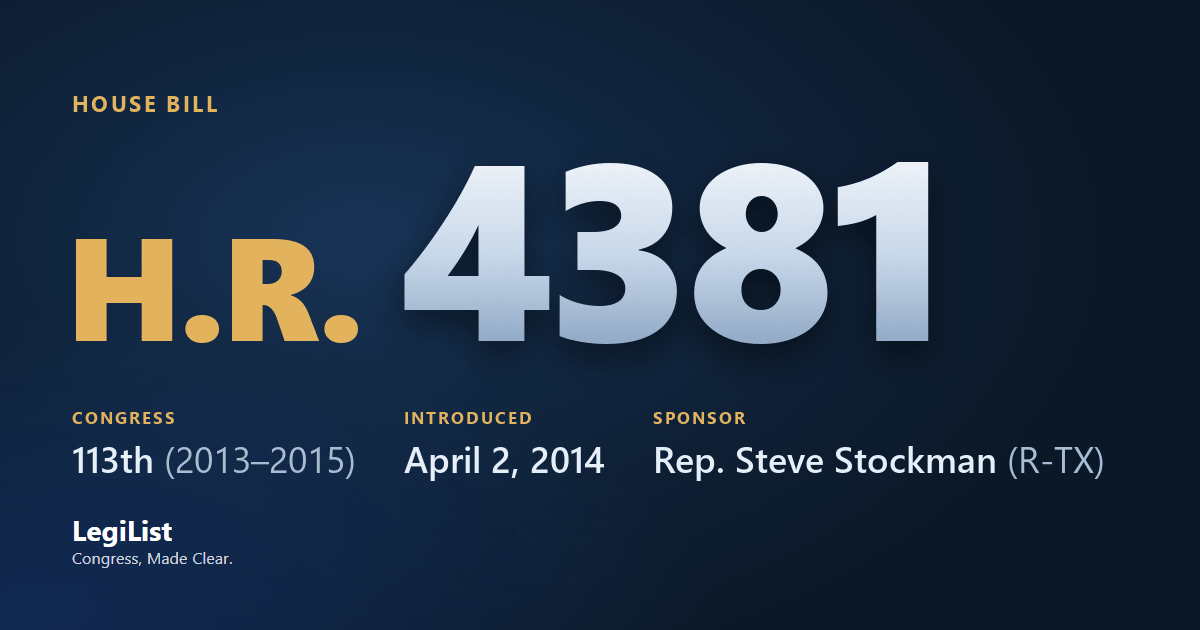
Biometric Information Privacy Act
Latest action · Apr 16, 2014 Referred to the Subcommittee on Crime, Terrorism, Homeland Security, and Investigations.
Progress
Where this bill reached, and when. A stage with no date was not reached; one that failed a vote and later carried shows the date it carried.
- IntroducedApr 2, 2014
- Passed HouseNot reached
- Passed SenateNot reached
- To the PresidentNot reached
- Became lawNot reached
Summary
Biometric Information Privacy Act - Establishes an offense that subjects business entities (including organizations, trusts, and nonprofits), government entities, and people to penalties for knowingly: (1) obtaining in a fraudulent manner personal physiological biometric information relating to an individual, or (2) disclosing such information without permission from the individuals to whom the information pertains.
Defines "personal physiological biometric information" as genetic information, finger prints, palm prints, hand geometry, iris scans, retina scans, and eye vein scans.
Sets forth the following penalties to apply to such offenses:
- a fine of up to $50,000, imprisonment for up to 1 year, or both;
- if the offense is committed under false pretenses, a fine of up to $100,000, imprisonment for up to 5 years, or both; and
- if the offense is committed with intent to sell, transfer, or use individually identifiable health information for commercial advantage, personal gain, or malicious harm, a fine of up to $250,000, imprisonment for up to 10 years, or both.
Permits a governmental entity to obtain such personal information pursuant to a court order only if, in the court proceeding relevant to such order: (1) such entity offers clear and convincing evidence that the subject of the information is reasonably suspected of engaging in criminal activity and that the information sought would be material evidence in the case, and (2) the subject of the information is afforded the opportunity to appear and contest such entity's claim.
Requires the Attorney General (DOJ) to enforce violations of this Act.
Cosponsors
Members who signed on, in the order they did.
Committees 1
Where it was sent and what each committee and subcommittee did with it, in order.
| Chamber | Committee | What it did |
|---|---|---|
| House | Judiciary Committee | Referred Apr 2, 2014 |
| Crime and Federal Government Surveillance Subcommittee | Referred Apr 16, 2014 |
Actions 3
Everything that happened, newest first.
- Apr 16, 2014Referred to the Subcommittee on Crime, Terrorism, Homeland Security, and Investigations.
- Apr 2, 2014Introduced in House
- Apr 2, 2014Referred to the House Committee on the Judiciary.
Research
What has been written about this bill: committee reports, cost estimates, the sponsor’s authority statement, printed hearings and the Congressional Research Service’s work.
Constitutional authority
The sponsor’s statement, as printed in the page H2854.
Titles 2
Every title it has carried, official and short, at each stage.
- Official Title as Introduced
- To protect the privacy of individuals' personal genetic information and other personal identifier information.
- Short Titles as Introduced
- Biometric Information Privacy Act
Subjects
Assigned by the Library of Congress. Policy area: Civil Rights and Liberties, Minority Issues.
Text 1
Each version as it was printed, newest first.
- Apr 2, 2014Introduced in House
Support LegiList
This page is free, carries no paywall, and is built and maintained by one person. If the record here is useful to you, a few dollars keeps it going.
Everything here is as published by Congress: the summary is the Congressional Research Service's, the action wording is the clerks', and the subjects are the Library of Congress's. How far it got is read from the actions themselves, taking the most recent one of each kind, so a bill that failed a vote and later passed is shown as having passed. Records come from this bill on Congress.gov and govinfo.gov; cost estimates are the Congressional Budget Office's, and the hearings are the printed hearings GovInfo publishes, which can appear months after the hearing.