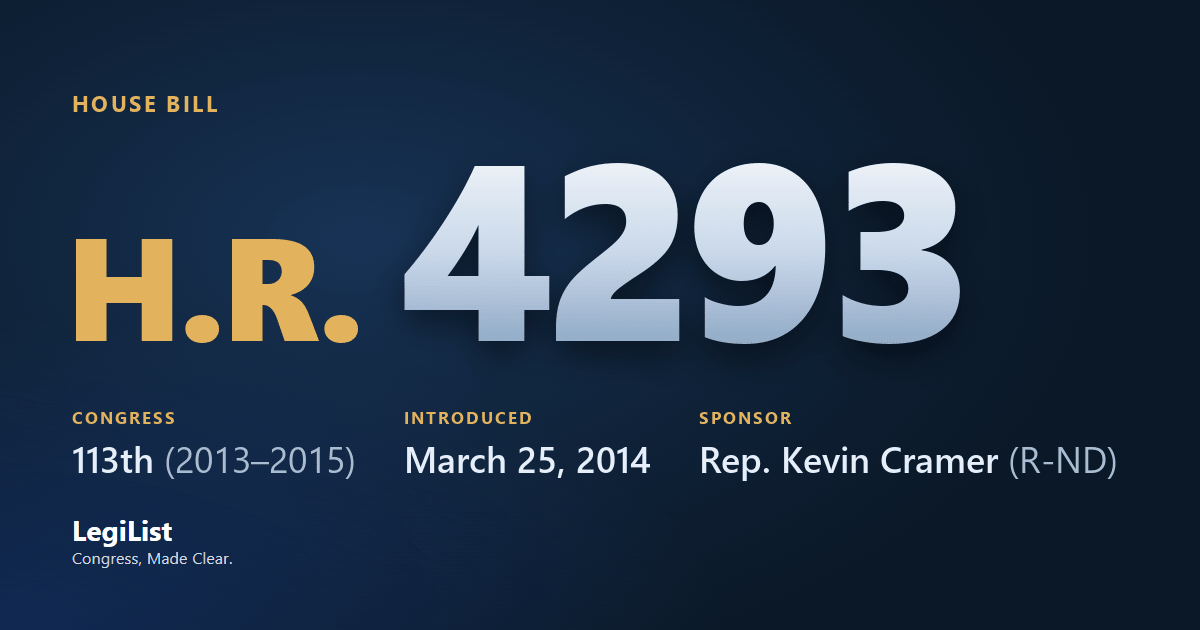
Natural Gas Gathering Enhancement Act
Latest action · Jun 20, 2014 Subcommittee Hearings Held.
Progress
Where this bill reached, and when. A stage with no date was not reached; one that failed a vote and later carried shows the date it carried.
- IntroducedMar 25, 2014
- Passed HouseNot reached
- Passed SenateNot reached
- To the PresidentNot reached
- Became lawNot reached
Summary
Natural Gas Gathering Enhancement Act - Authorizes the Secretary of the Interior to permit the use of rights of way for natural gas pipelines through public lands, forest, and other reservations of the United States, and specified national parks in California.
Defines "gas gathering line and associated field compression unit" as: (1) a pipeline installed to transport natural gas production associated with one or more wells drilled and completed to produce crude oil; and (2) if necessary, a compressor to raise the pressure of that transported natural gas to higher pressures suitable to enable the gas to flow into pipelines and other facilities.
Excludes from such definition any pipeline or compression unit installed to transport natural gas from a processing plant to a common carrier pipeline or facility.
Excludes from federal lands, for purposes of gas gathering line and associated field compression units, any unit of the National Park System, any unit of the National Wildlife Refuge System, or a component of the National Wilderness Preservation System.
Deems the issuance of a sundry notice or right-of-way for a gas gathering line and associated field compression unit located on federal or Indian land and servicing an oil well to be an action categorically excluded for purposes of the National Environmental Policy Act of 1969 (NEPA), if the line and the compression unit: (1) are within a field or unit for which an approved land use plan or an environmental document prepared pursuant to NEPA analyzed transportation of natural gas produced from one or more oil wells in that field or unit as a reasonably foreseeable activity, and (2) are located adjacent to an existing disturbed area for the construction of a road or pad.
(A "categorical exclusion" is a category of actions which do not individually or cumulatively have a significant effect on the human environment and which have been found to have no such effect in procedures adopted by a federal agency in implementing environmental regulations and for which, therefore, neither an environmental assessment nor an environmental impact statement is required.)
Declares such categorical exclusion inapplicable if the governor of the state or the Indian tribe with jurisdiction requests in writing that it be waived.
Amends the Energy Policy Act of 2005 to direct the Secretary to study permissible actions or proposed changes to federal law which would expedite permitting for gas gathering lines and associated field compression units on federal or Indian land to transport natural gas associated with crude oil production, on any land, to a processing plant or a common carrier pipeline for delivery to markets.
Amends the Mineral Leasing Act and the Federal Land Policy and Management Act of 1976 to direct the appropriate agency head to issue a sundry notice or right-of-way for a gas gathering line and associated field compression unit located on federal or public lands: (1) within 30 days after receiving the request for a line and compression unit described in this Act, and (2) within 60 days after receiving a request for all other lines and compression units.
Cosponsors 1
Members who signed on, in the order they did. All signed on Mar 25, 2014.
| Seat | Cosponsor | Signed on | |
|---|---|---|---|
| R-WY | Cynthia M. Lummis | Original | Mar 25, 2014 |
Committees 2
Where it was sent and what each committee and subcommittee did with it, in order.
| Chamber | Committee | What it did |
|---|---|---|
| House | Natural Resources Committee | Referred Mar 25, 2014 |
| Energy and Mineral Resources Subcommittee | Referred Mar 27, 2014Hearings Jun 20, 2014 | |
| Federal Lands Subcommittee | Referred Mar 27, 2014 | |
| House | Agriculture Committee | Referred Mar 25, 2014 |
| Forestry and Horticulture Subcommittee | Referred Apr 1, 2014 |
Actions 6
Everything that happened, newest first.
- Jun 20, 2014Subcommittee Hearings Held.
- Apr 1, 2014Referred to the Subcommittee on Conservation, Energy, and Forestry.
- Mar 27, 2014Referred to the Subcommittee on Energy and Mineral Resources.
- Mar 27, 2014Referred to the Subcommittee on Public Lands and Environmental Regulation.
- Mar 25, 2014Introduced in House
Research
What has been written about this bill: committee reports, cost estimates, the sponsor’s authority statement, printed hearings and the Congressional Research Service’s work.
Constitutional authority
The sponsor’s statement, as printed in the page H2644.
Printed hearings 1
Hearings whose printed record names this bill, newest first: hearings on it, and wider hearings where it came up.
Related bills 2
Companion bills and other measures the record links to this one.
| Bill | Title | Relationship | Latest action |
|---|---|---|---|
| S 2112 | Natural Gas Gathering Enhancement Act | Identical bill | Mar 12, 2014 |
| S 2592 | North Atlantic Energy Security Act | Related bill | Jul 21, 2014 |
Titles 2
Every title it has carried, official and short, at each stage.
- Official Title as Introduced
- To authorize the approval of natural gas pipelines and establish deadlines and expedite permits for certain natural gas gathering lines on Federal land and Indian land.
- Short Titles as Introduced
- Natural Gas Gathering Enhancement Act
Subjects
Assigned by the Library of Congress. Policy area: Energy.
- Administrative law and regulatory procedures
- Congressional oversight
- Energy
- Environmental assessment, monitoring, research
- Government studies and investigations
- Indian lands and resources rights
- Land use and conservation
- Licensing and registrations
- Oil and gas
- Parks, recreation areas, trails
- Pipelines
Text 1
Each version as it was printed, newest first.
- Mar 25, 2014Introduced in House
Support LegiList
This page is free, carries no paywall, and is built and maintained by one person. If the record here is useful to you, a few dollars keeps it going.
Everything here is as published by Congress: the summary is the Congressional Research Service's, the action wording is the clerks', and the subjects are the Library of Congress's. How far it got is read from the actions themselves, taking the most recent one of each kind, so a bill that failed a vote and later passed is shown as having passed. Records come from this bill on Congress.gov and govinfo.gov; cost estimates are the Congressional Budget Office's, and the hearings are the printed hearings GovInfo publishes, which can appear months after the hearing.