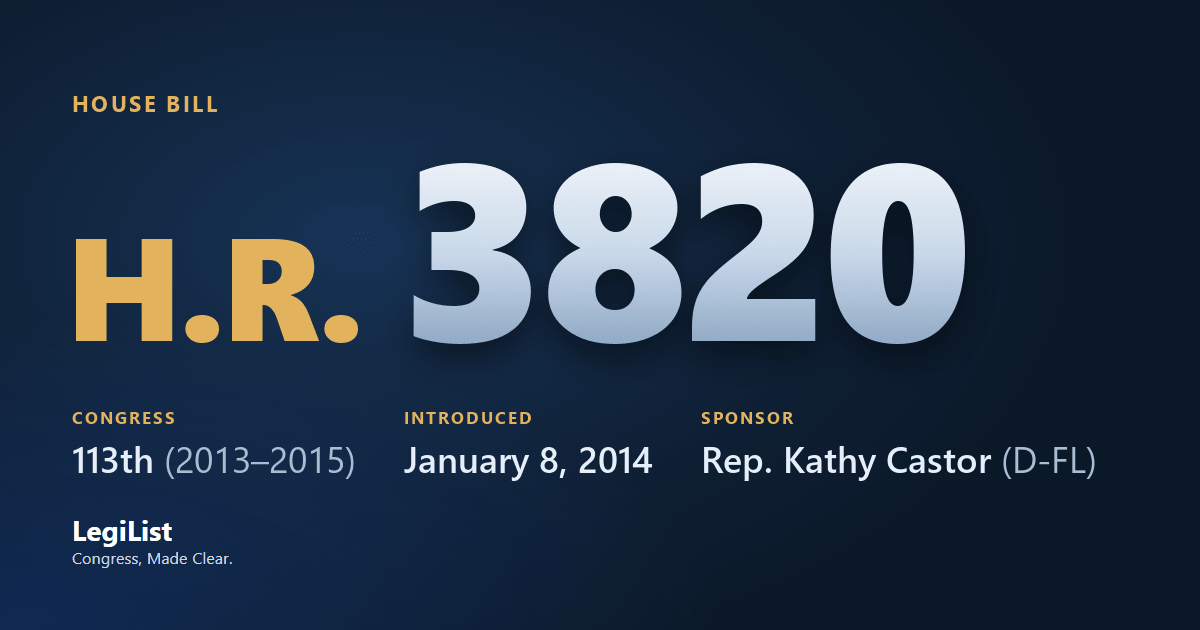
To encourage benchmarking and disclosure of energy information for commercial buildings.
Latest action · Jan 10, 2014 Referred to the Subcommittee on Energy and Power.
Progress
Where this bill reached, and when. A stage with no date was not reached; one that failed a vote and later carried shows the date it carried.
- IntroducedJan 8, 2014
- Passed HouseNot reached
- Passed SenateNot reached
- To the PresidentNot reached
- Became lawNot reached
Summary
Amends the Energy Independence and Security Act of 2007 to revise exceptions to the requirement that federal agencies must lease space in buildings that have earned the Energy Star label. Requires a space leased by an agency in a building that has not earned the Energy Star label to be benchmarked under a nationally recognized, online, free benchmarking program, with public disclosure. Exempts from such requirement a space for which owners cannot access whole building utility consumption data.
Requires an agency that is a tenant of a space that has not earned such label to provide to a building owner, or authorize the owner to obtain from the utility, the energy consumption information of the space for the benchmarking and disclosure requirements.
Requires the Secretary of Energy (DOE) to study and report on: (1) the impact of state and local performance benchmarking and disclosure policies, and any associated building efficiency policies, for commercial and multifamily buildings and the impact of programs and systems in which utilities provide aggregated information regarding whole building energy consumption and usage information to owners of multitenant commercial, residential, and mixed-use buildings; and (2) best practice policy approaches that have resulted in the greatest improvements in building energy efficiency.
Requires the Secretary to modify and maintain existing databases or create and maintain a new database platform to store and make publicly available energy-related information on commercial and multifamily buildings.
Authorizes the Secretary to make awards to utilities, utility regulators, and utility partners to develop and implement programs to provide aggregated whole building energy consumption information to multitenant building owners.
Cosponsors
Members who signed on, in the order they did.
Committees 1
Where it was sent and what each committee and subcommittee did with it, in order.
| Chamber | Committee | What it did |
|---|---|---|
| House | Energy and Commerce Committee | Referred Jan 8, 2014 |
| Energy Subcommittee | Referred Jan 10, 2014 |
Actions 3
Everything that happened, newest first.
- Jan 10, 2014Referred to the Subcommittee on Energy and Power.
- Jan 8, 2014Introduced in House
- Jan 8, 2014Referred to the House Committee on Energy and Commerce.
Research
What has been written about this bill: committee reports, cost estimates, the sponsor’s authority statement, printed hearings and the Congressional Research Service’s work.
Constitutional authority
The sponsor’s statement, as printed in the page H72.
Related bills 4
Companion bills and other measures the record links to this one.
| Bill | Title | Relationship | Latest action |
|---|---|---|---|
| S 1206 | A bill to encourage benchmarking and disclosure of energy information for commercial buildings. | Identical bill | Jun 25, 2013 |
| S 2074 | Energy Savings and Industrial Competitiveness Act of 2014 | Related bill | Feb 27, 2014 |
| HR 2126 | Energy Efficiency Improvement Act of 2014 | Related bill | Mar 6, 2014 |
| S 2971 | Energy Efficiency Improvement Act of 2014 | Related bill | Dec 3, 2014 |
Titles 1
Every title it has carried, official and short, at each stage.
- Official Title as Introduced
- To encourage benchmarking and disclosure of energy information for commercial buildings.
Subjects
Assigned by the Library of Congress. Policy area: Energy.
Text 1
Each version as it was printed, newest first.
- Jan 8, 2014Introduced in House
Everything here is as published by Congress: the summary is the Congressional Research Service's, the action wording is the clerks', and the subjects are the Library of Congress's. How far it got is read from the actions themselves, taking the most recent one of each kind, so a bill that failed a vote and later passed is shown as having passed. Records come from this bill on Congress.gov and govinfo.gov; cost estimates are the Congressional Budget Office's, and the hearings are the printed hearings GovInfo publishes, which can appear months after the hearing.