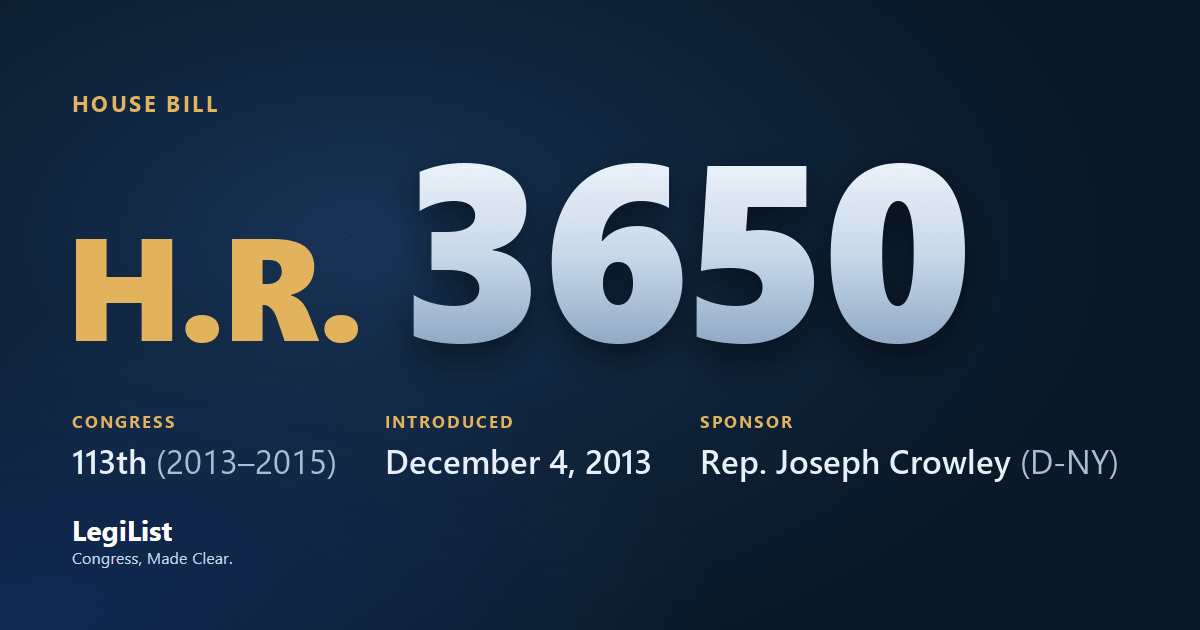
Silent Skies Act of 2013
Latest action · Dec 5, 2013 Referred to the Subcommittee on Aviation.
Progress
Where this bill reached, and when. A stage with no date was not reached; one that failed a vote and later carried shows the date it carried.
- IntroducedDec 4, 2013
- Passed HouseNot reached
- Passed SenateNot reached
- To the PresidentNot reached
- Became lawNot reached
Summary
Silent Skies Act of 2013 - Directs the Administrator of the Federal Aviation Administration (FAA) to enter into a competitive cooperative agreement with an institution, entity, or consortium to carry out a program for the development of aircraft technology that will assist in-service and in-production civil turbojets not meeting stage 4 noise standards to comply with them or with more stringent noise standards.
Directs the Secretary of Transportation (DOT) to issue regulations to establish minimum standards to ensure that graduated percentages of civil turbojets weighing over 75,000 pounds comply with the stage 4 noise levels by specified dates.
Requires the Secretary to request the International Civil Aviation Organization to add to its Work Programme the consideration of international standards for the phase-out of aircraft not complying with stage 4 noise levels.
Declares that the requirements of this Act shall not apply to civil turbojet aircraft that operate outside of the 48 contiguous states.
Cosponsors 11
Members who signed on, in the order they did. Signatures ran from Dec 4, 2013 to Sep 18, 2014; 7 are original cosponsors, there from the day it was introduced.
| Seat | Cosponsor | Signed on | |
|---|---|---|---|
| D-NJ | Albio Sires | Original | Dec 4, 2013 |
| D-NY | Grace Meng | Original | Dec 4, 2013 |
| D-NY | Gregory W. Meeks | Original | Dec 4, 2013 |
| D-CT | James A. Himes | Original | Dec 4, 2013 |
| D-IL | Janice D. Schakowsky | Original | Dec 4, 2013 |
| D-IL | Mike Quigley | Original | Dec 4, 2013 |
| D-NY | Steve Israel | Original | Dec 4, 2013 |
| D-TN | Steve Cohen | Dec 11, 2013 | |
| D-NY | Carolyn McCarthy | Dec 12, 2013 | |
| D-MN | Keith Ellison | Jan 3, 2014 | |
| D-IL | Tammy Duckworth | Sep 18, 2014 |
Committees 1
Where it was sent and what each committee and subcommittee did with it, in order.
| Chamber | Committee | What it did |
|---|---|---|
| House | Transportation and Infrastructure Committee | Referred Dec 4, 2013 |
| Aviation Subcommittee | Referred Dec 5, 2013 |
Actions 3
Everything that happened, newest first.
- Dec 5, 2013Referred to the Subcommittee on Aviation.
- Dec 4, 2013Introduced in House
- Dec 4, 2013Referred to the House Committee on Transportation and Infrastructure.
Research
What has been written about this bill: committee reports, cost estimates, the sponsor’s authority statement, printed hearings and the Congressional Research Service’s work.
Constitutional authority
The sponsor’s statement, as printed in the page H7507.
Titles 2
Every title it has carried, official and short, at each stage.
- Official Title as Introduced
- To amend title 49, United States Code, to prohibit the operation of certain aircraft not complying with stage 4 noise levels, and for other purposes.
- Short Titles as Introduced
- Silent Skies Act of 2013
Subjects
Assigned by the Library of Congress. Policy area: Transportation and Public Works.
Text 1
Each version as it was printed, newest first.
- Dec 4, 2013Introduced in House
Support LegiList
This page is free, carries no paywall, and is built and maintained by one person. If the record here is useful to you, a few dollars keeps it going.
Everything here is as published by Congress: the summary is the Congressional Research Service's, the action wording is the clerks', and the subjects are the Library of Congress's. How far it got is read from the actions themselves, taking the most recent one of each kind, so a bill that failed a vote and later passed is shown as having passed. Records come from this bill on Congress.gov and govinfo.gov; cost estimates are the Congressional Budget Office's, and the hearings are the printed hearings GovInfo publishes, which can appear months after the hearing.