Public Access to Public Science Act
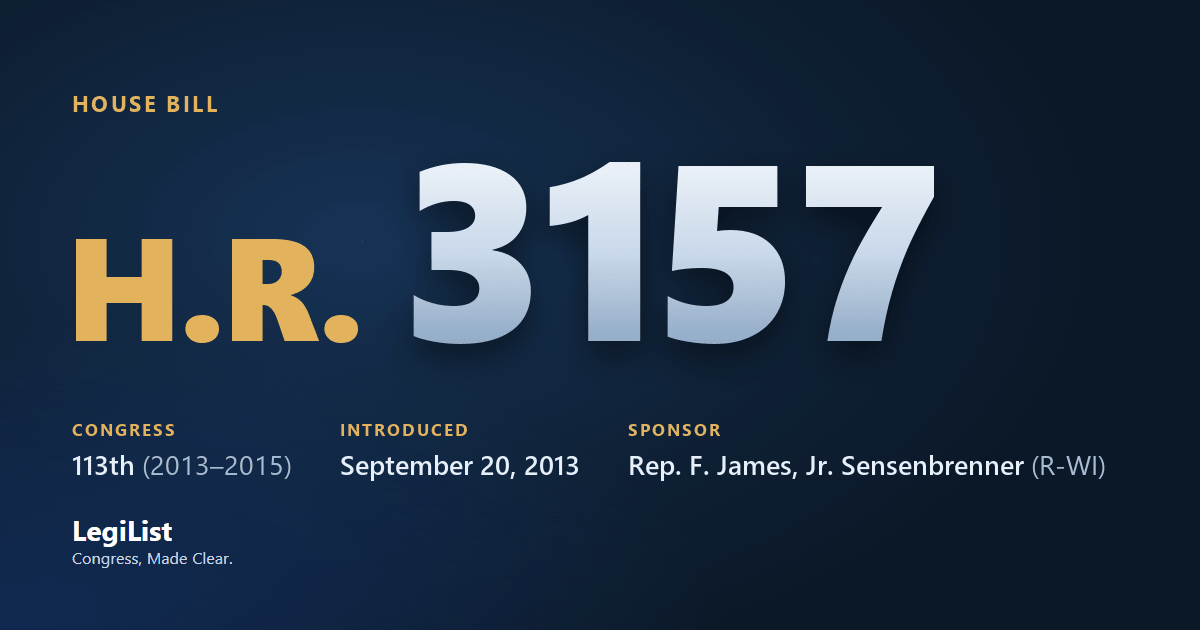
Latest action · Dec 13, 2013 Referred to the Subcommittee on Research and Technology.
Progress
Where this bill reached, and when. A stage with no date was not reached; one that failed a vote and later carried shows the date it carried.
- IntroducedSep 20, 2013
- Passed HouseNot reached
- Passed SenateNot reached
- To the PresidentNot reached
- Became lawNot reached
Summary
Public Access to Public Science Act - Directs each of the covered agencies (the National Aeronautics and Space Administration [NASA], National Science Foundation [NSF], National Institute of Standards and Technology [NIST], and National Weather Service [NWS]) to formulate and implement a public access policy to make covered works publicly available, without charge, on the day after the end of an embargo period.
Defines: (1) "covered work" as any peer-reviewed research results published in scholarly publications, with certain exceptions, that are based on research funded in whole or in part by a covered agency; and (2) "embargo period" as the period of time no more than 12 months after the initial date of publication of a covered work, unless modified.
Specifies that the public access policy shall: (1) allow the public to read, download, and analyze by machine covered works in digital form; (2) facilitate easy public search of, analysis of, and access to covered works; (3) encourage public-private collaboration; (4) ensure that attribution to authors, journals, and original publishers is maintained; and (5) ensure that publications and metadata are stored in an archive.
Requires a covered agency's public access policy to ensure full public access to covered works' metadata, without charge, upon first publication.
Requires each covered agency, in coordination with specified stakeholders, to provide a mechanism for a stakeholder to petition to change the embargo period for specific covered works by presenting evidence that the public will be substantially and uniquely harmed under the agency's public access policy related to that work.
Cosponsors 1
Members who signed on, in the order they did. All signed on Sep 20, 2013.
| Seat | Cosponsor | Signed on | |
|---|---|---|---|
| D-TX | Eddie Bernice Johnson | Original | Sep 20, 2013 |
Committees 1
Where it was sent and what each committee and subcommittee did with it, in order.
| Chamber | Committee | What it did |
|---|---|---|
| House | Science, Space, and Technology Committee | Referred Sep 20, 2013 |
| Research and Technology Subcommittee | Referred Dec 13, 2013 |
Actions 3
Everything that happened, newest first.
- Dec 13, 2013Referred to the Subcommittee on Research and Technology.
- Sep 20, 2013Introduced in House
- Sep 20, 2013Referred to the House Committee on Science, Space, and Technology.
In the Congressional Record 1
Days the Record’s own index lists this bill, newest first, with the pages and the members it names. Pages starting H are the House, S the Senate, E Extensions of Remarks.
| Where | In the Record | Members | Date |
|---|---|---|---|
| House | Lists H5802H.R. 3157–3168 | — | Sep 20, 2013 |
Research
What has been written about this bill: committee reports, cost estimates, the sponsor’s authority statement, printed hearings and the Congressional Research Service’s work.
Constitutional authority
The sponsor’s statement, as printed in the page H5802.
Titles 2
Every title it has carried, official and short, at each stage.
- Official Title as Introduced
- To ensure public access to published materials concerning scientific research and development activities funded by Federal science agencies.
- Short Titles as Introduced
- Public Access to Public Science Act
Subjects
Assigned by the Library of Congress. Policy area: Science, Technology, Communications.
Text 1
Each version as it was printed, newest first.
- Sep 20, 2013Introduced in House
Everything here is as published by Congress: the summary is the Congressional Research Service's, the action wording is the clerks', and the subjects are the Library of Congress's. How far it got is read from the actions themselves, taking the most recent one of each kind, so a bill that failed a vote and later passed is shown as having passed. Records come from this bill on Congress.gov and govinfo.gov; cost estimates are the Congressional Budget Office's, and the hearings are the printed hearings GovInfo publishes, which can appear months after the hearing.