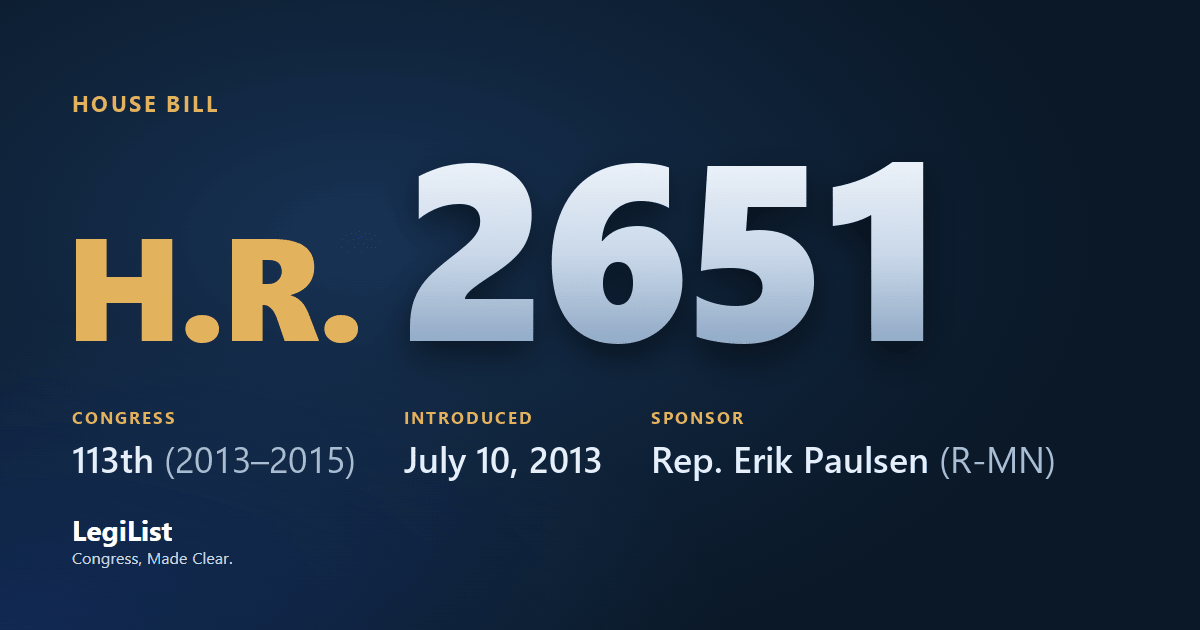
Critical Care Assessment and Improvement Act of 2013
Latest action · Jul 23, 2013 Referred to the Subcommittee on Health.
Progress
Where this bill reached, and when. A stage with no date was not reached; one that failed a vote and later carried shows the date it carried.
- IntroducedJul 10, 2013
- Passed HouseNot reached
- Passed SenateNot reached
- To the PresidentNot reached
- Became lawNot reached
Summary
Critical Care Assessment and Improvement Act of 2013 - Requires studies on critical care health services in the United States by the Institute of Medicine and the Health Resources and Services Administration of the Department of Health and Human Services (HHS).
Directs the HHS Secretary, acting through the Director of the National Institutes of Health (NIH), to establish the Critical Care Coordinating Council to coordinate the collection and analysis of information on current NIH research relating to the care of the critically ill and injured, identify gaps in such research, and make recommendations to the Director of NIH on how to improve such research.
Directs the Secretary, acting through the Center for Medicare and Medicaid Innovation, to carry out a demonstration project to improve the quality and efficiency of care provided to critically ill and injured patients receiving care in acute care hospitals.
Cosponsors 8
Members who signed on, in the order they did. Signatures ran from Jul 10, 2013 to Sep 18, 2014; 2 are original cosponsors, there from the day it was introduced.
| Seat | Cosponsor | Signed on | |
|---|---|---|---|
| D-MD | C. A. Dutch Ruppersberger | Original | Jul 10, 2013 |
| D-UT | Jim Matheson | Original | Jul 10, 2013 |
| R-MI | Mike Rogers | Nov 14, 2013 | |
| R-MS | Gregg Harper | Feb 3, 2014 | |
| R-NJ | Leonard Lance | Feb 3, 2014 | |
| D-WI | Mark Pocan | May 23, 2014 | |
| D-CA | Doris O. Matsui | Sep 10, 2014 | |
| R-OH | Steve Stivers | Sep 18, 2014 |
Committees 2
Where it was sent and what each committee and subcommittee did with it, in order.
| Chamber | Committee | What it did |
|---|---|---|
| House | Energy and Commerce Committee | Referred Jul 10, 2013 |
| Health Subcommittee | Referred Jul 12, 2013 | |
| House | Ways and Means Committee | Referred Jul 10, 2013 |
| Health Subcommittee | Referred Jul 23, 2013 |
Actions 4
Everything that happened, newest first.
- Jul 23, 2013Referred to the Subcommittee on Health.
- Jul 12, 2013Referred to the Subcommittee on Health.
- Jul 10, 2013Introduced in House
- Jul 10, 2013Referred to the Committee on Energy and Commerce, and in addition to the Committee on Ways and Means, for a period to be subsequently determined by the Speaker, in each case for consideration of such provisions as fall within the jurisdiction of the committee concerned.
Research
What has been written about this bill: committee reports, cost estimates, the sponsor’s authority statement, printed hearings and the Congressional Research Service’s work.
Constitutional authority
The sponsor’s statement, as printed in the page H4370.
Related bills 1
Companion bills and other measures the record links to this one.
| Bill | Title | Relationship | Latest action |
|---|---|---|---|
| S 2966 | Critical Care Assessment and Improvement Act of 2014 | Related bill | Nov 20, 2014 |
Titles 2
Every title it has carried, official and short, at each stage.
- Official Title as Introduced
- To improve the understanding and coordination of critical care health services.
- Short Titles as Introduced
- Critical Care Assessment and Improvement Act of 2013
Subjects
Assigned by the Library of Congress. Policy area: Health.
- Department of Health and Human Services
- Emergency medical services and trauma care
- Executive agency funding and structure
- Government studies and investigations
- Health
- Health care quality
- Health personnel
- Health programs administration and funding
- Health technology, devices, supplies
- Medical research
- National Institutes of Health (NIH)
- Public-private cooperation
Text 1
Each version as it was printed, newest first.
- Jul 10, 2013Introduced in House
Everything here is as published by Congress: the summary is the Congressional Research Service's, the action wording is the clerks', and the subjects are the Library of Congress's. How far it got is read from the actions themselves, taking the most recent one of each kind, so a bill that failed a vote and later passed is shown as having passed. Records come from this bill on Congress.gov and govinfo.gov; cost estimates are the Congressional Budget Office's, and the hearings are the printed hearings GovInfo publishes, which can appear months after the hearing.