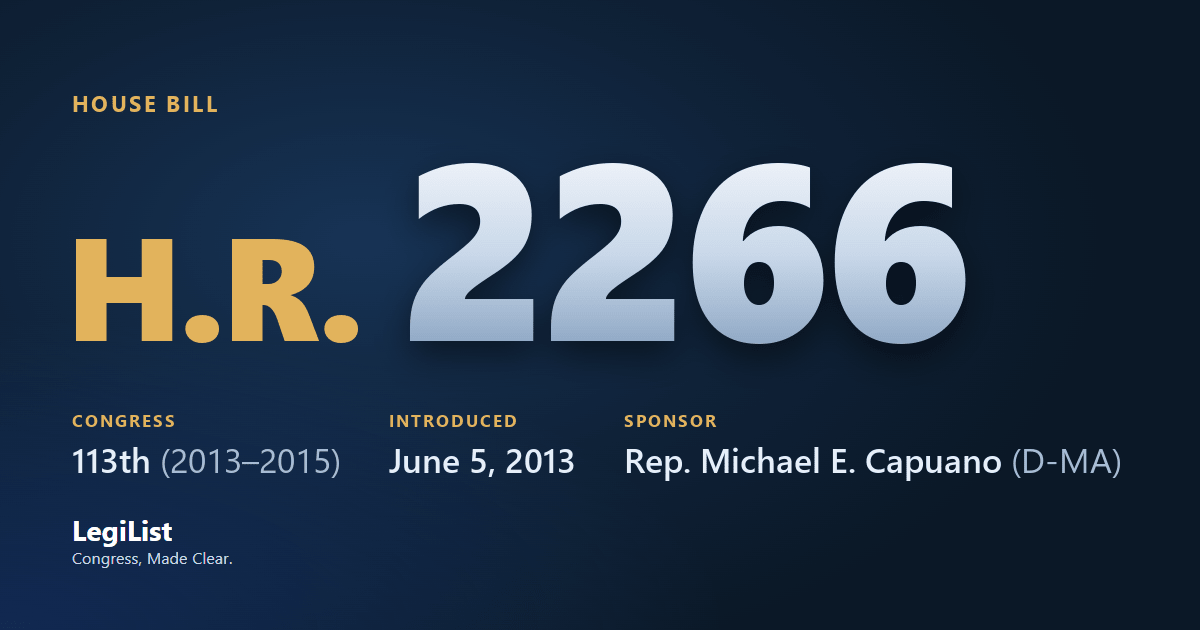
Subsidy Reserve Act of 2013
Latest action · Jun 5, 2013 Referred to the House Committee on Financial Services.
Progress
Where this bill reached, and when. A stage with no date was not reached; one that failed a vote and later carried shows the date it carried.
- IntroducedJun 5, 2013
- Passed HouseNot reached
- Passed SenateNot reached
- To the PresidentNot reached
- Became lawNot reached
Summary
Subsidy Reserve Act of 2013 - Amends the Dodd-Frank Wall Street Reform and Consumer Protection Act (Dodd-Frank) to require a nonbank financial company supervised by the Board of Governors of the Federal Reserve (Board) and each bank holding company with total consolidated assets of $500 billion or more (companies) to establish and maintain a Subsidy Reserve.
Instructs the Board to:
- establish a formula for determining the financial benefit received by such companies as a result of the expectations on the part of their shareholders, creditors, and counterparties that the government will shield them from losses in the event of their failure;
- require them to apply the formula annually to their annual financial statement; and
- maintain the resulting amount in their Subsidy Reserve, in addition to any such previous amounts.
Prohibits a decrease in the amount of funds in the Subsidy Reserve unless a company makes a sale of assets, spins off a subsidiary, or makes a similar divestiture. Permits the decrease only in an amount that reflects the amount of such sale, spin off, or similar divestiture, either on a pro rata basis or according to the risk weighting of the property sold, spun off, or divested.
Prohibits amounts in the Subsidy Reserve from being taken into account when determining the companies' capital for purposes of meeting any capital requirement.
Cosponsors
Members who signed on, in the order they did.
Committees 1
Where it was sent and what each committee and subcommittee did with it, in order.
| Chamber | Committee | What it did |
|---|---|---|
| House | Financial Services Committee | Referred Jun 5, 2013 |
Actions 2
Everything that happened, newest first.
- Jun 5, 2013Introduced in House
- Jun 5, 2013Referred to the House Committee on Financial Services.
Research
What has been written about this bill: committee reports, cost estimates, the sponsor’s authority statement, printed hearings and the Congressional Research Service’s work.
Constitutional authority
The sponsor’s statement, as printed in the page H3216.
Printed hearings 4
Hearings whose printed record names this bill, newest first: hearings on it, and wider hearings where it came up.
| Number | Hearing | Committee | Held |
|---|---|---|---|
| Serial No. 113-94 | ASSESSING THE IMPACT OF THE DODD-FRANK ACT FOUR YEARS LATER169 pages | Financial Services Committee | Jul 23, 2014 |
| Serial No. 113-64 | MONETARY POLICY AND THE STATE OF THE ECONOMY288 pages | Financial Services Committee | Feb 11, 2014 |
| S. Hrg. 113-364 | EXAMINING THE GAO REPORT ON GOVERNMENT SUPPORT FOR BANK HOLDING COMPANIES140 pages | Banking, Housing, and Urban Affairs Committee | Jan 8, 2014 |
| Serial No. 113-34 | EXAMINING HOW THE DODD-FRANK ACT COULD RESULT IN MORE TAXPAYER-FUNDED BAILOUTS214 pages | Financial Services Committee | Jun 26, 2013 |
Titles 2
Every title it has carried, official and short, at each stage.
- Official Title as Introduced
- To amend the Dodd-Frank Wall Street Reform and Consumer Protection Act to require certain systemically important entities to account for the financial benefit they receive as a result of the expectations on the part of shareholders, creditors, and counterparties of such entities that the Government will shield them from losses in the event of failure, and for other purposes.
- Short Titles as Introduced
- Subsidy Reserve Act of 2013
Subjects
Assigned by the Library of Congress. Policy area: Finance and Financial Sector.
Text 1
Each version as it was printed, newest first.
- Jun 5, 2013Introduced in House
Everything here is as published by Congress: the summary is the Congressional Research Service's, the action wording is the clerks', and the subjects are the Library of Congress's. How far it got is read from the actions themselves, taking the most recent one of each kind, so a bill that failed a vote and later passed is shown as having passed. Records come from this bill on Congress.gov and govinfo.gov; cost estimates are the Congressional Budget Office's, and the hearings are the printed hearings GovInfo publishes, which can appear months after the hearing.