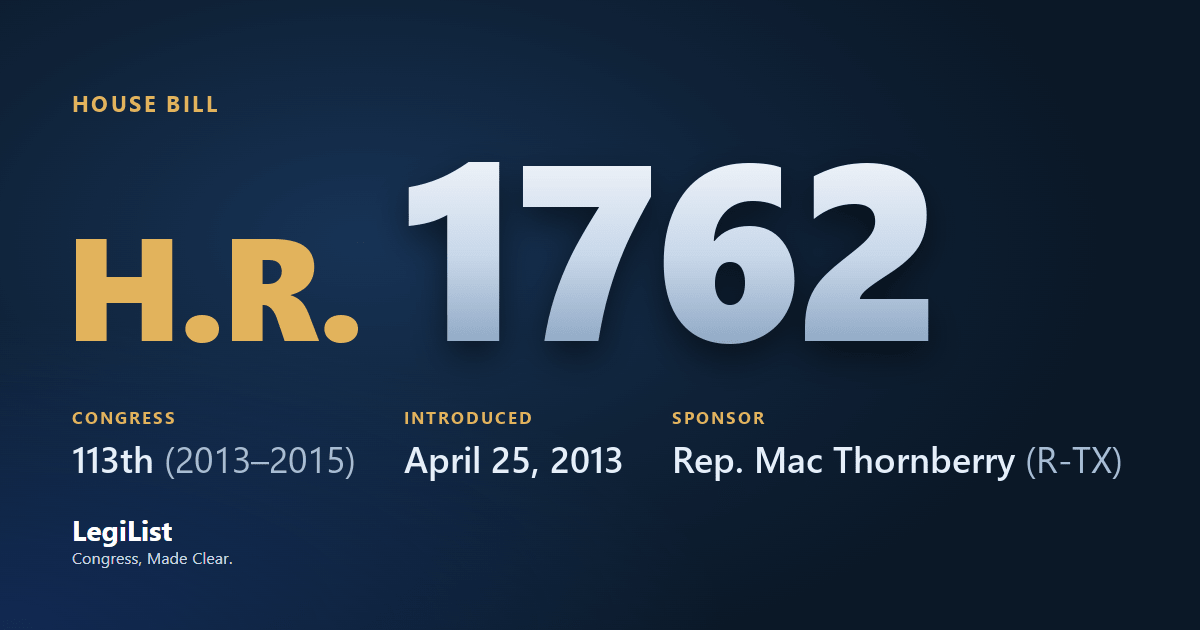
Biennial Budgeting and Appropriations Act of 2013
Latest action · Apr 25, 2013 Referred to the Committee on the Budget, and in addition to the Committees on Rules, and Oversight and Government Reform, for a period to be subsequently determined by the Speaker, in each case for consideration of such provisions as fall within the jurisdiction of the committee concerned.
Progress
Where this bill reached, and when. A stage with no date was not reached; one that failed a vote and later carried shows the date it carried.
- IntroducedApr 25, 2013
- Passed HouseNot reached
- Passed SenateNot reached
- To the PresidentNot reached
- Became lawNot reached
Summary
Biennial Budgeting and Appropriations Act of 2013 - Amends the Congressional Budget Act of 1974 to require: (1) biennial (instead of annual) budget resolutions, (2) biennial appropriations Acts, and (3) biennial government strategic and performance plans.
Makes conforming amendments to the Rules of the House of Representatives.
Defines the budget biennium as the two consecutive fiscal years beginning on October 1 of any odd-numbered year.
Requires: (1) a federal agency, upon request by a congressional committee, to provide appropriate information regarding its appropriations requests and program administration; (2) the Comptroller General to furnish to such committee summaries of any audits or reviews of such program which the Comptroller General has completed during the preceding six years; and (3) the Comptroller General, Director of the Congressional Budget Office (CBO), and the Director of the Congressional Research Service (CRS) to furnish such committee appropriate information, studies, analyses, and reports.
Requires the Director of the Office of Management and Budget (OMB) to determine and report to Congress on the impact and feasibility of changing the definition of a fiscal year, and the budget process based on that definition, to a two-year fiscal period with a biennial budget process based on such period.
Requires the President's budget submission for FY2016 to include: (1) an identification of the budget accounts for which an appropriation should be made for each fiscal year of the FY2016-FY2017 biennium, and (2) budget authority that should be provided for each such fiscal year for the budget accounts.
Directs: (1) the House and Senate committees, during the first session of the 114th Congress, to work with the Comptroller General to develop plans to transition program authorizations to a multi-year schedule; and (2) the Comptroller General, during such Congress, to continue to provide assistance to Congress with respect to programmatic oversight, and in particular to assist the congressional committees in designing and conforming programmatic oversight procedures for FY2016-FY2017 biennium.
Requires a vote of at least three-fifths of the Members in each chamber for passage of any bill or joint resolution, amendment, or conference report making supplemental appropriations.
Cosponsors 2
Members who signed on, in the order they did. Signatures ran from May 13, 2013 to Jun 4, 2013.
| Seat | Cosponsor | Signed on | |
|---|---|---|---|
| R-TX | Michael T. McCaul | May 13, 2013 | |
| R-FL | Vern Buchanan | Jun 4, 2013 |
Withdrew 1 Kay Granger R-TX Feb 11, 2014
Committees 3
Where it was sent and what each committee and subcommittee did with it, in order.
| Chamber | Committee | What it did |
|---|---|---|
| House | Budget Committee | Referred Apr 25, 2013 |
| House | Rules Committee | Referred Apr 25, 2013 |
| House | Oversight and Government Reform Committee | Referred Apr 25, 2013 |
Actions 2
Everything that happened, newest first.
- Apr 25, 2013Introduced in House
- Apr 25, 2013Referred to the Committee on the Budget, and in addition to the Committees on Rules, and Oversight and Government Reform, for a period to be subsequently determined by the Speaker, in each case for consideration of such provisions as fall within the jurisdiction of the committee concerned.
Research
What has been written about this bill: committee reports, cost estimates, the sponsor’s authority statement, printed hearings and the Congressional Research Service’s work.
Constitutional authority
The sponsor’s statement, as printed in the page H2353.
CRS reports 1
Congressional Research Service work that CRS links to this bill or the law it became, newest first.
Cite it 1
Products on other subjects that cite it, usually among other measures.
| Product | Title | Kind | Published |
|---|---|---|---|
| R41764 | Biennial Budgeting: Options, Issues, and Previous Congressional Action Archived | Report | Feb 2, 2015 |
Related bills 6
Companion bills and other measures the record links to this one.
| Bill | Title | Relationship | Latest action |
|---|---|---|---|
| S 554 | Biennial Budgeting and Appropriations Act | Related bill | Mar 13, 2013 |
| S 625 | Biennial Appropriations Act | Related bill | Mar 20, 2013 |
| HR 879 | Biennial Budgeting and Appropriations Act | Related bill | Feb 28, 2013 |
| HR 1654 | Budget Process Improvement Act of 2013 | Related bill | Apr 18, 2013 |
| HR 1869 | Biennial Budgeting and Enhanced Oversight Act of 2014 | Related bill | Dec 11, 2014 |
| HR 3059 | Biennial Budgeting and Appropriations Act of 2013 | Related bill | Aug 2, 2013 |
Titles 2
Every title it has carried, official and short, at each stage.
- Official Title as Introduced
- To provide a biennial budget for the United States Government.
- Short Titles as Introduced
- Biennial Budgeting and Appropriations Act of 2013
Subjects
Assigned by the Library of Congress. Policy area: Economics and Public Finance.
Text 1
Each version as it was printed, newest first.
- Apr 25, 2013Introduced in House
Everything here is as published by Congress: the summary is the Congressional Research Service's, the action wording is the clerks', and the subjects are the Library of Congress's. How far it got is read from the actions themselves, taking the most recent one of each kind, so a bill that failed a vote and later passed is shown as having passed. Records come from this bill on Congress.gov and govinfo.gov; cost estimates are the Congressional Budget Office's, and the hearings are the printed hearings GovInfo publishes, which can appear months after the hearing.