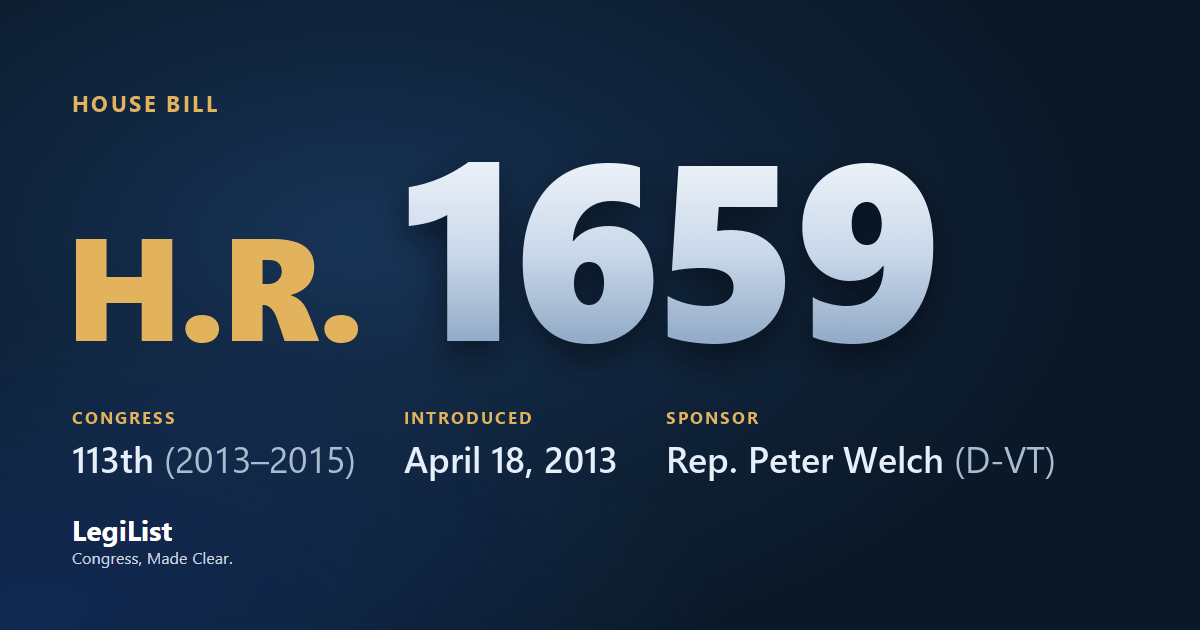
Federal Buildings Energy Savings Act of 2013
Latest action · Apr 19, 2013 Referred to the Subcommittee on Energy and Power.
Progress
Where this bill reached, and when. A stage with no date was not reached; one that failed a vote and later carried shows the date it carried.
- IntroducedApr 18, 2013
- Passed HouseNot reached
- Passed SenateNot reached
- To the PresidentNot reached
- Became lawNot reached
Summary
Federal Buildings Energy Savings Act of 2013 - Amends the National Energy Conservation Policy Act to direct each federal agency to implement requirements for the use of energy and water efficiency measures in federal buildings through private financing instead of appropriations, unless: (1) to do so conflicts with the primary mission of the agency or facility, or (2) if greater cost savings can be generated under a different program.
Requires the Secretary of Energy (DOE) to direct agencies to include in energy savings performance contracts appropriate termination clauses for facilities that will or may close before the end of a contract's term.
Includes as an "energy or water conservation measure" under such Act a measure to support the use of electric vehicles or the fueling or charging infrastructure necessary for such vehicles. Includes measures to finance the acquisition or use of such vehicles or their fueling infrastructure among energy efficiency, water conservation, or electricity demand management programs in which agencies are authorized and encouraged to participate.
Cosponsors 2
Members who signed on, in the order they did. Signatures ran from Apr 18, 2013 to Apr 25, 2013; 1 is an original cosponsor, there from the day it was introduced.
| Seat | Cosponsor | Signed on | |
|---|---|---|---|
| R-CO | Cory Gardner | Original | Apr 18, 2013 |
| D-NH | Ann M. Kuster | Apr 25, 2013 |
Committees 1
Where it was sent and what each committee and subcommittee did with it, in order.
| Chamber | Committee | What it did |
|---|---|---|
| House | Energy and Commerce Committee | Referred Apr 18, 2013 |
| Energy Subcommittee | Referred Apr 19, 2013 |
Actions 3
Everything that happened, newest first.
- Apr 19, 2013Referred to the Subcommittee on Energy and Power.
- Apr 18, 2013Introduced in House
- Apr 18, 2013Referred to the House Committee on Energy and Commerce.
In the Congressional Record 1
Days the Record’s own index lists this bill, newest first, with the pages and the members it names. Pages starting H are the House, S the Senate, E Extensions of Remarks.
| Where | In the Record | Members | Date |
|---|---|---|---|
| House | Debate and remarks H2311 | Peter Welch D-VT | Apr 25, 2013 |
Research
What has been written about this bill: committee reports, cost estimates, the sponsor’s authority statement, printed hearings and the Congressional Research Service’s work.
Constitutional authority
The sponsor’s statement, as printed in the page H2161.
Titles 2
Every title it has carried, official and short, at each stage.
- Official Title as Introduced
- To provide for utilizing energy savings performance contracts and utility energy service contracts.
- Short Titles as Introduced
- Federal Buildings Energy Savings Act of 2013
Subjects
Assigned by the Library of Congress. Policy area: Energy.
Text 1
Each version as it was printed, newest first.
- Apr 18, 2013Introduced in House
Support LegiList
This page is free, carries no paywall, and is built and maintained by one person. If the record here is useful to you, a few dollars keeps it going.
Everything here is as published by Congress: the summary is the Congressional Research Service's, the action wording is the clerks', and the subjects are the Library of Congress's. How far it got is read from the actions themselves, taking the most recent one of each kind, so a bill that failed a vote and later passed is shown as having passed. Records come from this bill on Congress.gov and govinfo.gov; cost estimates are the Congressional Budget Office's, and the hearings are the printed hearings GovInfo publishes, which can appear months after the hearing.