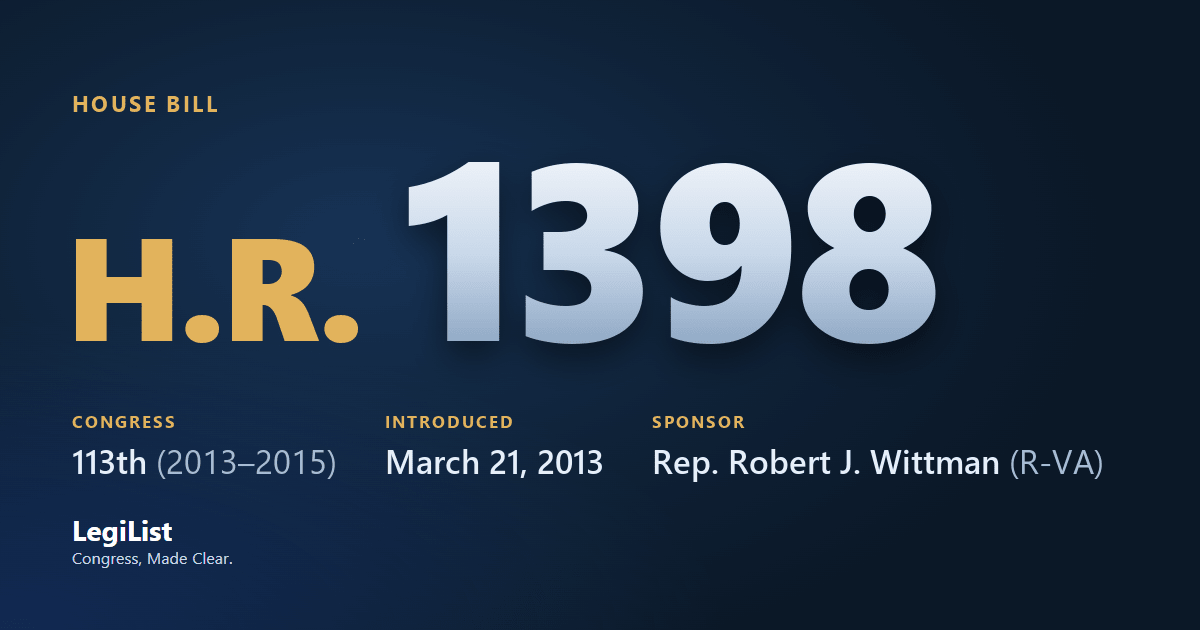
Advancing Offshore Wind Production Act
Latest action · Apr 11, 2013 Referred to the Subcommittee on Energy and Mineral Resources.
Progress
Where this bill reached, and when. A stage with no date was not reached; one that failed a vote and later carried shows the date it carried.
- IntroducedMar 21, 2013
- Passed HouseNot reached
- Passed SenateNot reached
- To the PresidentNot reached
- Became lawNot reached
Summary
Advancing Offshore Wind Production Act - Exempts any project determined by the Secretary of the Interior to be an offshore meteorological site testing and monitoring project from environmental impact statement requirements under the National Environmental Policy Act of 1969 (NEPA).
Defines an "offshore meteorological site testing and monitoring project" as a project that is administered by the Department of the Interior and carried out on or in the waters of the Outer Continental Shelf to test or monitor weather (including wind, tidal, current, and solar energy) using towers, buoys, or other temporary ocean infrastructure and that: (1) causes less than one acre of surface or seafloor disruption at the location of each meteorological tower or other device and no more than five acres of surface or seafloor disruption within the proposed area affected by the project (including hazards to navigation), (2) is decommissioned within five years of its commencement, and (3) provides meteorological information to the Secretary of the Interior.
Directs the Secretary to: (1) require that any applicant seeking to conduct an offshore meteorological site testing and monitoring project on the outer Continental Shelf obtain a permit and right of way; (2) determine whether to issue such a permit and right of way within 30 days after receiving an application; (3) provide an opportunity for submission of comments by the public; (4) consult with the Secretary of Defense (DOD), the Commandant of the Coast Guard, and the heads of other federal, state, and local agencies that would be affected by issuance of the permit and right of way; and (5) provide an applicant the opportunity to remedy deficiencies in an application that was denied.
Cosponsors 1
Members who signed on, in the order they did. All signed on Mar 21, 2013.
| Seat | Cosponsor | Signed on | |
|---|---|---|---|
| R-WA | Doc Hastings | Original | Mar 21, 2013 |
Committees 1
Where it was sent and what each committee and subcommittee did with it, in order.
| Chamber | Committee | What it did |
|---|---|---|
| House | Natural Resources Committee | Referred Mar 21, 2013 |
| Energy and Mineral Resources Subcommittee | Referred Apr 11, 2013 |
Actions 3
Everything that happened, newest first.
- Apr 11, 2013Referred to the Subcommittee on Energy and Mineral Resources.
- Mar 21, 2013Introduced in House
- Mar 21, 2013Referred to the House Committee on Natural Resources.
Research
What has been written about this bill: committee reports, cost estimates, the sponsor’s authority statement, printed hearings and the Congressional Research Service’s work.
Constitutional authority
The sponsor’s statement, as printed in the page H1828.
Related bills 3
Companion bills and other measures the record links to this one.
| Bill | Title | Relationship | Latest action |
|---|---|---|---|
| S 1401 | Domestic Energy and Jobs Act | Related bill | Jul 31, 2013 |
| HR 1782 | Virginia Jobs and Energy Act | Related bill | May 7, 2013 |
| HR 4304 | Jumpstarting Opportunities with Bold Solutions Act | Related bill | Jun 13, 2014 |
Titles 2
Every title it has carried, official and short, at each stage.
- Official Title as Introduced
- To facilitate the development of offshore wind energy resources.
- Short Titles as Introduced
- Advancing Offshore Wind Production Act
Subjects
Assigned by the Library of Congress. Policy area: Public Lands and Natural Resources.
- Administrative remedies
- Alternative and renewable resources
- Atmospheric science and weather
- Department of the Interior
- Environmental assessment, monitoring, research
- Environmental regulatory procedures
- Licensing and registrations
- Marine and coastal resources, fisheries
- Public Lands and Natural Resources
Text 1
Each version as it was printed, newest first.
- Mar 21, 2013Introduced in House
Support LegiList
This page is free, carries no paywall, and is built and maintained by one person. If the record here is useful to you, a few dollars keeps it going.
Everything here is as published by Congress: the summary is the Congressional Research Service's, the action wording is the clerks', and the subjects are the Library of Congress's. How far it got is read from the actions themselves, taking the most recent one of each kind, so a bill that failed a vote and later passed is shown as having passed. Records come from this bill on Congress.gov and govinfo.gov; cost estimates are the Congressional Budget Office's, and the hearings are the printed hearings GovInfo publishes, which can appear months after the hearing.