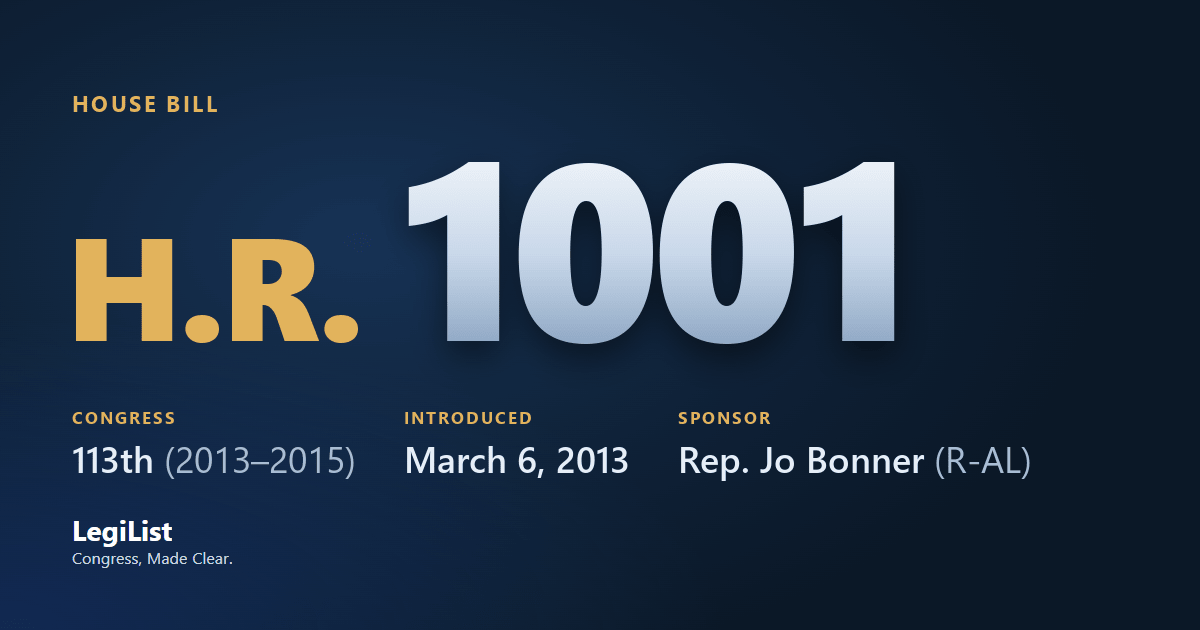
To amend the Fair Labor Standards Act of 1938 to provide a specific limited exemption from the overtime pay requirements of such Act for work related to disaster or catastrophe claims adjustment after a major disaster.
Latest action · Apr 23, 2013 Referred to the Subcommittee on Workforce Protections.
Progress
Where this bill reached, and when. A stage with no date was not reached; one that failed a vote and later carried shows the date it carried.
- IntroducedMar 6, 2013
- Passed HouseNot reached
- Passed SenateNot reached
- To the PresidentNot reached
- Became lawNot reached
Summary
Amends the Fair Labor Standards Act of 1938 to exempt from maximum hours requirements any employee who: (1) adjusts or evaluates claims resulting from or relating to a major disaster for at least $591 per week (or any minimum weekly amount established by the Secretary of Labor, whichever is greater) during the 2-year period after the disaster; and (2) is employed as an adjuster or evaluator by an employer not itself engaged, directly or through an affiliate, in underwriting, selling, or marketing property, casualty, or liability insurance policies or contracts.
Cosponsors 18
Members who signed on, in the order they did. Signatures ran from Mar 6, 2013 to Sep 17, 2013; 2 are original cosponsors, there from the day it was introduced.
| Seat | Cosponsor | Signed on | |
|---|---|---|---|
| D-FL | Alcee L. Hastings | Original | Mar 6, 2013 |
| D-NJ | Donald M. Payne, Jr. | Original | Mar 6, 2013 |
| R-CA | Howard P. "Buck" McKeon | Mar 15, 2013 | |
| D-NC | Mike McIntyre | Mar 18, 2013 | |
| D-FL | Joe Garcia | Apr 11, 2013 | |
| R-AL | Spencer Bachus | Apr 11, 2013 | |
| D-FL | Frederica S. Wilson | Jun 4, 2013 | |
| D-IL | William L. Enyart | Jun 4, 2013 | |
| R-SC | Joe Wilson | Jun 11, 2013 | |
| D-FL | Debbie Wasserman Schultz | Jun 19, 2013 | |
| R-CA | Duncan Hunter | Jun 19, 2013 | |
| R-FL | Thomas J. Rooney | Jun 19, 2013 | |
| R-AZ | Matt Salmon | Jun 27, 2013 | |
| D-NJ | Robert E. Andrews | Jun 27, 2013 | |
| R-NC | Richard Hudson | Jul 24, 2013 | |
| D-NY | Timothy H. Bishop | Aug 1, 2013 | |
| R-OK | Tom Cole | Aug 1, 2013 | |
| D-LA | Cedric L. Richmond | Sep 17, 2013 |
Committees 1
Where it was sent and what each committee and subcommittee did with it, in order.
| Chamber | Committee | What it did |
|---|---|---|
| House | Education and Workforce Committee | Referred Mar 6, 2013 |
| Workforce Protections Subcommittee | Referred Apr 23, 2013 |
Actions 3
Everything that happened, newest first.
- Apr 23, 2013Referred to the Subcommittee on Workforce Protections.
- Mar 6, 2013Introduced in House
- Mar 6, 2013Referred to the House Committee on Education and the Workforce.
Research
What has been written about this bill: committee reports, cost estimates, the sponsor’s authority statement, printed hearings and the Congressional Research Service’s work.
Constitutional authority
The sponsor’s statement, as printed in the page H5348.
Related bills 1
Companion bills and other measures the record links to this one.
| Bill | Title | Relationship | Latest action |
|---|---|---|---|
| HR 3179 | To amend the Fair Labor Standards Act of 1938 to provide a specific limited exemption from the overtime pay requirements of such Act for work related to disaster or catastrophe claims adjustment after a major disaster. | Identical bill | Jan 22, 2014 |
Titles 1
Every title it has carried, official and short, at each stage.
- Official Title as Introduced
- To amend the Fair Labor Standards Act of 1938 to provide a specific limited exemption from the overtime pay requirements of such Act for work related to disaster or catastrophe claims adjustment after a major disaster.
Subjects
Assigned by the Library of Congress. Policy area: Labor and Employment.
Text 1
Each version as it was printed, newest first.
- Mar 6, 2013Introduced in House
Support LegiList
This page is free, carries no paywall, and is built and maintained by one person. If the record here is useful to you, a few dollars keeps it going.
Everything here is as published by Congress: the summary is the Congressional Research Service's, the action wording is the clerks', and the subjects are the Library of Congress's. How far it got is read from the actions themselves, taking the most recent one of each kind, so a bill that failed a vote and later passed is shown as having passed. Records come from this bill on Congress.gov and govinfo.gov; cost estimates are the Congressional Budget Office's, and the hearings are the printed hearings GovInfo publishes, which can appear months after the hearing.