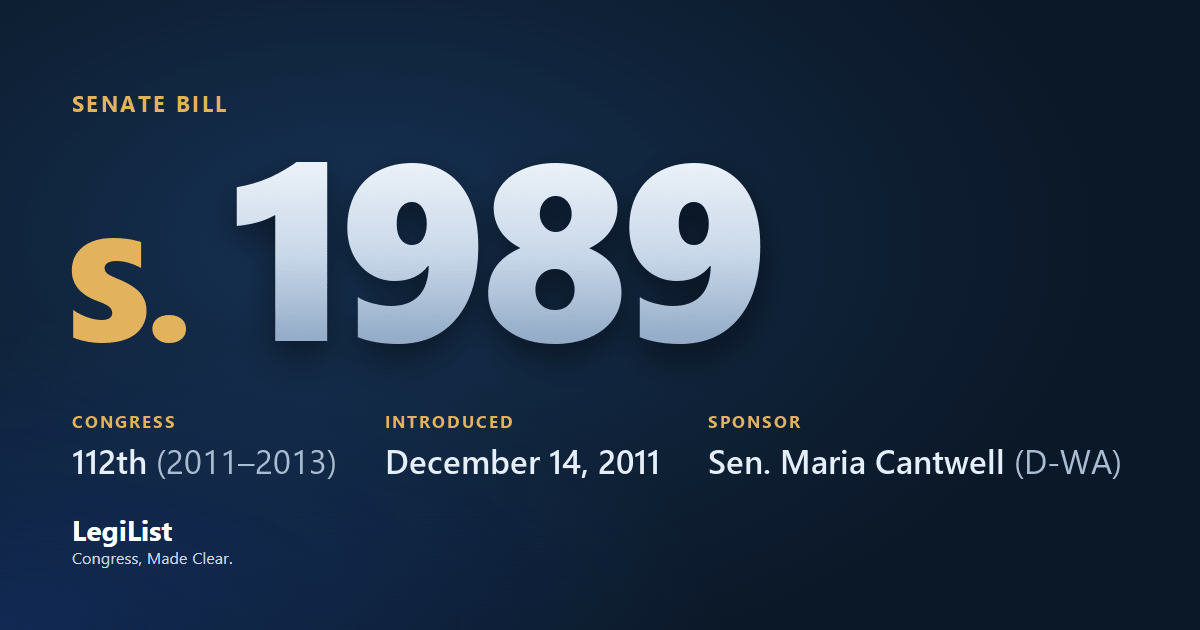
A bill to amend the Internal Revenue Code of 1986 to make permanent the minimum low-income housing tax credit rate for unsubsidized buildings and to provide a minimum 4 percent credit rate for existing buildings.
Latest action · Dec 14, 2011 Read twice and referred to the Committee on Finance.
Progress
Where this bill reached, and when. A stage with no date was not reached; one that failed a vote and later carried shows the date it carried.
- IntroducedDec 14, 2011
- Passed SenateNot reached
- Passed HouseNot reached
- To the PresidentNot reached
- Became lawNot reached
Summary
Amends the Internal Revenue Code to: (1) make permanent the the minimum low-income housing tax credit rate for new buildings that are not federally subsidized, and (2) establish a minimum 4% low-income housing tax rate for existing buildings that are not federally subsidized.
Cosponsors 24
Members who signed on, in the order they did. Signatures ran from Dec 14, 2011 to Sep 11, 2012; 10 are original cosponsors, there from the day it was introduced.
| Seat | Cosponsor | Signed on | |
|---|---|---|---|
| D-MD | Benjamin L. Cardin | Original | Dec 14, 2011 |
| I-VT | Bernard Sanders | Original | Dec 14, 2011 |
| D-FL | Bill Nelson | Original | Dec 14, 2011 |
| D-NM | Jeff Bingaman | Original | Dec 14, 2011 |
| D-MA | John F. Kerry | Original | Dec 14, 2011 |
| R-ID | Mike Crapo | Original | Dec 14, 2011 |
| R-ME | Olympia J. Snowe | Original | Dec 14, 2011 |
| D-NJ | Robert Menendez | Original | Dec 14, 2011 |
| R-MA | Scott P. Brown | Original | Dec 14, 2011 |
| R-ME | Susan M. Collins | Original | Dec 14, 2011 |
| I-CT | Joseph I. Lieberman | Jan 31, 2012 | |
| D-MN | Al Franken | Feb 14, 2012 | |
| D-RI | Sheldon Whitehouse | Apr 26, 2012 | |
| D-MN | Amy Klobuchar | May 9, 2012 | |
| D-MI | Debbie Stabenow | May 17, 2012 | |
| D-NY | Kirsten E. Gillibrand | May 17, 2012 | |
| D-IA | Tom Harkin | May 24, 2012 | |
| D-MI | Carl Levin | Jun 5, 2012 | |
| D-HI | Daniel K. Inouye | Jun 5, 2012 | |
| D-CA | Barbara Boxer | Jun 7, 2012 | |
| D-NY | Charles E. Schumer | Jun 7, 2012 | |
| D-CT | Richard Blumenthal | Jun 26, 2012 | |
| D-OH | Sherrod Brown | Jun 26, 2012 | |
| D-HI | Daniel K. Akaka | Sep 11, 2012 |
Committees 1
Where it was sent and what each committee and subcommittee did with it, in order.
| Chamber | Committee | What it did |
|---|---|---|
| Senate | Finance Committee | Referred Dec 14, 2011 |
Actions 2
Everything that happened, newest first.
- Dec 14, 2011Introduced in Senate
- Dec 14, 2011Read twice and referred to the Committee on Finance.
Research
What has been written about this bill: committee reports, cost estimates, the sponsor’s authority statement, printed hearings and the Congressional Research Service’s work.
Printed hearings 1
Hearings whose printed record names this bill, newest first: hearings on it, and wider hearings where it came up.
| Number | Hearing | Committee | Held |
|---|---|---|---|
| S. Hrg. 112-631 | NOMINATIONS TO THE EXECUTIVE OFFICE OF THE PRESIDENT, THE CONSUMER PRODUCT SAFETY COMMISSION, AND THE FEDERAL MARITIME COMMISSION82 pages | Commerce, Science, and Transportation Committee | May 10, 2012 |
Related bills 1
Companion bills and other measures the record links to this one.
| Bill | Title | Relationship | Latest action |
|---|---|---|---|
| HR 3661 | To amend the Internal Revenue Code of 1986 to make permanent and expand the temporary minimum credit rate for the low-income housing tax credit program. | Related bill | Dec 14, 2011 |
Titles 1
Every title it has carried, official and short, at each stage.
- Official Title as Introduced
- A bill to amend the Internal Revenue Code of 1986 to make permanent the minimum low-income housing tax credit rate for unsubsidized buildings and to provide a minimum 4 percent credit rate for existing buildings.
Subjects
Assigned by the Library of Congress. Policy area: Taxation.
Text 1
Each version as it was printed, newest first.
- Dec 14, 2011Introduced in Senate
Everything here is as published by Congress: the summary is the Congressional Research Service's, the action wording is the clerks', and the subjects are the Library of Congress's. How far it got is read from the actions themselves, taking the most recent one of each kind, so a bill that failed a vote and later passed is shown as having passed. Records come from this bill on Congress.gov and govinfo.gov; cost estimates are the Congressional Budget Office's, and the hearings are the printed hearings GovInfo publishes, which can appear months after the hearing.