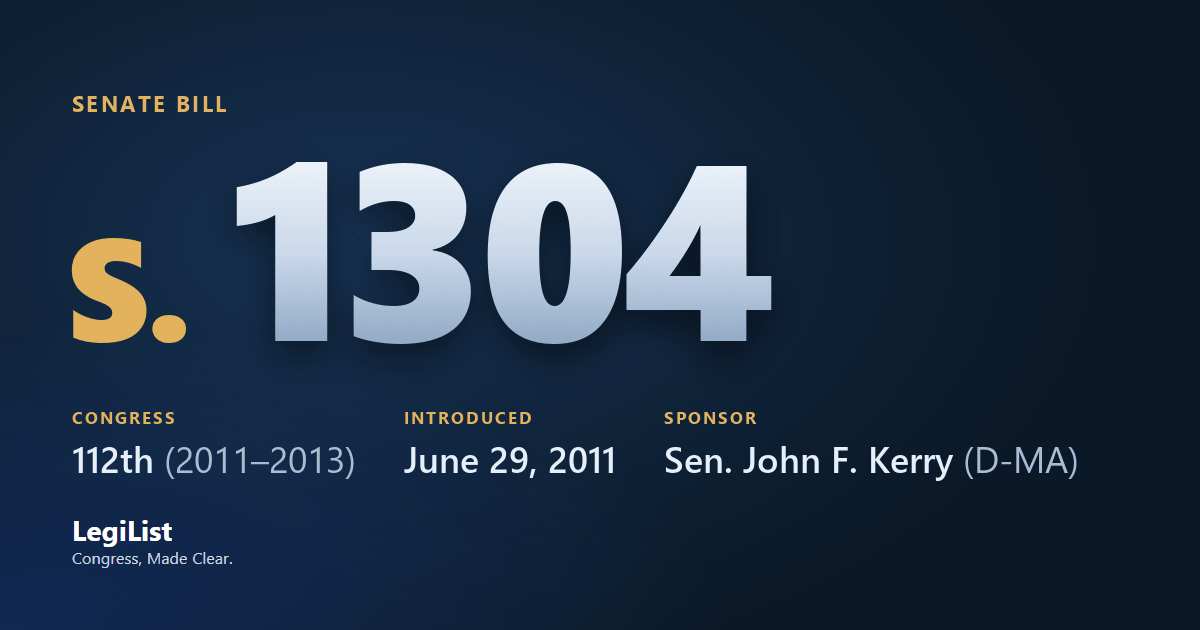
Fisheries Fee Fairness Act of 2011
Latest action · Jun 29, 2011 Read twice and referred to the Committee on Commerce, Science, and Transportation.
Progress
Where this bill reached, and when. A stage with no date was not reached; one that failed a vote and later carried shows the date it carried.
- IntroducedJun 29, 2011
- Passed SenateNot reached
- Passed HouseNot reached
- To the PresidentNot reached
- Became lawNot reached
Summary
Fisheries Fee Fairness Act of 2011 - Authorizes the Secretary of Commerce, using sums received as fines, penalties, and forfeitures of property for violations of the Magnuson-Stevens Fishery Conservation and Management Act or other fishery resource laws enforced by the Secretary, to reimburse certain legal fees and costs to a person applying for reimbursement that: (1) the Secretary directed to be remitted a fisheries enforcement penalty in the Secretarial Decision Memorandum issued by the Secretary on May 17, 2011, entitled Decisions regarding Certain NOAA Fisheries Enforcement Cases Based on Special Master Swartwood's Report and Recommendations; or (2) received a Notice of Violation and Assessment for a fisheries enforcement penalty issued on or after March 17, 1994, that was settled or otherwise resolved prior to February 3, 2010, paid a civil penalty, submitted a complaint seeking remittance prior to May 7, 2011, and was directed by the Secretary to receive at least a portion of such remittance.
Directs the Secretary to make a final determination on whether to provide a reimbursement within 90 days after receiving such an application.
Prohibits providing more than $200,000 to such a person for appropriate legal fees and costs.
Cosponsors 1
Members who signed on, in the order they did. All signed on Jul 5, 2011.
| Seat | Cosponsor | Signed on | |
|---|---|---|---|
| R-MA | Scott P. Brown | Jul 5, 2011 |
Committees 1
Where it was sent and what each committee and subcommittee did with it, in order.
| Chamber | Committee | What it did |
|---|---|---|
| Senate | Commerce, Science, and Transportation Committee | Referred Jun 29, 2011 |
Actions 3
Everything that happened, newest first.
- Jun 29, 2011Introduced in Senate
- Jun 29, 2011Sponsor introductory remarks on measure. (CR S4234-4235)
- Jun 29, 2011Read twice and referred to the Committee on Commerce, Science, and Transportation.
In the Congressional Record 1
Days the Record’s own index lists this bill, newest first, with the pages and the members it names. Pages starting H are the House, S the Senate, E Extensions of Remarks.
| Where | In the Record | Members | Date |
|---|---|---|---|
| Senate | Debate and remarks S4234 | John F. Kerry D-MA | Jun 29, 2011 |
Research
What has been written about this bill: committee reports, cost estimates, the sponsor’s authority statement, printed hearings and the Congressional Research Service’s work.
CRS reports 2
Congressional Research Service work that CRS links to this bill or the law it became, newest first.
Cite it 2
Products on other subjects that cite it, usually among other measures.
| Product | Title | Kind | Published |
|---|---|---|---|
| R43565 | Reauthorization Issues for the Magnuson Stevens Fishery Conservation and Management Act Archived | Report | May 22, 2014 |
| R41613 | Fishery, Aquaculture, and Marine Mammal Issues in the 112th Congress Archived | Report | Jan 22, 2013 |
Related bills 1
Companion bills and other measures the record links to this one.
| Bill | Title | Relationship | Latest action |
|---|---|---|---|
| HR 2610 | Asset Forfeiture Fund Reform and Distribution Act of 2011 | Related bill | Dec 1, 2011 |
Titles 2
Every title it has carried, official and short, at each stage.
- Official Title as Introduced
- A bill to make funds available to reimburse certain fishermen for legal fees and costs incurred in connection with improper fines and for other purposes.
- Short Titles as Introduced
- Fisheries Fee Fairness Act of 2011
Subjects
Assigned by the Library of Congress. Policy area: Public Lands and Natural Resources.
Text 1
Each version as it was printed, newest first.
- Jun 29, 2011Introduced in Senate
Everything here is as published by Congress: the summary is the Congressional Research Service's, the action wording is the clerks', and the subjects are the Library of Congress's. How far it got is read from the actions themselves, taking the most recent one of each kind, so a bill that failed a vote and later passed is shown as having passed. Records come from this bill on Congress.gov and govinfo.gov; cost estimates are the Congressional Budget Office's, and the hearings are the printed hearings GovInfo publishes, which can appear months after the hearing.