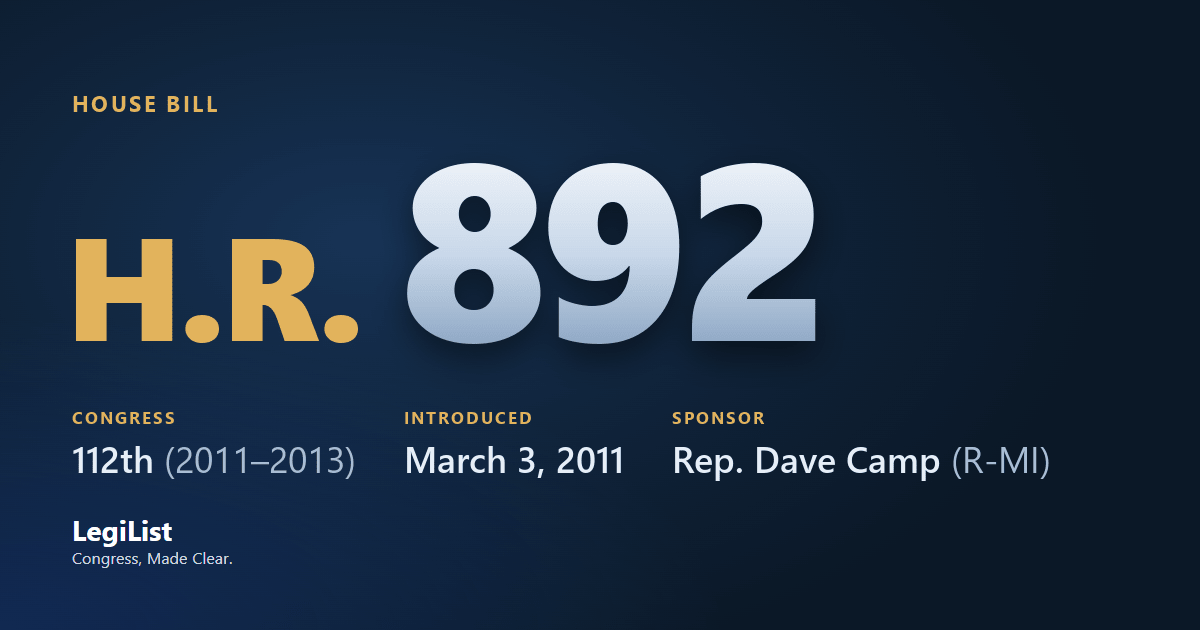
Stop Asian Carp Act
Latest action · Mar 7, 2011 Referred to the Subcommittee on Fisheries, Wildlife, Oceans, and Insular Affairs.
Progress
Where this bill reached, and when. A stage with no date was not reached; one that failed a vote and later carried shows the date it carried.
- IntroducedMar 3, 2011
- Passed HouseNot reached
- Passed SenateNot reached
- To the PresidentNot reached
- Became lawNot reached
Summary
Stop Asian Carp Act - Directs the Secretary of the Army, acting through the Chief of Engineers, to study the watersheds of the Illinois, Chicago, and Calumet Rivers, including their tributaries, that drain directly into Lake Michigan to determine the feasibility and best means of implementing the hydrologic separation of the Great Lakes and the Mississippi River Basins to prevent the introduction or establishment of populations of aquatic nuisance species between the Great Lakes and Mississippi River Basins through the Chicago Area Water System (CAWS) and other aquatic pathways.
Requires the study to: (1) include options to address flooding, Chicago wastewater and stormwater infrastructure, waterway safety operations, and barge and recreational vessel traffic alternatives; and (2) contain a detailed analysis of the environmental benefits and costs of each option.
Directs: (1) the Secretary to carry out this Act at full federal cost; and (2) the President, or the Council on Environmental Quality as a designee to the President, to oversee the study to ensure its thoroughness and timely completion.
Requires the Director of the United States Geological Survey (USGS), in cooperation with the Director of the United States Fish and Wildlife Service, to: (1) monitor and survey all waters that connect to the Great Lakes Basin or could connect to it due to flooding, underground hydrological connection, or human-made diversion to identify additional threats that could allow Asian Carp to enter the Basin; and (2) prioritize each threat and help identify means to impede the passage of Asian Carp to the Basin.
Cosponsors 36
Members who signed on, in the order they did. Signatures ran from Mar 3, 2011 to Feb 29, 2012; 21 are original cosponsors, there from the day it was introduced.
| Seat | Cosponsor | Signed on | |
|---|---|---|---|
| D-MN | Betty McCollum | Original | Mar 3, 2011 |
| R-MI | Bill Huizenga | Original | Mar 3, 2011 |
| D-NY | Brian Higgins | Original | Mar 3, 2011 |
| R-MI | Candice S. Miller | Original | Mar 3, 2011 |
| D-NY | Carolyn B. Maloney | Original | Mar 3, 2011 |
| D-MI | Dale E. Kildee | Original | Mar 3, 2011 |
| R-MI | Dan Benishek | Original | Mar 3, 2011 |
| R-MI | Fred Upton | Original | Mar 3, 2011 |
| D-MI | Gary C. Peters | Original | Mar 3, 2011 |
| D-NY | Gary L. Ackerman | Original | Mar 3, 2011 |
| D-MI | Hansen Clarke | Original | Mar 3, 2011 |
| D-NY | Jerrold Nadler | Original | Mar 3, 2011 |
| D-MI | John Conyers, Jr. | Original | Mar 3, 2011 |
| D-MI | John D. Dingell | Original | Mar 3, 2011 |
| I-MI | Justin Amash | Original | Mar 3, 2011 |
Committees 2
Where it was sent and what each committee and subcommittee did with it, in order.
| Chamber | Committee | What it did |
|---|---|---|
| House | Transportation and Infrastructure Committee | Referred Mar 3, 2011 |
| Water Resources and Environment Subcommittee | Referred Mar 4, 2011 | |
| House | Natural Resources Committee | Referred Mar 3, 2011 |
| Water, Wildlife and Fisheries Subcommittee | Referred Mar 7, 2011 | |
| Fisheries, Wildlife, Oceans, and Insular Affairs Subcommittee | Referred Mar 7, 2011 |
Actions 5
Everything that happened, newest first.
- Mar 7, 2011Referred to the Subcommittee on Water and Power.
- Mar 7, 2011Referred to the Subcommittee on Fisheries, Wildlife, Oceans, and Insular Affairs.
- Mar 4, 2011Referred to the Subcommittee on Water Resources and Environment.
- Mar 3, 2011Introduced in House
- Mar 3, 2011Referred to the Committee on Transportation and Infrastructure, and in addition to the Committee on Natural Resources, for a period to be subsequently determined by the Speaker, in each case for consideration of such provisions as fall within the jurisdiction of the committee concerned.
In the Congressional Record 1
Days the Record’s own index lists this bill, newest first, with the pages and the members it names. Pages starting H are the House, S the Senate, E Extensions of Remarks.
| Where | In the Record | Members | Date |
|---|---|---|---|
| Extensions | Debate and remarks E287 | Marcy Kaptur D-OH | Feb 29, 2012 |
Research
What has been written about this bill: committee reports, cost estimates, the sponsor’s authority statement, printed hearings and the Congressional Research Service’s work.
Constitutional authority
The sponsor’s statement, as printed in the page H1575.
CRS reports 2
Congressional Research Service work that CRS links to this bill or the law it became, newest first.
Cite it 2
Products on other subjects that cite it, usually among other measures.
| Product | Title | Kind | Published |
|---|---|---|---|
| R41613 | Fishery, Aquaculture, and Marine Mammal Issues in the 112th Congress Archived | Report | Jan 22, 2013 |
| R41961 | Army Corps Fiscal Challenges: Frequently Asked Questions Archived | Report | Dec 15, 2011 |
Related bills 1
Companion bills and other measures the record links to this one.
| Bill | Title | Relationship | Latest action |
|---|---|---|---|
| S 471 | Stop Asian Carp Act of 2011 | Related bill | Mar 3, 2011 |
Titles 2
Every title it has carried, official and short, at each stage.
- Official Title as Introduced
- To require the Secretary of the Army to study the feasibility of the hydrological separation of the Great Lakes and Mississippi River Basins.
- Short Titles as Introduced
- Stop Asian Carp Act
Subjects
Assigned by the Library of Congress. Policy area: Water Resources Development.
- Aquatic ecology
- Fishes
- Floods and storm protection
- Government studies and investigations
- Great Lakes
- Hydrology and hydrography
- Illinois
- Indiana
- Lakes and rivers
- Marine and inland water transportation
- Mississippi River
- Water Resources Development
- Watersheds
- Wildlife conservation and habitat protection
Text 1
Each version as it was printed, newest first.
- Mar 3, 2011Introduced in House
Support LegiList
This page is free, carries no paywall, and is built and maintained by one person. If the record here is useful to you, a few dollars keeps it going.
Everything here is as published by Congress: the summary is the Congressional Research Service's, the action wording is the clerks', and the subjects are the Library of Congress's. How far it got is read from the actions themselves, taking the most recent one of each kind, so a bill that failed a vote and later passed is shown as having passed. Records come from this bill on Congress.gov and govinfo.gov; cost estimates are the Congressional Budget Office's, and the hearings are the printed hearings GovInfo publishes, which can appear months after the hearing.