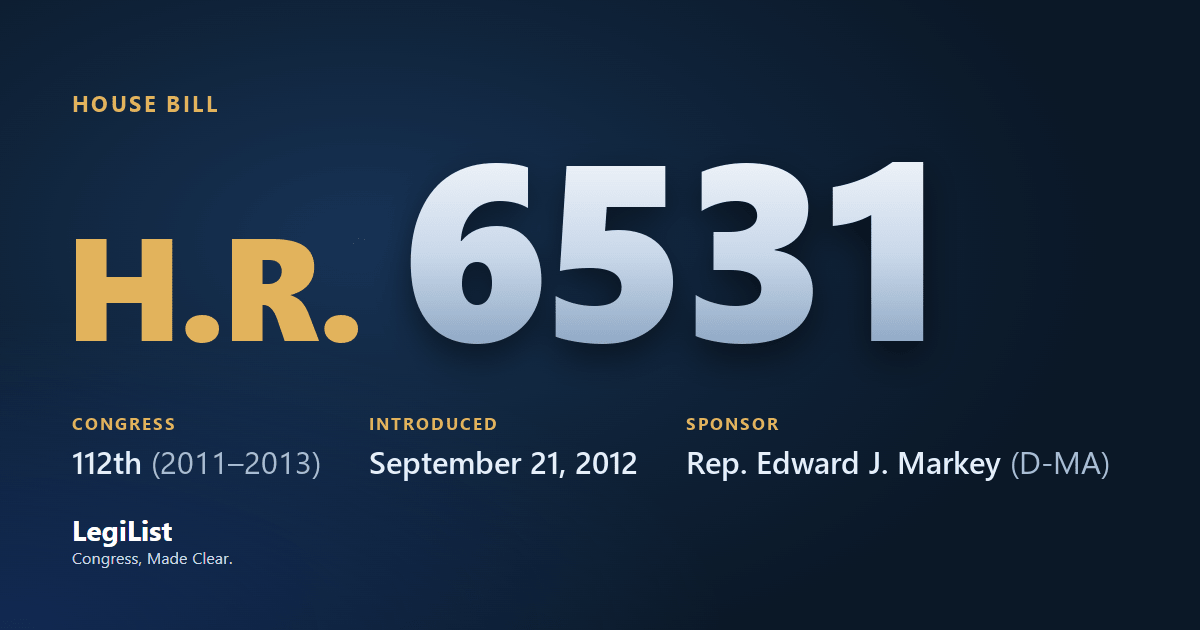
Bottle Recycling Climate Protection Act of 2012
Latest action · Sep 26, 2012 Referred to the Subcommittee on Environment and the Economy.
Progress
Where this bill reached, and when. A stage with no date was not reached; one that failed a vote and later carried shows the date it carried.
- IntroducedSep 21, 2012
- Passed HouseNot reached
- Passed SenateNot reached
- To the PresidentNot reached
- Became lawNot reached
Summary
Bottle Recycling Climate Protection Act of 2012 - Amends the Solid Waste Disposal Act to prohibit retailers and distributors from selling beverages in containers that do not display a statement of a refund value of five cents. Defines "beverage" as an alcoholic or non-alcoholic, carbonated or uncarbonated liquid that is intended for human consumption.
Requires: (1) distributors to collect the refund value for each beverage sold to retailers by a deposit initiator, and (2) retailers to collect the refund value for each beverage sold to consumers. Requires: (1) retailers to pay the refund on returned unbroken containers of brands sold for up to a specified number of containers per day based on the square footage of the retailer's space (excluding any container contaminated by a hazardous waste), and (2) distributors to pay the refund on returned containers of brands sold, plus at least three cents per container for handling costs.
Directs each deposit initiator to pay to a state, quarterly, unclaimed refund amounts, which shall be available to the state for programs designed to reduce greenhouse gas emissions.
Prohibits distributors and retailers from intentionally disposing of containers subject to this Act or any metal, glass, or plastic from such containers (other than the top or seal) in landfills or solid waste disposal facilities.
Exempts states that have implemented laws requiring beverage container deposits or that have demonstrated achievement of specified recycling, reuse, or recovery rates for beverage containers.
Prohibits states or political subdivisions that impose taxes on the sale of beverage containers from imposing any tax on the amount attributable to the refund value of such containers.
Provides for the adjustment for inflation of the refund amounts at ten-year intervals.
Prescribes civil penalties for violations of this Act.
Cosponsors
Members who signed on, in the order they did.
Committees 1
Where it was sent and what each committee and subcommittee did with it, in order.
| Chamber | Committee | What it did |
|---|---|---|
| House | Energy and Commerce Committee | Referred Sep 21, 2012 |
| Environment Subcommittee | Referred Sep 26, 2012 |
Actions 3
Everything that happened, newest first.
- Sep 26, 2012Referred to the Subcommittee on Environment and the Economy.
- Sep 21, 2012Introduced in House
- Sep 21, 2012Referred to the House Committee on Energy and Commerce.
Research
What has been written about this bill: committee reports, cost estimates, the sponsor’s authority statement, printed hearings and the Congressional Research Service’s work.
Constitutional authority
The sponsor’s statement, as printed in the page H6278.
Titles 2
Every title it has carried, official and short, at each stage.
- Official Title as Introduced
- To amend the Solid Waste Disposal Act to require a refund value for certain beverage containers, and to provide resources for State pollution prevention and recycling programs, and for other purposes.
- Short Titles as Introduced
- Bottle Recycling Climate Protection Act of 2012
Subjects
Assigned by the Library of Congress. Policy area: Environmental Protection.
Text 1
Each version as it was printed, newest first.
- Sep 21, 2012Introduced in House
Support LegiList
This page is free, carries no paywall, and is built and maintained by one person. If the record here is useful to you, a few dollars keeps it going.
Everything here is as published by Congress: the summary is the Congressional Research Service's, the action wording is the clerks', and the subjects are the Library of Congress's. How far it got is read from the actions themselves, taking the most recent one of each kind, so a bill that failed a vote and later passed is shown as having passed. Records come from this bill on Congress.gov and govinfo.gov; cost estimates are the Congressional Budget Office's, and the hearings are the printed hearings GovInfo publishes, which can appear months after the hearing.