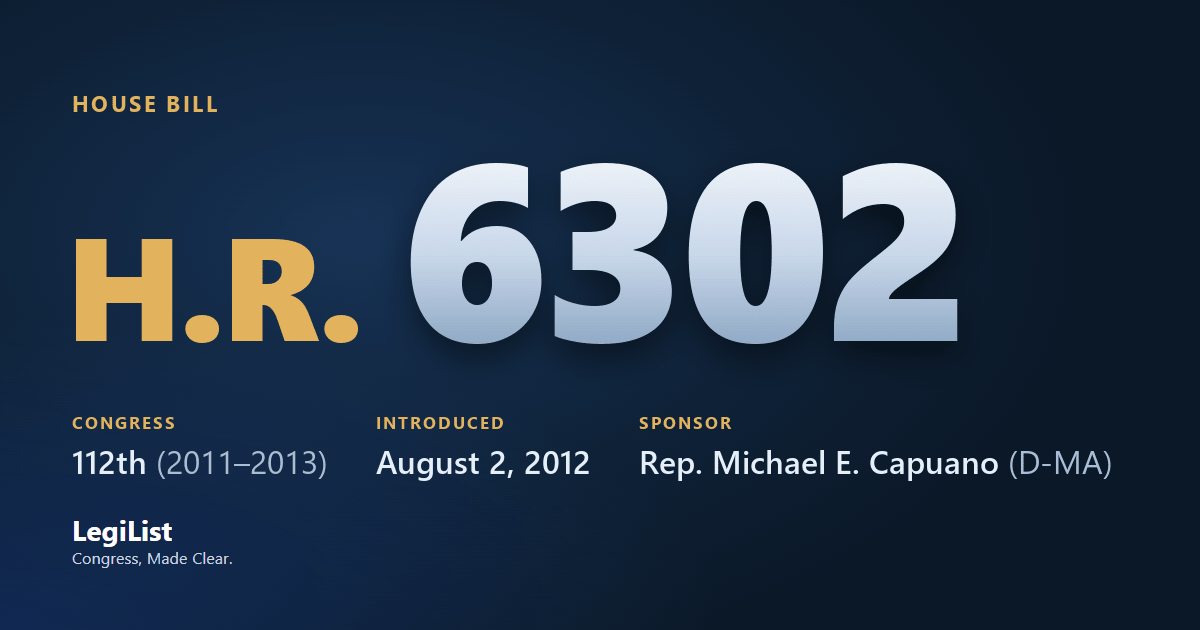
Reasonable Policies on Automated License Plate Readers Act
Latest action · Sep 7, 2012 Referred to the Subcommittee on Crime, Terrorism, and Homeland Security.
Progress
Where this bill reached, and when. A stage with no date was not reached; one that failed a vote and later carried shows the date it carried.
- IntroducedAug 2, 2012
- Passed HouseNot reached
- Passed SenateNot reached
- To the PresidentNot reached
- Became lawNot reached
Summary
Reasonable Policies on Automated License Plate Readers Act - Amends the Omnibus Crime Control and Safe Streets Act of 1968 to prohibit assistance under the Edward Byrne Memorial Justice Assistance Grant Program or the Public Safety and Community Policing grant program to a law enforcement agency that uses an automated license plate reader unless the agency has developed written and binding policies for the use of the reader that ensure that data collected by the reader: (1) is not stored for a period exceeding 30 days unless the data is being used in an active law enforcement investigation; (2) is not stored in a statewide database or other database that consolidates data from such readers; and (3) is shared with an entity other than the agency that operates it only if the entity is another law enforcement agency, the data is to be used in an active law enforcement investigation, and the data is provided in response to a specific request for the data.
Cosponsors 1
Members who signed on, in the order they did. All signed on Sep 21, 2012.
| Seat | Cosponsor | Signed on | |
|---|---|---|---|
| D-CA | Fortney Pete Stark | Sep 21, 2012 |
Committees 1
Where it was sent and what each committee and subcommittee did with it, in order.
| Chamber | Committee | What it did |
|---|---|---|
| House | Judiciary Committee | Referred Aug 2, 2012 |
| Crime and Federal Government Surveillance Subcommittee | Referred Sep 7, 2012 |
Actions 3
Everything that happened, newest first.
- Sep 7, 2012Referred to the Subcommittee on Crime, Terrorism, and Homeland Security.
- Aug 2, 2012Introduced in House
- Aug 2, 2012Referred to the House Committee on the Judiciary.
Research
What has been written about this bill: committee reports, cost estimates, the sponsor’s authority statement, printed hearings and the Congressional Research Service’s work.
Constitutional authority
The sponsor’s statement, as printed in the page H5709.
Titles 2
Every title it has carried, official and short, at each stage.
- Official Title as Introduced
- To amend the Omnibus Crime Control and Safe Streets Act of 1968 to prohibit funding under the Edward Byrne Memorial Justice Assistance grant program and the Public Safety and Community Policing grant program to be provided to law enforcement agencies that use license plate readers unless certain conditions are met.
- Short Titles as Introduced
- Reasonable Policies on Automated License Plate Readers Act
Subjects
Assigned by the Library of Congress. Policy area: Crime and Law Enforcement.
Text 1
Each version as it was printed, newest first.
- Aug 2, 2012Introduced in House
Support LegiList
This page is free, carries no paywall, and is built and maintained by one person. If the record here is useful to you, a few dollars keeps it going.
Everything here is as published by Congress: the summary is the Congressional Research Service's, the action wording is the clerks', and the subjects are the Library of Congress's. How far it got is read from the actions themselves, taking the most recent one of each kind, so a bill that failed a vote and later passed is shown as having passed. Records come from this bill on Congress.gov and govinfo.gov; cost estimates are the Congressional Budget Office's, and the hearings are the printed hearings GovInfo publishes, which can appear months after the hearing.