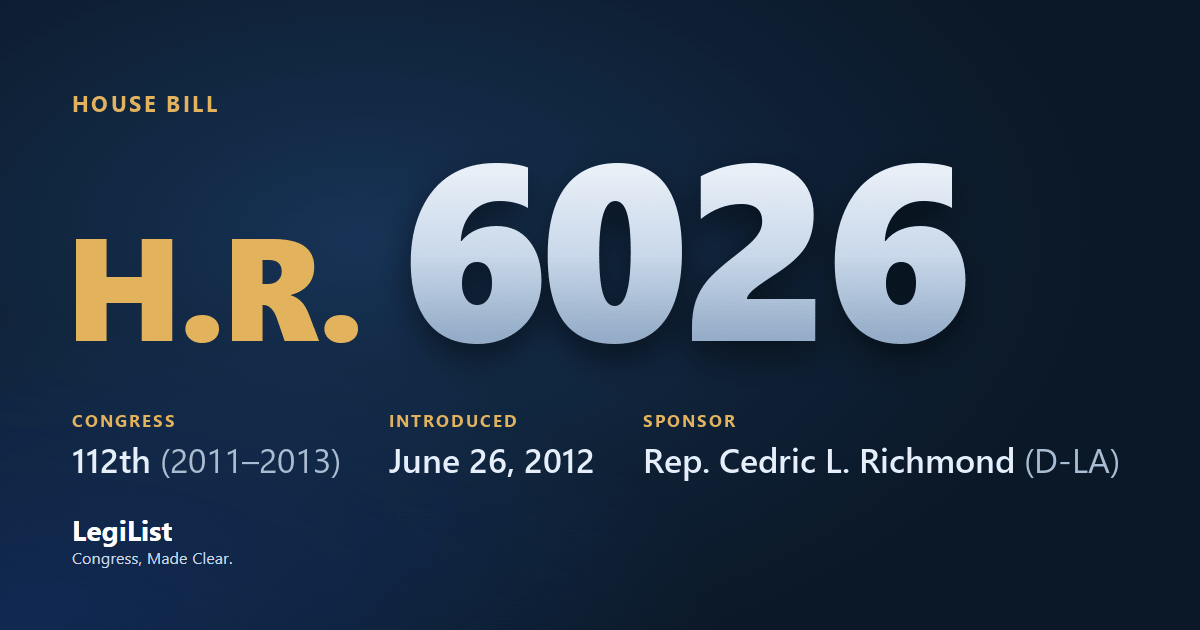
DREDGE Act of 2012
Latest action · Jun 27, 2012 Referred to the Subcommittee on Water Resources and Environment.
Progress
Where this bill reached, and when. A stage with no date was not reached; one that failed a vote and later carried shows the date it carried.
- IntroducedJun 26, 2012
- Passed HouseNot reached
- Passed SenateNot reached
- To the PresidentNot reached
- Became lawNot reached
Summary
Dredging for Restoration and Economic Development for Global Exports Act of 2012 or the DREDGE Act of 2012 - Modifies the project for navigation, Mississippi River Ship Channel, Gulf of Mexico to Baton Rouge, Louisiana, to direct the Secretary of the Army to: (1) achieve, operate, and maintain a navigation channel of 50 feet with respect to the portion of the project from Baton Rouge to the Southwest Pass sea buoy; (2) complete such work not later than the last day of the third fiscal year beginning after the enactment of this Act; (3) conduct a pilot disposal and sediment project in the Southwest Pass area to determine the cost-effectiveness of pump-out disposal operations for hopper dredges for environmental enhancement and dredged material disposal; and (4) consult with appropriate federal, state, and local agencies and stakeholders to determine the safe placement and timing of such pump-out disposal operations that protect, create, restore, and nourish coastal wetlands and aquatic habitat.
Requires: (1) all costs of such work to be treated as operation and maintenance costs, including the first costs of achieving a navigation channel of 50 feet; (2) the federal cost share of such work to be 100%; and (3) the Secretary to pay 100% of the costs of such work out of amounts made available from the Harbor Maintenance Trust Fund for operation and maintenance expenses.
Directs the Secretary to report to Congress on: (1) the cost and the environmental, storm damage reduction, and social benefits of the pump-out disposal operation; and (2) the total quantity of dredge material produced during operation and maintenance activities in the New Orleans District and the quantity that is beneficially used.
Cosponsors
Members who signed on, in the order they did.
Committees 1
Where it was sent and what each committee and subcommittee did with it, in order.
| Chamber | Committee | What it did |
|---|---|---|
| House | Transportation and Infrastructure Committee | Referred Jun 26, 2012 |
| Water Resources and Environment Subcommittee | Referred Jun 27, 2012 |
Actions 3
Everything that happened, newest first.
- Jun 27, 2012Referred to the Subcommittee on Water Resources and Environment.
- Jun 26, 2012Introduced in House
- Jun 26, 2012Referred to the House Committee on Transportation and Infrastructure.
Research
What has been written about this bill: committee reports, cost estimates, the sponsor’s authority statement, printed hearings and the Congressional Research Service’s work.
Constitutional authority
The sponsor’s statement, as printed in the page H4064.
Titles 3
Every title it has carried, official and short, at each stage.
- Official Title as Introduced
- To modify the project for navigation, Mississippi River Ship Channel, Gulf of Mexico to Baton Rouge, Louisiana, and for other purposes.
- Short Titles as Introduced
- DREDGE Act of 2012
- Dredging for Restoration and Economic Development for Global Exports Act of 2012
Subjects
Assigned by the Library of Congress. Policy area: Transportation and Public Works.
- Aquatic ecology
- Environmental assessment, monitoring, research
- Floods and storm protection
- Gulf of Mexico
- Lakes and rivers
- Louisiana
- Marine and coastal resources, fisheries
- Marine and inland water transportation
- Mississippi River
- Navigation, waterways, harbors
- Transportation and Public Works
- Wetlands
- Wildlife conservation and habitat protection
Text 1
Each version as it was printed, newest first.
- Jun 26, 2012Introduced in House
Support LegiList
This page is free, carries no paywall, and is built and maintained by one person. If the record here is useful to you, a few dollars keeps it going.
Everything here is as published by Congress: the summary is the Congressional Research Service's, the action wording is the clerks', and the subjects are the Library of Congress's. How far it got is read from the actions themselves, taking the most recent one of each kind, so a bill that failed a vote and later passed is shown as having passed. Records come from this bill on Congress.gov and govinfo.gov; cost estimates are the Congressional Budget Office's, and the hearings are the printed hearings GovInfo publishes, which can appear months after the hearing.